Lead nurturing campaign: 7 steps to build one that converts in 2026
 15 minutes
 17.08.2026
A lead nurturing campaign is the difference between a signup that goes cold and a signup that turns into pipeline. It is a defined, bounded sequence of touches, built around one goal, one audience, and one metric, that moves a specific group of leads from “interested” to “ready to talk to sales.”
Most guides on this topic treat lead nurturing as an abstract strategy, which skips the real friction: deciding what to send, how many touches to plan, how far apart to space them, and when to hand a lead off to a human rep or an AI agent.
This article covers all of that. Seven steps to build a campaign from scratch, real cadence benchmarks instead of vague ranges, three concrete campaign examples, and where AI actually changes the mechanics of nurturing, not the marketing around it.
What is a lead nurturing campaign?
A lead nurturing campaign is a time-bound sequence of touches, across one or more channels, designed to move a defined group of potential customers toward a specific outcome, such as booking a demo or replying to a rep. Unlike lead nurturing as a whole, which is an ongoing strategy, a campaign has a start, an end, a goal, and a way to measure whether it worked.
A lead nurturing campaign is not the same thing as your lead nurturing campaign. The strategy is the umbrella: your overall approach to keeping leads engaged. A campaign is one executable unit inside that strategy, built for one segment and one goal, with a defined start and end.
That distinction matters operationally. A strategy can run forever. A campaign cannot. If a campaign has been running for six months with no clear end condition, it has quietly turned into an always-on sequence, which is a different thing to manage and measure.
In most B2B SaaS funnels, a nurturing campaign sits inside the broader inbound sales funnel, usually between the point a lead is captured and the point they become sales-qualified. Where it fits depends on the goal: a welcome campaign runs right after signup, a re-engagement campaign runs after a lead goes quiet.
Both sit closer to the top of funnel than a purchase decision, which is why the goal is engagement, not a signed contract. That handoff point, where inbound marketing stops owning the lead and sales starts, is exactly why the campaign’s goal should map to a funnel stage instead of a fixed calendar date.
Types of lead nurturing campaigns (and which one fits your funnel stage)
The five most common lead nurturing campaign types are:
- Welcome,
- Re-engagement,
- Product deep-dive,
- Multi-channel,
- Drip email campaigns.
Each one matches a different point in the buyer’s journey, from the moment a lead signs up to the point they go quiet and need a reason to come back.
A welcome campaign starts the moment someone converts, a trial signup, a gated content download, a demo request that did not close. Its job is to set expectations fast, build trust early, and confirm the lead reached the right place. Three to five touches over the first two weeks is typical.
A re-engagement campaign targets leads who went cold: no opens, no clicks, no logins for 30 or more days. The goal is narrow, get one response, not close a deal. This is the type most teams under-invest in, even though the leads are already in the database and cost nothing to reach again.
A product deep-dive campaign follows a specific action, a demo attended, a feature explored, a pricing page visited more than once. It layers in relevant content as proof: a use case, a comparison, a short case study. Because it is triggered by behavior rather than a calendar date, it tends to convert better than a generic sequence.
Email lead nurturing campaigns and lead nurturing drip campaigns lean entirely on email marketing, one channel doing the whole job on a fixed schedule. A multi-channel campaign spreads the same sequence across email, in-app messages, and messaging apps instead.
Cross-referencing multi-channel lead nurturing mechanics before picking a type saves a rework cycle later, especially if the plan is to run the same campaign across more than one channel from day one. WhatsApp lead nurturing sequences are a common addition to that mix for teams selling into markets where WhatsApp is the default channel, not a secondary one.
How to build a lead nurturing campaign: 7 steps
Building a lead nurturing campaign takes seven steps: define the goal and audience, map the flow, set cadence and channel mix, write content for each stage, set up automation and triggers, QA the sequence before launch, then track and optimize. Skipping the first step is the most common reason campaigns underperform.
1. Define the campaign goal and audience
Every campaign needs one goal, not three. “Get a reply,” “book a demo,” and “reactivate a dormant trial” are three different campaigns, not one campaign with three objectives. Pick one, then define the audience narrowly enough that the content can speak to a specific situation.
For B2B SaaS teams, this usually means segmenting by ICP fit and lifecycle stage in the CRM before writing a single line of copy. Reviewing B2B lead nurturing strategies for how other SaaS teams define segments is a faster starting point than building a segmentation model from scratch.
2. Map the lead nurturing flow
Draw the flow before writing content: entry condition, number of touches, exit conditions (converted, unsubscribed, disqualified), and what happens at each branch. A flow with no exit condition turns into a permanent subscription nobody agreed to, not a campaign.
3. Set cadence and channel mix
Decide how many touches, how far apart, and on which channels. This step deserves its own section below, because most teams either guess or copy a number from a blog post without checking whether it fits their sales cycle.
4. Write and assign content per stage
Match content marketing assets to where the lead is in the journey. Early touches earn attention with something useful. Later touches ask for something, a reply, a click, a booked slot. Reusing the same value proposition in every email is the fastest way to get ignored by touch three.
5. Set up automation and triggers
This is where most of the manual work disappears, and where marketing automation and AI-driven qualification change the economics. Instead of a person deciding whether a lead is ready to move forward, an automated layer can apply lead scoring, route, and qualify leads inside the campaign itself, in real time, based on how they actually engage.
Dashly’s AI qualifier agent is a concrete example of this mechanism. Instead of a rep manually asking the same qualifying questions on a call, the agent runs that conversation itself, already knows what pages or cases the lead has viewed so it does not repeat questions the lead already answered, tags the lead as MQL or not, and routes them straight to booking or self-serve accordingly.
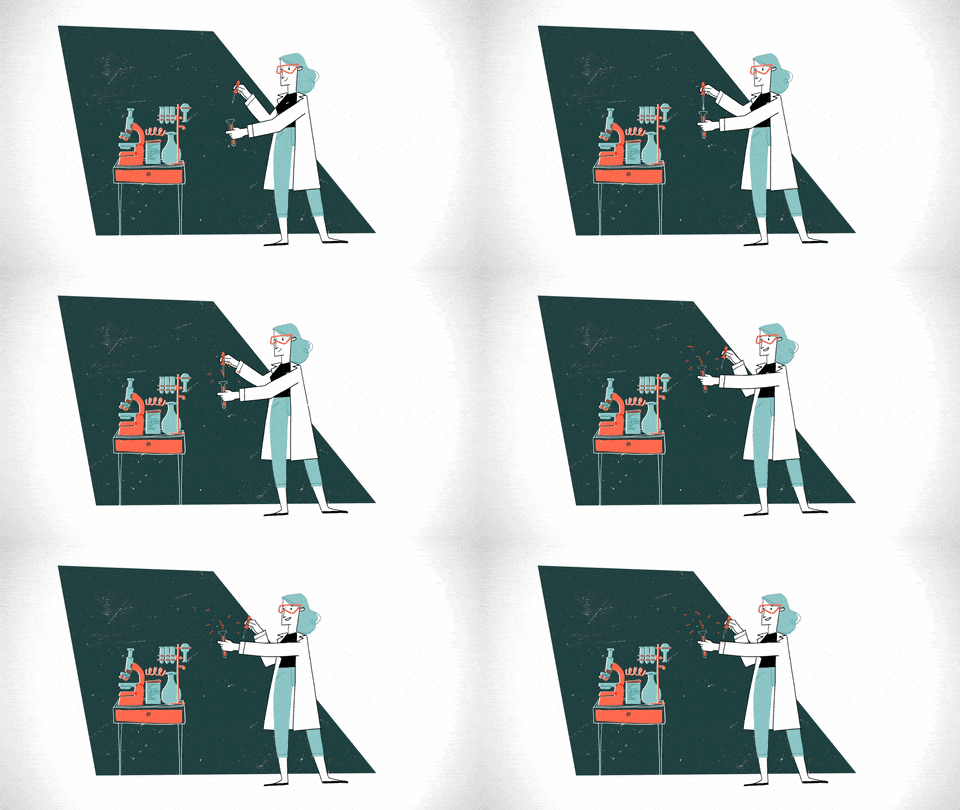
Here’s how Dashly’s AI agent handles qualification and meeting booking autonomously 👇
Step 1: Engagement
Step 2: Qualification
Step 3: Booking
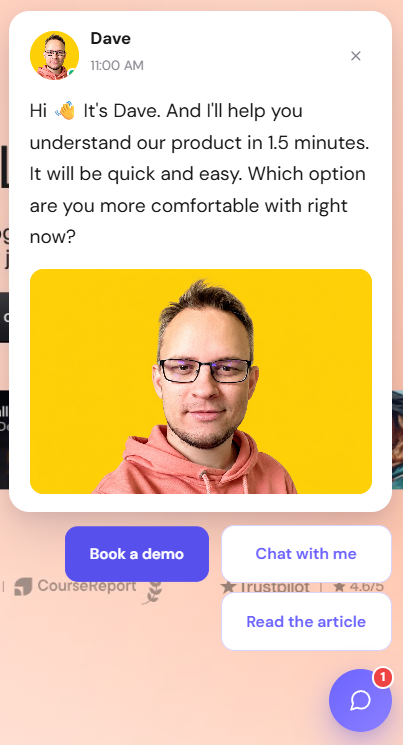
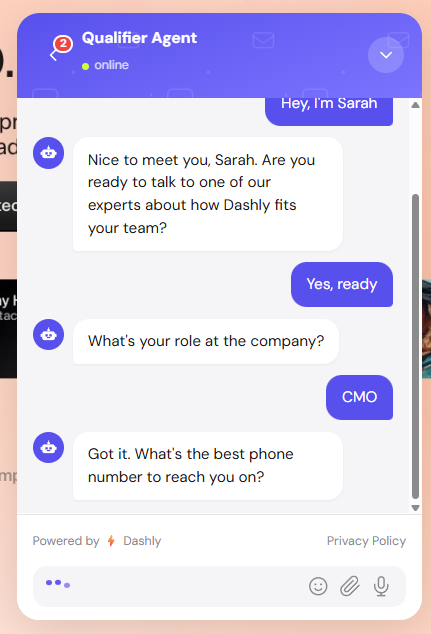
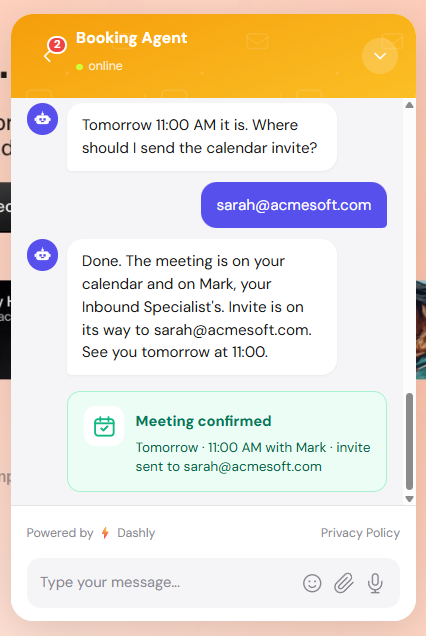
After that, leads are automatically nurtured, using the collected data.
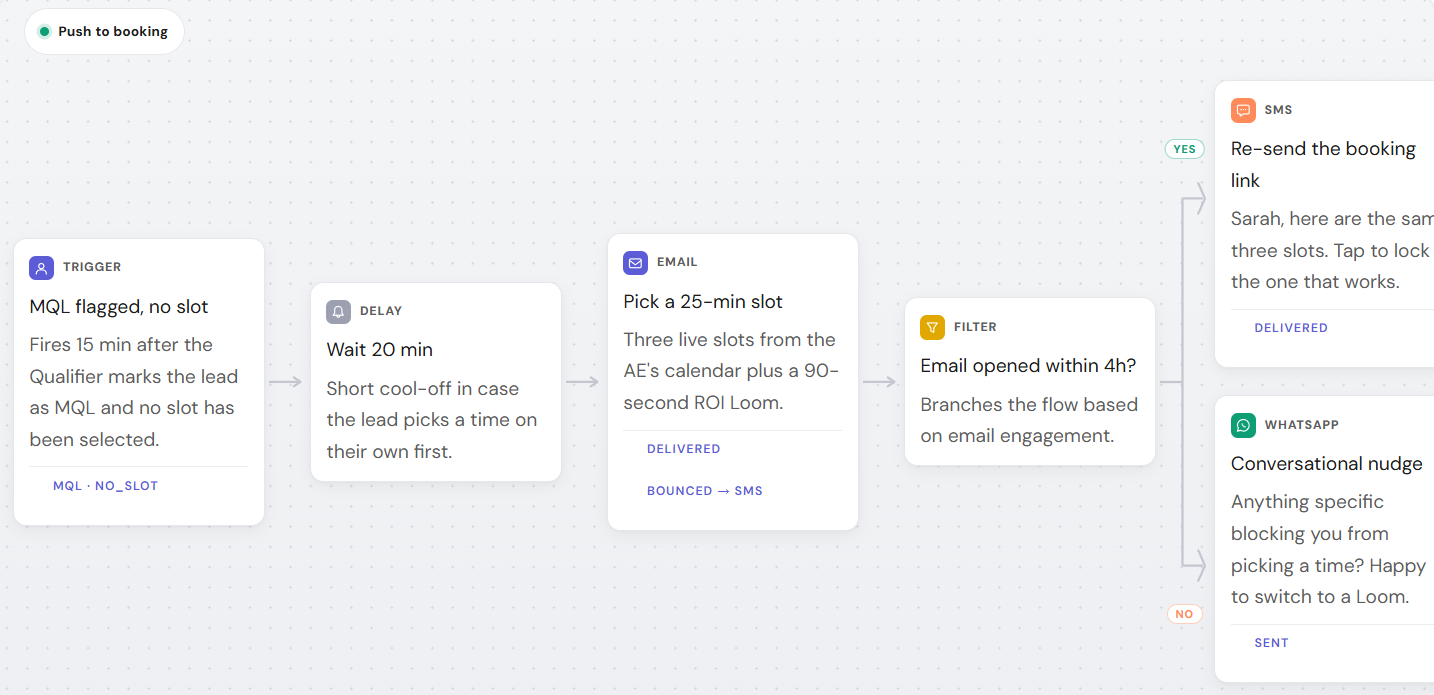
Here’s an example of an AI campaign for booking a meeting:
6. QA the sequence before launch
Send every touch to a test inbox. Check timing, personalization tokens, and exit logic before a single real lead enters the campaign. A broken merge tag or a wrong send-time zone in touch one damages trust before the campaign even gets to prove its value.
7. Track and optimize
Watch open rate, click rate, and reply rate for the first two weeks, then shift attention to the metric that actually matters: how many leads the campaign moved to the next funnel stage. Optimization is covered in more depth further down.
Lead nurturing campaign cadence: How many touches, and how far apart
Cadence benchmarks vary by campaign type:
- A welcome campaign typically runs 3 to 5 touches over 10 to 14 days;
- A re-engagement campaign runs 3 touches over 30 days;
- A drip email campaign runs 5 to 7 touches spread across 6 to 8 weeks.
Matching cadence, and the touchpoints inside it, to campaign type matters more than hitting a specific number.
A single “space touches 6 to 45 days apart” rule of thumb is technically true and practically useless. That range covers a welcome sequence and a full-cycle nurture at the same time, and treating them the same way is exactly how campaigns lose relevance halfway through.
Speed matters more than most cadence advice admits. Artemis GTM’s 2026 Speed to Lead Benchmark found that leads contacted within five minutes convert at roughly 21%, compared with 2.3% for leads left for 24 or more hours, a 9x gap. That gap applies to the first touch of any campaign, not just cold outbound.
The practical rule: front-load the first touch. Everything after that can follow a slower cadence, but the first touch after a trigger event, a signup, a demo request, a page revisit, should go out in minutes, not the next business day.
As a campaign matures past the first two touches, reduce frequency for leads who are not engaging. Sending five emails to someone who has not opened the first three signals desperation, not persistence.
Cadence discipline is also why triggered sends keep beating scheduled ones at scale. In Omnisend’s 2025 eCommerce Marketing Report, automated emails drove 37% of all email-generated sales from just 2% of total email volume, evidence that a small number of well-timed touches can outperform a much larger batch of scheduled ones.
AI in lead nurturing campaigns: From static drips to real-time triggers
Most lead nurturing campaigns still run on a fixed schedule, sending touch two three days after touch one regardless of what the lead actually did in between. AI-driven nurturing replaces that calendar logic with event-based triggers, reacting to user behavior the moment it happens instead of waiting for the next scheduled send.
The gap between AI adoption and AI execution is wide. Salesforce’s State of Marketing report (Tenth Edition) found that 75% of marketers have adopted AI in some form, yet 84% admit to still running generic, one-way campaigns. Adopting an AI tool and actually changing how a campaign behaves are two different projects.
Most teams stop at the first project and call it done.
A static drip cannot see that a lead just revisited the pricing page for the third time this week. A real-time trigger can, and can react within the same session instead of three days later on a schedule set before the lead did anything at all.
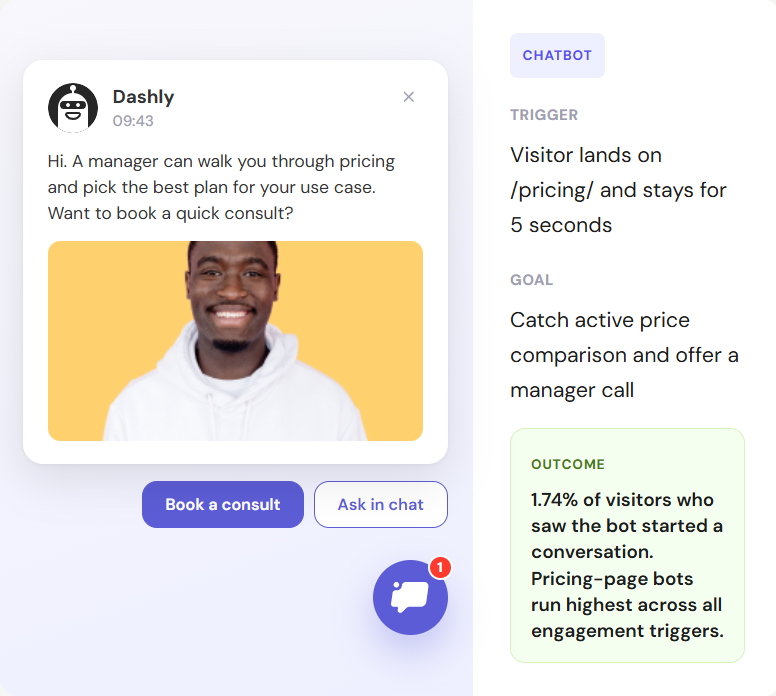
Event-triggered emails are the mechanism most teams reach for first, sending a message the moment a specific action happens rather than on a fixed day count. Dashly’s AI Engagement extends that same logic beyond email, triggering a proactive message in the product or on the site the moment a lead’s behavior signals renewed interest, not on the next day the campaign calendar happened to schedule a send.
Here’s an example of an engaging message based on user behavior:
That shift changes what “cadence” even means. Instead of planning touch three for day nine no matter what, the campaign plans a trigger condition, and the timing follows the lead’s behavior instead of a spreadsheet.
Lead nurturing campaign examples with real numbers
Three campaign patterns show how the pieces above fit together in practice: a trial welcome sequence, a 30-day re-engagement sequence, and a multi-channel sequence triggered by an inbound form fill.
A trial welcome sequence for a B2B SaaS product typically runs 4 touches over 12 days:
- An immediate confirmation
- A day-3 “here is one thing to try” nudge tied to the product’s core action
- A day-7 case study relevant to the lead’s industry
- A day-12 check-in asking directly whether they need help
The goal metric is activation, not opens.
A re-engagement sequence for trials that went quiet after 30 days runs 3 touches over 3 weeks: a direct “still interested?” message, a touch highlighting one new feature shipped since they left, and a final message offering a short call instead of another email. Narrow goal: one reply, not a signed contract.
A multi-channel sequence for an inbound lead who filled out a contact form combines an immediate email confirmation with an in-app or on-site trigger the next time that lead returns to the website, closing the gap between “filled a form” and “got a real response” instead of leaving that gap to a generic autoresponder.
These are known nurturing patterns, not attributed to a single named replacement study. The result you should expect depends heavily on your sales cycle length, how your sales leads are segmented, and how fast your first touch actually goes out.
Lead nurturing campaign best practices without burning out your list
The most common way lead nurturing campaigns fail is sending too often to people who have stopped engaging, not writing bad copy. Protecting deliverability and email list hygiene matters as much as writing a good subject line.
- Watch unsubscribe rate and spam-complaint rate per touch, not just per campaign. A spike after touch three usually means the cadence is too aggressive for that segment, not that the content is bad.
- List hygiene is not a one-time cleanup. Check bounce rates, prune addresses that never engage, and keep suppression rules current before every new campaign launches.
- Build a suppression rule into the flow from day one: after two consecutive unopened touches, either slow the cadence, switch channel, or exit the lead from the campaign entirely. Continuing to send at full frequency to someone who has stopped opening protects nobody’s inbox metrics.
- A/B test structural elements, send time, subject line length, channel order, before testing wording. Structural changes tend to move the needle more than copy tweaks in the first few iterations of a new campaign.
- A personalized email built on what is actually true for that lead, their industry, their signup trigger, their last action, outperforms one built on a first-name token. Generic personalization tokens do not move conversion the way behavior-based personalization does.
How to measure a lead nurturing campaign
The right way to measure a lead nurturing campaign is to track engagement metrics for the first two weeks, then shift to pipeline metrics:
- The marketing-qualified lead (MQL) to sales-qualified lead (SQL) conversion rate,
- Time-to-conversion, for leads that passed through the campaign versus leads that did not.
Open rate and click rate tell you whether the campaign is being seen. They do not tell you whether it is producing pipeline. Treat them as early warning signals, not success metrics.
Multi-touch attribution gets harder once a lead has several touches across multiple channels before converting. Crediting the last email before a demo request ignores the four touches that built the interest in the first place, and crediting the first touch ignores everything that happened after.
A unified lead record solves this by keeping every touch, email, in-app message, page visit, tied to the same lead across the whole campaign, so the credit does not have to be guessed. Dashly’s Lead Profile keeps that history in one place, which makes it possible to see the full sequence of touches that led to a conversion instead of just the last one.
Key takeaways
A lead nurturing campaign succeeds or fails on cadence and timing for more than on creative. A campaign is a bounded unit with a goal and an exit condition, not an always-on subscription. Speed on the first touch outweighs polish on the fifth. Real-time triggers consistently bear scheduled batch sends, and measuring by last touch alone hides most of what actually worked.
Put those pieces together and a lead nurturing campaign stops being a guessing game: define one goal and audience, map the flow with a real exit condition, set cadence by campaign type instead of a generic range, and let automation handle the qualification step so a human only gets involved once a lead is actually ready.
Frequently asked questions
Lead nurturing is the ongoing process of building relationships with leads who are not yet ready to buy, through relevant content and touches across channels, until they are ready for a sales conversation. See the full lead nurturing funnel stages for how it breaks down by buyer stage.
A lead nurturing strategy is the overall, ongoing approach to keeping leads engaged. A campaign is one bounded execution inside that strategy, built for a specific segment and goal, with a clear start and end. Your broader lead nurturing strategy can contain several campaigns running at once.
The lead nurturing funnel is the sequence of stages a lead moves through, from initial awareness to sales-ready, mapped against the content and touches that move them forward. See the lead nurturing funnel breakdown for the full 5-stage framework.
A typical lead nurturing process starts with segmentation, moves through content mapped to each buyer stage, layers in lead scoring, and ends with a handoff to sales once a lead crosses a defined threshold. The full lead nurturing workflow lays out all nine steps.
Yes, for the repetitive parts: sending scheduled touches, scoring engagement, and routing qualified leads to a rep. Lead nurturing automation frees the team to focus on the conversations that actually need a human, rather than manually tracking who opened what.
At minimum, nurturing automation software that can trigger sends based on behavior, apply lead scoring, and hand off qualified leads automatically. See a comparison of AI lead nurturing tools for how the options differ on automation depth and channel coverage.
It depends on the type: a welcome campaign typically runs 10 to 14 days, a re-engagement campaign runs about 3 weeks, and a full drip campaign can run 6 to 8 weeks. Set an explicit end condition for every campaign so it does not quietly turn into a permanent sequence.