Multi-channel lead nurturing: how to combine email, chat, and ads into one sequence
 13 minutes
 15.07.2026
A lead fills out a form, gets three welcome emails over ten days, and never hears from your team again in any other channel. That is the entire nurture experience most B2B SaaS companies run in 2026. One channel, one rhythm, one shot at getting the timing right.
Meanwhile the lead is on WhatsApp with three other vendors, checking Instagram between meetings, and ignoring your email because it is buried under 200 unread messages. Reaching people only where marketing automation defaults to send is a 2019 habit that keeps costing pipeline in 2026.
This guide breaks down what multi-channel lead nurturing actually is, which channels earn a place in the sequence, and how to order them so a lead does not get an email and a WhatsApp message about the same offer on the same afternoon.
What is multi-channel lead nurturing?
Multi-channel lead nurturing, sometimes called omnichannel nurturing, is the practice of moving a lead toward a buying decision using more than one communication channel, typically email plus live chat, messengers, SMS, or retargeting ads, coordinated so each touchpoint builds on the last instead of repeating it. It replaces a single drip sequence with a channel-aware sequence that adapts to how the lead actually behaves at each stage of the customer journey.
It is easy to confuse this with lead generation. Generation is how a stranger becomes a known lead: a form fill, a gated download, a booked call. Nurturing is everything that happens after that moment, the sequence of messages that keeps a lead engaged until they are ready to buy, or until you can tell they will not be. Multi-channel nurturing is the same job, just run across more than one surface at once.
Multi-channel lead nurturing only counts as multi-channel when the channels are coordinated around one lead record. Running an email drip and a separate retargeting campaign that do not share data about the same lead is parallel single-channel marketing, not multi-channel nurturing.
Why single-channel nurturing leaves pipeline on the table
Single-channel nurturing leaves pipeline on the table because it caps reach at whatever share of leads check that one channel regularly. A single-channel lead nurturing strategy assumes every lead lives in their inbox, and a growing share of B2B buyers do not: they live in a messenger, a chat window, or a feed instead.
Email open rates in B2B have been sliding for years, and inbox competition only gets worse as more vendors adopt the same three-email nurture template. A lead who does not open email is not unreachable, they are reachable somewhere else, and a single-channel sequence has no answer for that.
The data backs this up at scale. According to Omnisend’s analysis of 135,000 campaigns and 610 million messages sent in 2021, marketers using three or more channels in a single campaign earned a 494% higher order rate than those running single-channel campaigns. That is not a rounding difference, it is a different order of magnitude.
The mechanism is simple. Every additional coordinated channel is another chance to catch a lead at the moment they are actually paying attention, without asking them to change their habits to match your marketing stack.
Preference splits by segment, too. Procurement-heavy enterprise buyers still lean on email for the paper trail, while fast-moving SMB founders often reply faster on a messenger than they ever would to a cold inbox message.
Over a multi-month B2B sales cycle, that adds up to meaningfully more qualified leads reaching a sales conversation.
For B2B teams building out a pipeline generation strategy, the channel mix matters as much as the volume of leads entering the top of the funnel. A bigger top of funnel feeding a single-channel nurture sequence still loses the same share of leads to channel mismatch.
The channels: what each one is actually good for
Not every channel belongs in every sequence. The real question is “what is each channel actually for,” because using SMS for a long-form product explainer wastes the channel’s strength just as badly as using email for a same-day, time-sensitive nudge.
Email remains the backbone of most nurture sequences, and for good reason. It handles long-form content well, it is asynchronous by nature so nobody expects an instant reply, and it is the one channel where every lead already expects to receive marketing content. Use it for case studies, product education, and the parts of the sequence that need room to explain a concept.
Live chat and on-site messaging
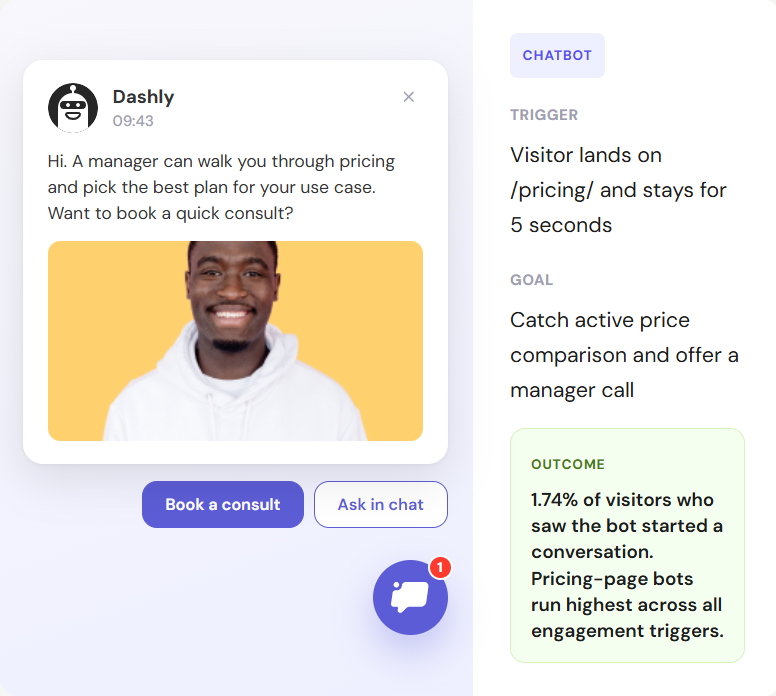
Live chat is for leads who are on your site right now. This is the only channel in the mix with real-time intent signal attached to it: a lead re-visiting a pricing page is telling you something an email open never will. Trigger a message based on that behavior instead of waiting for the next scheduled email in the sequence.
Messengers: WhatsApp and Telegram
For a large and growing share of B2B buyers, WhatsApp and Telegram are not a backup channel, they are the primary one. This is especially true for LATAM, MENA, and EU markets, and for any high-touch B2B motion where the buyer already expects a two-way conversation rather than a one-way broadcast.
Messengers change the shape of nurturing, not just the delivery pipe. A WhatsApp message sits in the same app a lead uses to talk to colleagues and family, which means it gets noticed faster than an email competing with a crowded inbox. It also supports genuine back-and-forth: a lead can ask a follow-up question mid-sequence instead of waiting for the next scheduled send.
Dashly runs nurture sequences natively inside WhatsApp and Telegram, so a lead who replies to a message on either platform stays in the same conversation thread and the same lead record, instead of falling into a channel your CRM cannot see.
SMS
SMS is narrow but effective for one job: time-sensitive nudges.
A demo reminder an hour before the call, a limited-time offer expiring today, a “your trial ends tomorrow” notice. Save it for moments where speed matters more than depth, and skip it for anything that needs more than two sentences to land.
Retargeting ads
Retargeting ads keep your brand visible in the gap between active touches, while a lead is deciding whether to open your next email or reply to your last message. Think of them as connective tissue: they hold the sequence together between real conversations, which still happen on email, chat, or a messenger.
Direct mail and social touchpoints
Direct mail earns its place for high-value ABM accounts where a physical touch signals effort that a digital message cannot. Instagram belongs in this category too, but as a social network, not a messenger: it works for visual proof (product screenshots, short demo clips) and for a lightweight Instagram Direct check-in with a lead who already follows your brand, not as a primary sequencing channel. Dashly’s Instagram integration handles that channel directly, instead of requiring a separate third-party inbox for it.
How to sequence channels without overwhelming leads
The right way to sequence channels is to let a lead’s behavior decide the next channel, not a fixed calendar. A rule that says “day 3, send email two” ignores whatever the lead actually did on day 2, and that is exactly how leads end up double-messaged.
Set one hard rule first: a lead gets one outbound touch per day, across every channel combined, not per channel. If a lead opened a pricing email this morning, that is the day’s touch. No SMS on top of it, no retargeting ad refresh timed for the same afternoon. This single rule is what prevents channel fatigue, the point where a lead starts tuning out every channel at once because too many of them fired in the same short window.
From there, let behavior trigger the channel switch instead of a fixed script. A lead who ignores three emails but replies instantly on WhatsApp has told you which channel to lead with next. A lead who re-visits the site after going quiet is a live-chat trigger, not an email trigger.
Dashly’s AI engagement reads real-time behavior, like a repeat visit to a pricing page or a lead going quiet mid-qualification, and triggers the next message with content and timing built for that exact moment, instead of running every lead through the same fixed script regardless of what they do in between.
See how AI personalizes engagement messages based on user’s behavior:
Build the data backbone: one lead profile across channels
A unified lead profile is the technical backbone that makes multi-channel nurturing possible: one record per lead that every channel, email, chat, WhatsApp, and Telegram, reads from and writes to. Without it, a rule like “one touch per day across every channel” is impossible to enforce, because no single system knows every touch that already happened.
This is the unglamorous part of multi-channel nurturing, and it is also the part that breaks first. A marketing team adds a new channel, wires it to its own point tool, and six months later two sequences are quietly running against the same lead with no visibility into each other.
In practice, that means syncing the profile back to your CRM so nothing lives only in a point tool. Dashly’s lead profile keeps one record per lead across email, chat, WhatsApp, and Telegram, so lead scoring and the next message both pull from what actually happened on every channel, not just the last one a rep happened to check. Segmentation should hang off that same profile: building sequences around a documented ideal customer profile attribute, company size, industry, or stated use case, gives every channel the same personalization logic instead of each tool inventing its own segment rules.
Best practices for multi-channel lead nurturing
The best practices for multi-channel lead nurturing come back to two things: one shared lead profile that every channel can read and write to, and a single daily touch cap enforced across every channel combined, not per channel.
- Cap outbound touches at one per lead per day across every channel combined, not per channel.
- Let engagement signals, not a fixed calendar, decide which channel sends the next message.
- Give every channel read and write access to one lead profile before adding a new channel to the mix.
- Match message length to the channel: short and time-sensitive on SMS, conversational on messengers, longer-form on email.
- Review channel performance monthly and retire channels that only add noise, not response rate.
Platforms and tools
Most marketing automation platforms handle email well and treat every other channel as a plugin. That is fine for a single-channel sequence, but it means a marketing team ends up stitching together an email tool, a chat widget, a messenger integration, and an ad platform by hand, with no shared lead record between them.
Dashly’s AI agents read behavioral and CRM data to decide when and how to reach a lead, so a marketing team does not have to hand-build the branching logic for every channel in a workflow builder. For a broader view of what else is on the market, the best AI lead nurturing tools roundup compares platforms by channel coverage.
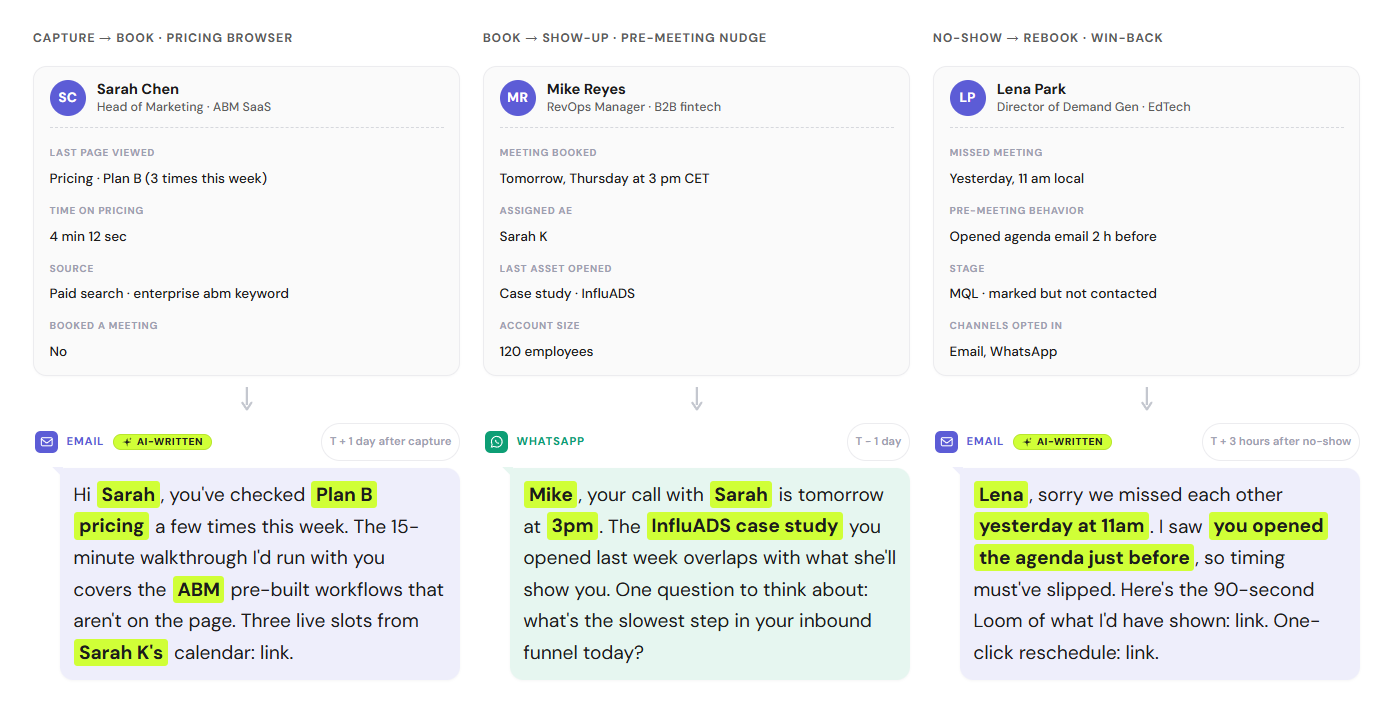
Here’s how emails can be personalized depending on user behavior:
Measuring multi-channel nurture performance
Measuring multi-channel nurture performance means tracking conversion at the lead level, not the channel level, because a lead who opens an email, ignores a retargeting ad, and converts on WhatsApp should not get scored as three separate partial wins or three separate failures. The number that matters most is how many leads move from MQL to SQL after entering a multi-channel sequence, compared to the single-channel baseline.
Channel-level metrics still matter for tuning the sequence itself: open rate on email, response rate on messengers, click-through on ads. But the metric that should gate budget decisions is conversion per lead across the full sequence, attributed to whichever channel carried the final touch before the lead converted.
This is where most teams’ existing sales funnel metrics stop short: they were built for a single-channel funnel and do not have a field for “which channel actually closed this.” Revisit how nurture maps onto your sales funnel stages before adding a new channel, so the new touch has a stage to report into instead of floating outside your existing funnel data.
Conclusion
Multi-channel lead nurturing means meeting a lead where they already pay attention, wherever that happens to be. Email still carries the long-form content. Live chat and messengers carry the real-time and two-way conversation. SMS and ads fill in the gaps.
None of that works without two things: a rule that caps outbound touches so leads never get double-messaged, and one shared lead profile that every channel reads from and writes to. Get those two right and the channel mix takes care of itself.
FAQ
Multi-channel lead nurturing is the practice of moving a lead toward a buying decision using more than one coordinated communication channel, such as email, live chat, messengers, SMS, or retargeting ads, instead of a single drip sequence.
Lead generation is how a stranger becomes a known lead, through a form fill, a gated download, or a booked call. Lead nurturing is everything that happens after that moment: the sequence of messages that keeps the lead engaged until they are ready to buy.
Most B2B sequences work well with three to four coordinated channels, typically email plus one real-time channel like live chat or a messenger, plus one supporting channel like SMS or retargeting ads. Adding channels beyond that increases coordination cost faster than it increases reach.
Yes. Email remains the strongest channel for long-form content and product education inside a nurture sequence. The issue is not email itself, it is relying on email as the only channel when a growing share of B2B buyers primarily engage on messengers or chat.
Look for a platform that keeps one lead profile across every channel rather than treating each channel as a separate plugin. The best AI lead nurturing tools comparison breaks down platforms by channel coverage and automation depth.
Cap outbound touches at one per lead per day across every channel combined, not per channel, and let a shared lead profile enforce that cap so email, chat, and messenger sends do not stack on the same day without visibility into each other.
Yes. An AI agent can read engagement signals, such as which channel a lead responds on, and automatically switch the next touch to that channel instead of running every lead through the same fixed sequence regardless of behavior.



![13 growth hacking examples tested by Dashly experts [+46 free templates]](https://www.dashly.io/blog/wp-content/uploads/2023/05/Growth-hacking-examples-to-inspire-your-team-720x317.png)