How to build an inbound sales funnel that converts (B2B Guide)
 16 minutes
 15.05.2026
Most B2B companies have an inbound funnel. Traffic from SEO. Forms on the website. Leads sitting in the CRM. But somewhere between “visitor submitted a form” and “sales rep made contact,” 60–70% of those leads disappear.
The lead fills the form at 14:30. The SDR sees it Monday morning at 9:05. By then, the lead has already taken a call with a competitor.
An inbound sales funnel isn’t a content strategy or a CRM category. It’s a system with four defined stages, automated first touch, and clear criteria for when a human takes over. Without that system, your marketing spend generates traffic your sales process fails to close.
This guide covers the four stages of an inbound sales funnel, the four most common places B2B funnels lose leads, a step-by-step build plan, and the metrics that tell you where to fix it.
What is an inbound sales funnel?
An inbound sales funnel is the path a prospect takes from first discovering your product (through search, content, referral, or social) to becoming a paying customer. Unlike outbound funnels where your team initiates contact, inbound buyers arrive already looking for a solution. They’re warm from the start.
The term “inbound sales funnel” is often used interchangeably with “inbound marketing sales funnel.” The distinction matters: the inbound marketing funnel covers attraction and nurturing — the process of getting the right people to your site and keeping them engaged. The inbound sales funnel starts at the moment a visitor shows buying intent: a pricing page visit, a demo request, a direct question about integrations.
That’s where the sales process takes over, and where most companies have the most unfixed leaks.
The difference from outbound is structural. In an outbound funnel, your team researches prospects and initiates contact cold. In an inbound funnel, the buyer has already done research, has a defined problem, and is comparing solutions. They’re more qualified at the top than a cold outbound lead — which makes mishandling them more expensive. Learn more about the distinction in our guide to inbound sales.
The 4 stages of an inbound sales funnel
Every inbound sales funnel runs through four stages. Understanding what happens at each stage — and what causes leads to drop — is the foundation for fixing conversion problems.
| Stage | Funnel level | Buyer mindset | Your goal |
|---|---|---|---|
| Attract | TOFU | “I have a problem” | Visibility: SEO, content, social |
| Engage | MOFU | “Looking for solutions” | Capture contact: lead magnets, chatbot, forms |
| Qualify | MOFU → BOFU | “Comparing options” | Filter by ICP fit: scoring, qualification questions |
| Convert | BOFU | “Ready to buy” | Close: demo, proposal, subscription |
Stage 1: Attract — getting the right visitors
The attract stage fills the top of your funnel. The goal isn’t traffic volume. It’s qualified traffic: visitors who match your ICP, have the problem you solve, and are actively searching for answers.
SEO-driven content is the most scalable attract channel for B2B SaaS. An article ranking for a high-intent keyword brings in visitors already in problem-solving mode. It’s a fundamentally different starting point than someone who clicked a display ad. A visitor who found you by searching “inbound lead qualification process” is more than halfway through their problem definition. See the full picture in our guide to inbound lead generation.
Other effective attract channels: LinkedIn organic, webinars, podcast appearances, industry communities, partner co-marketing. All work best when the content maps directly to a question your ICP is already searching for.
The measure of success at this stage is qualified sessions, instead of total sessions: what percentage of visitors match the profile you’re trying to close. If your pricing page has a 90% bounce rate, your attract stage is likely pulling in the wrong audience.
Stage 2: Engage — capturing intent before it cools
This is where most funnels start leaking. Visitors arrive, read an article, check pricing, maybe watch a demo video. Then they leave. No contact captured, no follow-up possible. Your marketing investment walked out the door.
A static contact form captures 1–5% of visitors on a good day. A chatbot or AI agent that opens on high-intent pages (pricing, product features, comparison pages) with a relevant triggered message can engage 5–15% of that same traffic. The difference is timing: you’re reaching visitors when their intent is highest, not hoping they seek you out.
Lead capture formats that work at the engage stage:
- Triggered chatbot message on pricing and product pages (“What’s the main challenge you’re trying to solve?”)
- Gated content — playbooks, benchmarks, templates — with an ICP-qualifying question in the capture form
- Exit-intent pop-ups on high-intent pages, with a specific offer (not “subscribe to our newsletter”)
- Webinar registrations that include a role and company size question
Example of an engaging message based on behavior:
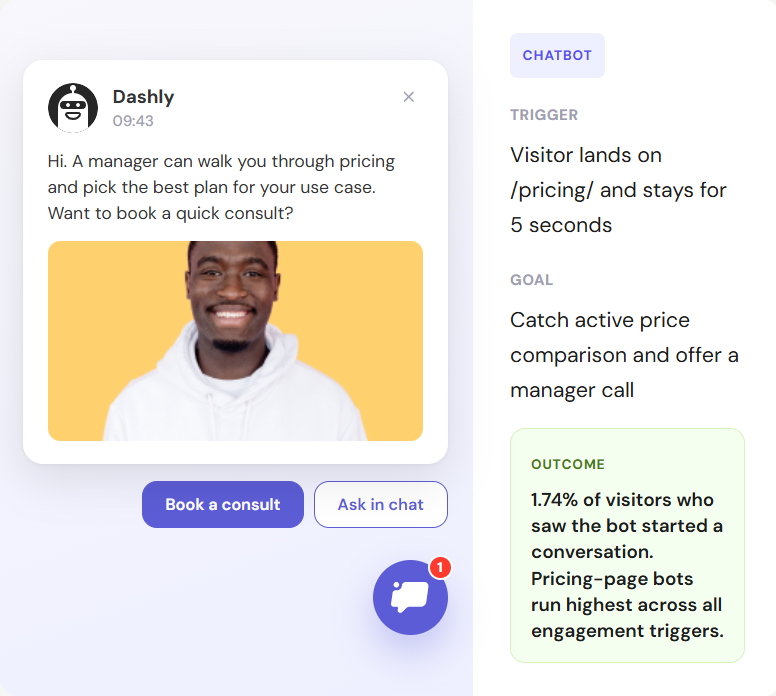
The rule for this stage: capture the lead at peak intent, not three days later via a retargeting ad.
Stage 3: Qualify — separating pipeline from noise
Not every inbound lead is sales-ready. Sending every contact to an SDR increases SDR workload while degrading the quality of conversations with the leads that actually matter.
Qualification filters inbound contacts by ICP fit: company size, role, industry, budget, timing. Leads that match become MQLs. MQLs with strong buying signals (high engagement score, demo request, repeated pricing page visits) become SQLs and route to sales.
A practical lead scoring setup for B2B SaaS:
- Visited pricing page: +20
- Downloaded a playbook or case study: +10
- Opened 3+ nurture emails: +5
- Watched demo video: +15
- Requested a demo: +40 (automatic SQL threshold)
Set a threshold — 40 or 50 points, agreed with sales — above which a lead routes to an SDR automatically. Below it, they stay in nurture until the score climbs.
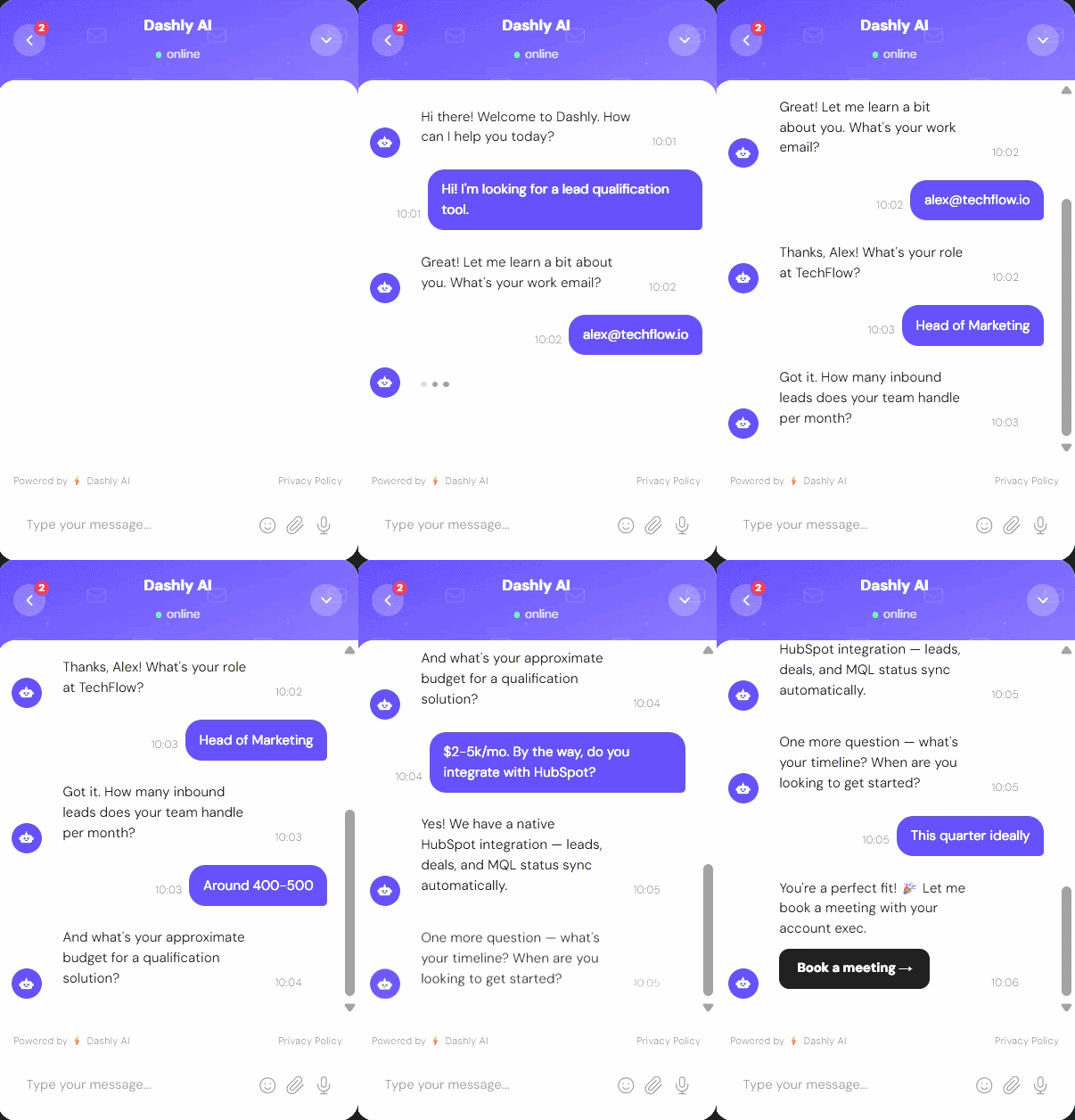
AI qualification adds a faster path: instead of waiting for behavioral signals to accumulate over days, an AI agent asks 3–5 qualification questions in real time during a chat session. The lead gets tagged by ICP fit and buying intent in CRM immediately, before any human has been involved. See how qualification works at scale in our guide to inbound lead qualification.
See how Dashly’s AI Qualifier identifies MQLs and offers them a meeting:
Stage 4: Convert — closing before the lead goes cold
The convert stage is where demos happen, proposals go out, and deals close. Your sales team is at the center of this stage. But the biggest risk here isn’t objection handling or pricing negotiation.
It’s delay.
Research from Velocify shows that following up within the first minute of contact increases conversion by 391%. Following up within 5 minutes still delivers a 9x conversion lift compared to waiting an hour or more.
Most B2B inbound processes don’t have a first-touch mechanism that works in under a minute. A form notification arrives in an SDR’s inbox — between 46 other emails — and gets seen 4 to 6 hours later. The lead has moved on.
Automation at the convert stage doesn’t replace sales. It holds the lead warm until the rep is ready. An AI agent that responds to a demo request instantly: confirms the interest, qualifies the lead, offers a booking link and keeps the conversation alive long enough for a human follow-up to land.
Where inbound sales funnels leak (and how to fix it)
Here are the four leaks responsible for most of that drop-off, and what actually fixes each one.
Leak #1 — Speed-to-lead gap
A lead submits your demo form at 14:30. Your SDR’s queue already has 47 items. The follow-up email goes out at 20:00 or worse, the next morning.
By then, the lead has taken three competitor calls and is already evaluating pricing.
The speed-to-lead gap is the highest-impact leak in most B2B funnels, and the most fixable. An AI agent closes it by responding the moment a form is submitted: qualifies the lead with 3–5 targeted questions, offers a direct booking link, and routes the result to CRM. No human involvement. Qualified leads stay in the conversation. Unqualified ones route to self-serve. Nothing slips through at 2 AM on a Friday.
One Dashly client automated engagement, qualification, and meeting booking this way and achieved a 82% conversion from lead to a booked meeting.
Leak #2 — Marketing-sales misalignment
Marketing passes MQLs to sales. Sales calls them unqualified. Marketing says conversion is fine. Sales says the pipeline is bad. Neither team is lying. They’re measuring different things against different definitions.
When “MQL” means something different to each team, leads fall through the gap between them. No one follows up, no one takes ownership, and the contact goes cold while both teams point at each other.
The fix is structural: define your ICP together, build shared scoring criteria, and write a handoff SLA, for example, sales contacts every SQL within 4 hours of receipt. This agreement has to exist before you build any automation on top of it. Automating a broken handoff process makes it break faster.
Leak #3 — Unqualified leads reaching account executives
Sending unqualified inbound contacts to AEs makes that math worse. Every hour an AE spends on a lead that doesn’t fit ICP is an hour not spent closing a real deal. Multiply that across a 5-person AE team and you’re losing significant pipeline capacity every week simply because of a broken filter.
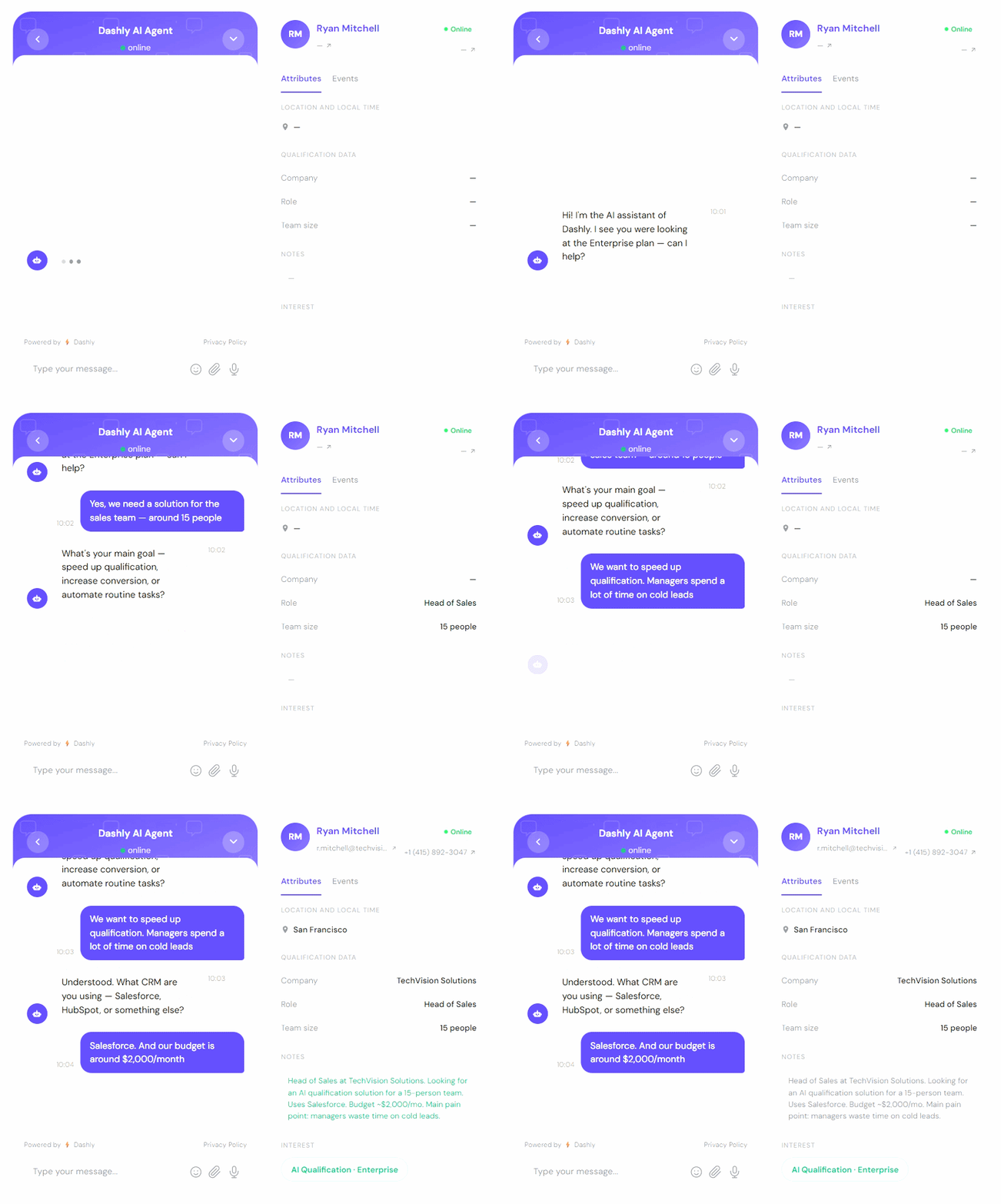
Add a qualification layer between inbound capture and AE handoff. AI-driven qualification at the chat or form stage filters out low-fit contacts before they reach the sales team. What gets through to AEs: role confirmed, company size in range, buying intent established, timing realistic. AEs have fewer contacts and better ones.
Dashly’s AI agent collects data from the lead and passes it straight to the CRM:
Leak #4 — Low-intent inquiries routed to sales
A meaningful share of inbound contacts aren’t in buying mode. They have a product question, a billing issue, or they want to know how a specific integration works. These contacts need support, not a sales conversation.
When support inquiries get pushed into a sales flow, two things go wrong: the prospect gets frustrated (they asked for help, not a call), and your SDR wastes 20 minutes on a contact that was never sales-ready.
Intent-based routing fixes this. Contacts get categorized at first touch by what they actually need. Support questions go to a knowledge base or support team. Feature questions go to self-serve docs. Demo requests and pricing questions go to sales. The routing logic lives in your chatbot, your CRM, or both. For a deeper breakdown of all four leaks, see our article on inbound funnel leaks.
💡 Want to plug these leaks in your funnel? Book a 30-minute demo — we’ll show you how Dashly AI agents qualify and route inbound leads automatically.
How to build an inbound sales funnel step by step
Building a functional inbound sales funnel from scratch takes four to six weeks for the foundation. Optimization is ongoing after that. Here’s the sequence that gets you to a working system without building things in the wrong order.
Step 1: Define your ICP and funnel boundaries
Write down exactly who your ideal buyer is and when they’re ready to talk to sales. “When they seem interested” isn’t a definition. You need specific criteria: score ≥ 40, role is VP or Director, company size is 50–500 employees, industry is SaaS or professional services.
This ICP definition is the input to everything else: your scoring model, your qualification questions, your handoff criteria. Get it wrong here and the rest of the funnel optimizes for the wrong buyer.
![Build Ideal Customer Profile Like a Pro Even If You’re Not [3 Templates]](https://www.dashly.io/blog/wp-content/uploads/2021/03/ideal-customer-profile-4-720x308.jpg)
Step 2: Map content to each funnel stage
Each stage needs content that matches where the buyer is in their decision process. TOFU content answers problem-awareness questions. MOFU content helps evaluate solutions. BOFU content reduces risk and builds confidence before the final decision.
| Stage | Content type | Goal |
|---|---|---|
| Attract (TOFU) | Blog posts, SEO guides, LinkedIn posts, webinars | Qualified traffic |
| Engage (MOFU) | Gated playbooks, case studies, benchmark reports | Capture contact + build trust |
| Qualify (MOFU → BOFU) | Product tours, demo pages, pricing pages, ROI calculators | Surface buying intent |
| Convert (BOFU) | Demos, proposals, free trials, competitive comparisons | Drive the decision |
Step 3: Set up lead capture at peak intent moments
Add lead capture on the pages where buying intent is highest: pricing, product features, comparison pages. Not just your homepage or blog.
If you only have a static contact form, you’re capturing the 2–3% of visitors willing to fill it out unprompted. A triggered chatbot that opens with a relevant question on a pricing page captures more contacts and starts qualifying them in the same conversation. That’s what AI agents for B2B handles at the engage stage.
Step 4: Implement lead scoring
Set up scoring in your CRM based on behavioral signals (page visits, content downloads, email opens) and firmographic fit (company size, role, industry). The specific point values matter less than the threshold: agree with your sales team on the score that defines an SQL before you go live, not after the first argument about lead quality.
Start simple. A 3-variable model that both teams understand and trust beats a 20-variable model nobody uses consistently.
Step 5: Automate first-touch qualification
The gap between form submission and first human response is where most pipeline leaks. An AI agent closes that gap: responds instantly, runs through ICP qualification questions, routes the lead to the right place before a human has opened their email.
High-fit leads get a booking link immediately. Low-fit leads route to self-serve or support. The CRM gets a tagged lead record automatically. This is the mechanism behind the inbound sales operations that consistently outperform manual-only follow-up across B2B SaaS teams.
Step 6: Define SQL criteria and handoff SLA
An SQL meets three conditions: ICP fit confirmed, score above your agreed threshold, and buying intent established (demo requested, pricing page visited twice, or an explicit “yes” to a timeline question). Write this down. Share it with both marketing and sales.
Then set the SLA: sales contacts every SQL within N hours of receiving it. Four hours is a reasonable starting point for most B2B teams. Whatever you pick, measure it weekly and review it monthly.
Step 7: Measure, diagnose, optimize
Run a weekly funnel review. Where is conversion below benchmark this week? Which stage has the biggest drop-off? What’s the average speed-to-lead for the past 7 days?
This is the Diagnose step of the Diagnose → Automate → Coach framework. Once you’ve identified the leak, automate what can be systematized, and invest in coaching where human judgment is the variable. Then measure again. The cycle repeats: new bottleneck surfaces, diagnose root cause, automate or coach, measure impact.
Tools for each stage of your inbound sales funnel
When evaluating tools, the question isn’t which has the most features — it’s which connects your stages without creating new handoff gaps. A chatbot that doesn’t sync to your CRM adds a manual step. A CRM that doesn’t connect to your booking tool creates another. Start with integration capability, then evaluate features.
| Stage | Tool category | Examples |
|---|---|---|
| Attract | SEO and content analytics | Ahrefs, Google Analytics 4, Semrush |
| Engage | Chatbot / AI agent | Dashly, Qualified, Drift |
| Engage | Landing pages and forms | Unbounce, HubSpot Forms, Typeform |
| Qualify | Lead scoring and CRM | HubSpot, Salesforce, Pipedrive |
| Qualify | Marketing automation | HubSpot, ActiveCampaign, Customer.io |
| Convert | Demo scheduling | Calendly, Chili Piper, HubSpot Meetings |
| All stages | Analytics and attribution | Dashly Analytics, Google Analytics 4, Mixpanel |
Measuring inbound funnel performance: the metrics that matter
The most useful diagnostic is stage-by-stage conversion rates. If your visitor-to-lead rate is healthy but your MQL-to-SQL rate is below 20%, the problem is at the qualify stage, not the attract stage. If your SQL-to-close rate is below 15%, the problem is at the convert stage. Measuring at the overall funnel level doesn’t tell you where to fix it.
| Metric | What it measures | B2B SaaS benchmark |
|---|---|---|
| Visitor-to-lead rate | % of site visitors who become leads | 1–5% (forms); 5–15% (chatbot) |
| MQL-to-SQL rate | % of MQLs accepted by sales | 20–40% |
| SQL-to-close rate | % of SQLs that become customers | 15–30% |
| Speed-to-lead | Time from lead capture to first sales contact | <5 minutes (with AI automation) |
| Customer Acquisition Cost (CAC) | Total cost to acquire one customer | Track per-channel, not as absolute |
| Funnel velocity | Average time from lead to closed deal | Track trend direction, not absolute |
Speed-to-lead is the metric that crosses all stages and gets measured least. Most teams don’t track it until after they’ve lost pipeline they can’t explain. Set up an automated report in your CRM that shows average time from form submission to first SDR activity, broken down by lead source and day of week.
Use the Diagnose → Automate → Coach cycle to work through your funnel data: identify the stage with the worst conversion rate, audit what’s causing the drop, automate what can be systematized, and coach the team on what requires judgment. Repeat every quarter.
🎯 Want a funnel audit before you build? Talk to the Dashly team — we’ll walk through your current funnel stages and identify where the biggest conversion gap is.
Build the system, not just the stages
An inbound sales funnel works when each stage has a defined output and a clear transition to the next. Attract builds the right audience. Engage captures intent before it disappears. Qualify separates real pipeline from noise. Convert closes deals before the lead cools.
The leaks are predictable and fixable. Speed-to-lead is the highest-leverage one. Most B2B teams don’t solve it because they assume it requires more headcount. It doesn’t. It requires automation at first touch before the lead has a reason to look elsewhere.
The inbound marketing funnel brings qualified visitors to your site. The inbound sales funnel determines how many of them become customers. Both matter. But the leaks in the sales funnel tend to be more expensive — because by the time a lead reaches it, you’ve already invested in attracting them.
Inbound sales funnel FAQs
An inbound sales funnel is the process through which prospects who found you organically — through content, SEO, referrals, or social — move from first contact to becoming a paying customer. Unlike outbound funnels, inbound buyers initiate contact themselves, which makes them warmer and more qualified at the top of the funnel. The funnel has four stages: Attract, Engage, Qualify, and Convert.
The four stages are: (1) Attract — bringing the right visitors through SEO, content, and social; (2) Engage — capturing contact information at peak intent using forms, chatbots, and lead magnets; (3) Qualify — filtering leads by ICP fit using lead scoring and qualification questions; (4) Convert — closing deals through demos, proposals, and trials before the lead cools.
Build an inbound sales funnel in 7 steps: (1) Define your ICP and funnel stage boundaries; (2) Map content to each stage (TOFU, MOFU, BOFU); (3) Set up lead capture on high-intent pages; (4) Implement lead scoring in your CRM; (5) Automate first-touch qualification with an AI agent; (6) Document SQL criteria and a handoff SLA with your sales team; (7) Run weekly funnel reviews using the Diagnose → Automate → Coach cycle. The foundation takes 4 to 6 weeks. Optimization is ongoing.
In an inbound sales funnel, the buyer initiates contact — they found you through content, search, or referral, and arrived with a defined problem and some intent to buy. In an outbound funnel, your team initiates contact cold. Inbound leads are typically more qualified at the top of the funnel, but more likely to go cold quickly if you don’t respond fast. Outbound gives you more control over targeting but requires more effort per lead at the top.
The four most common leaks in a B2B inbound funnel are: (1) Speed-to-lead gap — leads go cold before the SDR follows up; (2) Marketing-sales misalignment — undefined handoff criteria mean leads fall between teams; (3) Unqualified leads reaching AEs — wasted time on low-fit contacts; (4) Low-intent inquiries routed to sales — support questions pushed into a sales flow frustrate prospects and waste SDR time.
The foundation — ICP definition, lead capture setup, basic scoring, and first-touch automation — typically takes 4 to 6 weeks. Full optimization with content coverage for all stages, refined scoring thresholds, and tested messaging takes 3 to 6 months of iteration. The funnel is never fully done: conversion benchmarks shift, buyer behavior changes, and new leaks surface as you scale.