Lead nurturing stages: The 5-stage framework B2B SaaS teams use in 2026
 13 minutes
 22.07.2026
Most B2B teams can name their sales funnel stages without blinking. Ask them to name their lead nurturing stages, and the room goes quiet.
That gap costs pipeline. Leads sit in a generic “nurture” bucket for weeks, getting the same three emails regardless of whether they just downloaded a whitepaper or already asked for pricing. Sales blames marketing for sending unqualified leads too early. Marketing blames sales for ignoring leads that were never actually ready. Classic…
A stage-based nurturing model fixes this by giving every lead a defined position, a specific goal for that position, and a clear trigger for moving to the next one.
Below is the 5-stage framework we use to structure lead nurturing for B2B SaaS pipelines, how it maps onto your existing sales funnel and CRM, and the benchmarks worth tracking at each stage.
What are lead nurturing stages?
Lead nurturing stages are the defined steps a lead moves through between first contact and sales-readiness, each with its own goal, content, and exit criteria. Unlike a single “nurture campaign,” a staged model treats early-stage leads differently from leads who are actively evaluating a purchase. The stage determines what you send, when you send it, and who owns the follow-up.
Without stages, nurturing collapses into one long email sequence applied to everyone. A visitor who just joined a newsletter gets the same message as a prospect who requested a demo and went quiet. That mismatch is the single biggest reason nurture sequences underperform.
Lead nurturing stages are the checkpoints between “someone gave us an email address” and “someone is ready to talk to sales,” each with a distinct message, channel, and exit signal.
Why lead nurturing stages matter for B2B SaaS pipelines
Lead nurturing stages matter because they prevent two expensive failures: pushing unready leads to sales too early, and losing sales-ready leads in a generic drip sequence too late. Both failures show up as the same symptom on a revenue dashboard, a stalled MQL-to-SQL conversion rate, but they need opposite fixes.
The distinction that trips up most teams is lead generation versus lead nurturing. Generation gets someone into the funnel. Nurturing decides what happens to them once they’re in it, and for how long.
Without staged nurturing, that middle stretch of the buyer journey turns into a black hole. Leads enter it qualified and enthusiastic. They exit it, if they exit at all, cold and unresponsive.
This is exactly the moment where automated engagement earns its budget. Instead of a single scheduled sequence, an AI agent can read what a lead just did, an ROI page visit, a second look at the case-studies page, and adjust the next touch on its own. Dashly’s engagement layer handles that adjustment in real time rather than waiting for the next scheduled email.
Get the stage transitions right, and the buyer journey compresses. Get them wrong, and every stage becomes a leak.
The 5 stages of lead nurturing
The five stages of lead nurturing are capture and initial qualification, engagement and education, consideration and sales-readiness, conversion and handoff, and post-sale retention. Each stage has one job: move the lead closer to a decision without skipping the step that makes the next one possible.
| Stage | Lead’s question | Your job | Exit signal |
|---|---|---|---|
| 1. Capture & initial qualification | “Is this relevant to me?” | Confirm fit, not intent | ICP match confirmed |
| 2. Engagement & education | “Can this actually solve my problem?” | Teach the mechanism, not the pitch | Repeated content engagement |
| 3. Consideration & sales-readiness | “Is this worth a conversation?” | Score real buying signals | Qualifies as sales-ready |
| 4. Conversion & handoff | “Can I trust this team?” | Hand off with full context | Meeting booked, no data loss |
| 5. Post-sale retention | “Did I make the right call?” | Nurture toward expansion | Renewal or upsell signal |
Stage 1: Capture & initial qualification
A lead enters this stage the moment they hand over contact details, whether through a form, a chat widget, or a gated asset. The only job here is a fit check against your target audience and ICP: company size, industry, and role. Intent doesn’t matter yet, and treating a curious visitor like a buyer at this point wastes both their attention and your team’s time.
Keep the ask small. One clarifying question in a chat widget beats a five-field form, especially for prospects who haven’t decided whether they’re evaluating anything yet.
Stage 2: Engagement & education
This is where most nurture programs live, and where most of them go flat. The lead knows you exist. They don’t yet know whether your product actually fixes their specific problem, so generic content marketing collateral, the “10 tips” listicle every vendor publishes, won’t move them.
What works instead is content tied to the mechanism, not the brand: how the workflow changes, what gets automated, what a team stops doing manually. Repeated engagement with that kind of content, not a single click, is the real signal this stage is working.
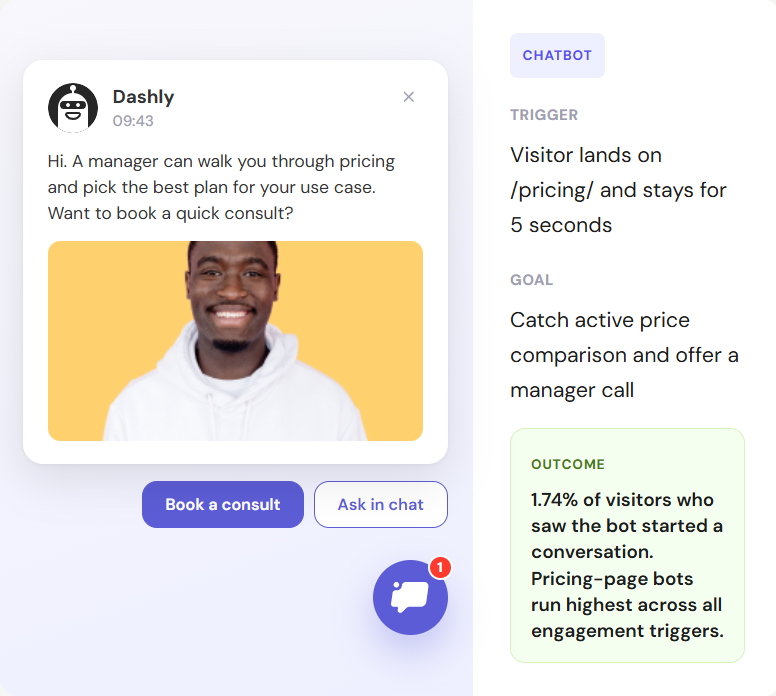
Static drip campaigns miss the moment when a lead’s behavior shifts. An AI engagement layer catches a pricing-page revisit or a longer-than-usual visit to a key page and responds inside the hour instead of waiting for the next scheduled send. That’s the mechanism behind Dashly’s AI engagement: it watches for the behavior change and reacts to it, rather than running the same five-email nurture sequence regardless of what the lead actually does.
Here’s an example of an engagement message:
Stage 3: Consideration & sales-readiness
A lead reaches consideration when their behavior starts looking like evaluation instead of research: pricing page visits, comparison content, questions about implementation. The job at this stage is separating real buying signals from casual interest, and doing it fast enough that sales doesn’t lose the moment.
Manual scoring lags by design. A rep checks a lead list once a day, maybe twice, and the signal that mattered at 10am is stale by 4pm.
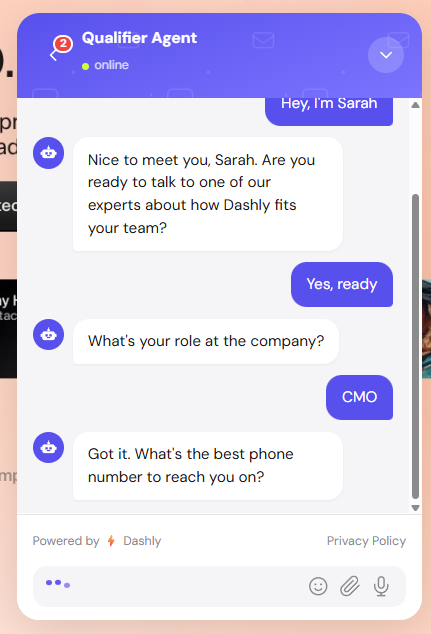
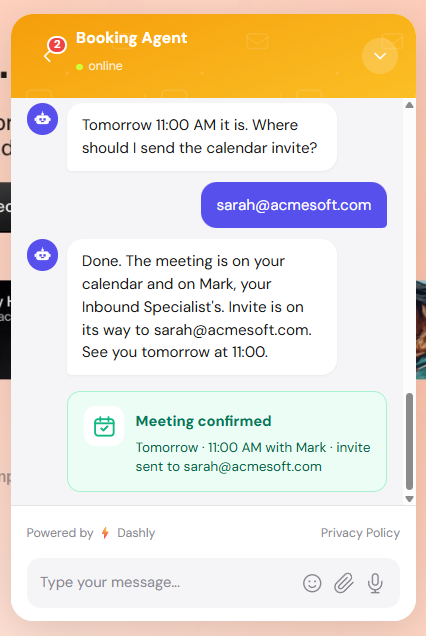
Dashly’s AI qualifier agent qualifies through an actual conversation, asking the qualification questions in real time and tagging MQL fit the moment the dialogue reveals it, instead of waiting for a rep to review a lead list once a day. The lead moves to sales-ready inside that same conversation, not the next time someone checks the list.
Here’s what the workflow looks like:
Step 1: Engagement
Step 2: Qualification
Step 3: Booking

Get this stage wrong in either direction and it costs you. Score too loosely and sales drowns in unready leads. Score too strictly and a genuinely ready buyer sits in the queue.

Stage 4: Conversion & handoff to sales
Conversion is the handoff moment: the lead has cleared qualification and a human rep takes over the conversation. The single biggest failure here is context loss. A prospect who spent three weeks in nurturing shouldn’t have to re-explain their use case from scratch on the first call.
Carry the full history into the handoff: which content they engaged with, what questions they asked, what triggered the qualification. A rep who opens the call already knowing the lead’s use case closes faster than one starting cold.
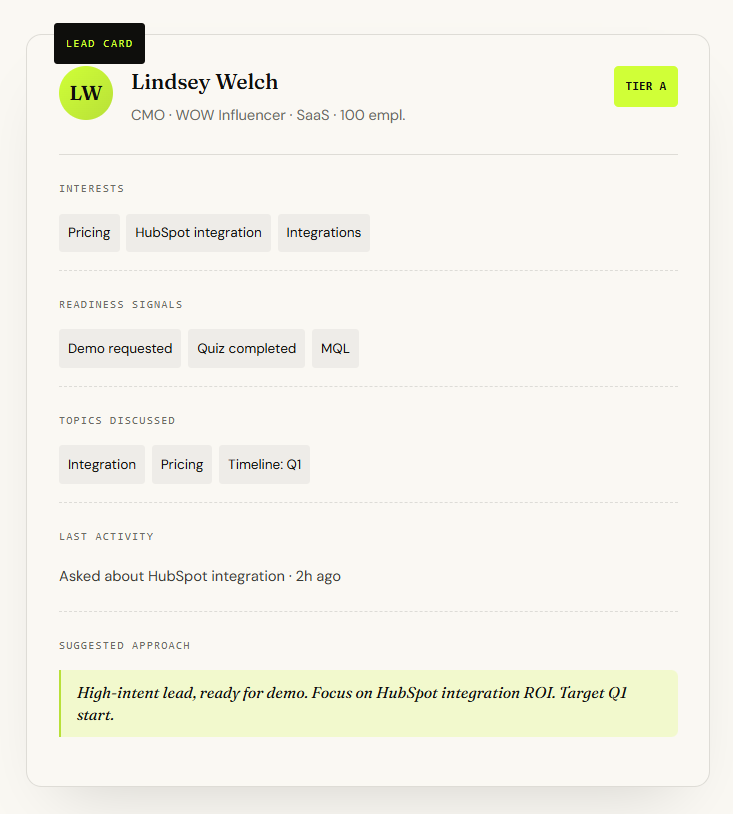
For this, we at Dashly collect all user data in a single user card. We generate a summary with the most important information about a person, so your sales reps get all relevant context about a prospect.
Stage 5: Post-sale retention & expansion nurturing
Nurturing doesn’t stop at the signature. New customers still need onboarding content, and existing customers still need to hear about features that solve problems they haven’t raised yet. This is the customer lifecycle stage most nurturing frameworks forget to design for at all. Renewal timing and usage milestones matter more than the campaign calendar.
Teams that treat closed-won as the finish line miss the cheapest revenue on the table: expansion inside an account that already trusts them, and the lifetime value that expansion protects.
Lead nurturing stages vs the sales funnel: how they map together
Lead nurturing stages and sales funnel stages describe the same buyer journey from two different angles. The funnel tracks where a deal sits from a revenue-forecasting view (awareness, interest, decision, purchase). Nurturing stages track what the lead needs from a content and engagement view. They should line up, not compete.
In practice, nurturing stages 1 to 3 sit inside the top and middle of the sales funnel stages most B2B teams already track, while stage 4 is the handoff into the funnel’s decision stage. Stage 5 lives entirely outside the acquisition funnel, in the retention motion.
Whoever owns the CRM software still has to pick actual field names for this, which is where most teams overcomplicate things by inventing a second taxonomy nobody maintains past the first quarter.
This mapping also answers a question CRM admins ask constantly: how many pipeline stages should a CRM actually have? Most B2B SaaS teams land on four to six, mirroring the B2B sales funnel stages already in use, rather than a parallel nurturing taxonomy tracked separately.
If your CRM stages and your nurturing stages use different names for the same checkpoint, fix that first. Two taxonomies for one journey is where most reporting confusion starts.
How to build a lead nurturing stage framework: step-by-step
Building a lead nurturing stage framework starts with auditing where leads actually get stuck today, then defining explicit entry and exit criteria for each stage before writing a single piece of content.
- Pull 90 days of lead activity and mark where deals stall longest. That’s your broken stage, not the one you assume is broken.
- Write one sentence of entry criteria and one sentence of exit criteria per stage, including the segmentation rule that moves a lead there (company size, behavior, or an explicit request). If you can’t write the exit criteria in a sentence, the stage is too vague to automate.
- Assign an owner per stage: marketing owns 1 to 2, an AI agent or SDR owns 3, sales owns 4, and customer success owns 5.
- Automate the transition trigger, not just the content. Whether that runs on a marketing automation platform or an AI agent, personalization at each touchpoint should key off real behavior, not a calendar date.
- Review stage-to-stage conversion monthly for the first quarter, then quarterly once the numbers stabilize.
The step most teams skip is the automated trigger. Everything else on this list is a planning exercise; the trigger is what actually makes the framework run without a human checking a spreadsheet every morning.
Lead nurturing stage benchmarks & KPIs to track per stage
Every stage needs its own metric, because a single “overall nurture conversion rate” hides exactly which stage is broken. Track time-in-stage, stage-to-stage conversion rate, and content engagement rate separately for each of the five stages.
- Time-in-stage: how many days a lead sits at each stage before moving on or going cold
- Stage-to-stage conversion: the percentage that actually advances rather than stalling
- Engagement depth: repeat content interactions, not just a single open or click
- Qualification accuracy: how many stage-3 qualified leads sales actually accepts as sales-ready
None of this is trackable without a single record per lead that follows them across every stage. A unified lead profile keeps that history in one place: what content a lead engaged with in stage 2, what triggered their stage-3 qualification, what the rep said on the handoff call.
Without it, each stage’s data lives in a different tool, and the benchmarks above become guesswork instead of a dashboard.
Once tracking is in place, resist the urge to buy new lead nurturing tooling before fixing the process it would run. The best AI lead nurturing tools still need clean stage definitions underneath them, or they just automate the same confusion faster.
Common mistakes when managing lead nurturing stages
The most common mistake is running one nurture campaign for the whole journey instead of five distinct ones. A second, closely related mistake is defining stages by time elapsed (“day 14 of the sequence”) instead of by behavior. Time-based stages ignore the lead entirely; behavior-based stages respond to what they actually do.
A third mistake shows up at the handoff: sales and marketing agree on stage names in a kickoff meeting, then quietly drift back to their own definitions within a quarter. Revisit the stage definitions the same way you’d revisit a pricing page, on a schedule, not only when something breaks.
Conclusion
Lead nurturing stages turn a vague “keep in touch” motion into a system with defined checkpoints, owners, and exit criteria. The five stages, capture, engagement, consideration, conversion, and retention, map cleanly onto the sales funnel your team already tracks, so building this framework doesn’t mean inventing a second taxonomy.
Start with the stage where leads currently stall the longest. Fix that one stage before rebuilding all five, and the rest of the framework gets easier to automate.
FAQ
The lead nurturing cycle is the full path a lead follows from initial capture through sales-readiness and, ideally, into retention. It’s the same journey the 5-stage framework describes, just viewed as a repeating cycle rather than a one-way funnel, since retained customers often re-enter early-stage nurturing for new products or use cases.
Most B2B SaaS teams use five stages: capture and initial qualification, engagement and education, consideration and sales-readiness, conversion and handoff, and post-sale retention. Some teams compress this to three or four by merging capture with engagement, but five keeps each transition specific enough to automate.
Lead generation gets a prospect into the funnel through a form, chat, or gated content. Lead nurturing is everything that happens after that: the staged sequence of content and engagement that moves the lead toward sales-readiness. Generation is the entry point; nurturing is the journey.
Sales pipeline stages track deal status for forecasting (awareness, interest, decision, purchase, retention), while nurturing stages track what the lead needs at each point. Nurturing stages 1 to 3 typically map to the top and middle of the pipeline, stage 4 to the decision stage, and stage 5 to the retention stage.
At each stage, match the content to what the lead needs to answer next: fit confirmation in stage 1, mechanism-focused education in stage 2, buying-signal validation in stage 3, context-rich handoff in stage 4, and usage-based expansion content in stage 5. The content should change with the stage, not repeat the same message on a schedule.
Define explicit entry and exit criteria before writing content, assign a clear owner per stage, and trigger transitions on behavior rather than a fixed date. Reviewing stage-to-stage conversion on a regular cadence, not just when pipeline stalls, is the practice most teams skip.
A CRM with clearly defined stage fields, a unified lead profile that tracks activity across stages, and AI-driven engagement or qualification tools that trigger stage transitions automatically. See the current roundup of AI lead nurturing tools for a feature-by-feature comparison.