Digital marketing funnel: Complete guide to stages, strategy, and metrics for 2026
 12 minutes
 14.08.2026
A prospect visits your pricing page, reads three blog posts, and watches a product demo video. No form fill, no chat message, no email reply. Three weeks later, they show up in a competitor’s deal as a signed customer, and nobody on your team ever spoke to them.
That gap between attention and action is exactly what a digital marketing funnel is built to close.
Most explanations of the concept stop at a four-box diagram: awareness, consideration, decision, done. That’s a fine start, but it skips the part that actually matters to a marketing or revenue leader: which channels feed each stage, what to measure, and where the funnel quietly leaks pipeline before anyone notices.
This guide covers all three. By the end, you’ll have a stage-by-stage map you can apply to your own funnel this quarter.
What is a digital marketing funnel?
A digital marketing funnel is the path a prospect travels across digital channels, search, social, email, paid ads, content, from first exposure to a brand to becoming a paying customer and, ideally, a repeat one. Some teams call this same path the buyer journey or the customer journey. A funnel is simply that journey grouped into measurable stages, so a team can improve conversion at each step, not just at the end.
Unlike a single campaign or channel report, a funnel view forces a team to look at the full path. A high volume of website visitors means nothing if none of them reach the consideration stage. A strong email open rate means nothing if it doesn’t move buyers toward a decision.
The funnel is the model that connects those dots.
Most B2B SaaS teams already run some version of this funnel, spread across a CRM, an ad platform, and the rest of the martech stack. Making it visible as one system is what turns scattered activity into something a team can optimize on purpose instead of by accident.
Digital marketing funnel vs. sales funnel: what’s the difference
- A digital marketing funnel covers the stages before a prospect becomes a qualified lead: awareness, consideration, and early interest, built and measured mostly by marketing.
- A sales funnel picks up from there: qualification, demo, negotiation, close, owned mostly by sales.
The two overlap at the handoff between a marketing-qualified lead (MQL) and a sales-qualified lead (SQL).
The confusion is understandable. Google’s own AI Overview for this exact search query blends definitions from both concepts into a single answer, and plenty of published guides use “marketing funnel” and “sales funnel” interchangeably.
They are not the same funnel.
A digital marketing funnel is also almost always inbound by design. Outbound marketing, cold email, cold calling, purchased contact lists, feeds a different funnel entirely, one that starts with sales-led outreach instead of an inbound click.
A marketing funnel is about earning attention and building enough interest that a stranger raises their hand. A sales funnel starts once that hand is raised, and its job is converting a qualified prospect into a paying account. Confusing the two puts the wrong metric on the wrong stage: marketing gets blamed for a slow sales cycle, or sales gets blamed for low-quality traffic.
The two funnels share one critical seam, the handoff itself, and treating it as purely a sales problem misses where the real leak usually is. Conversion rates at this exact handoff vary sharply by channel, which is exactly why the two funnels need to be modeled together instead of handed off blind.
The stages of a digital marketing funnel
A digital marketing funnel has four core stages: awareness, consideration, decision, and retention, each mapped to different channels, content, and goals. Awareness earns attention from people who don’t know the brand yet. Consideration builds interest. Decision converts a qualified prospect into a customer. Retention turns that customer into a repeat buyer and advocate.
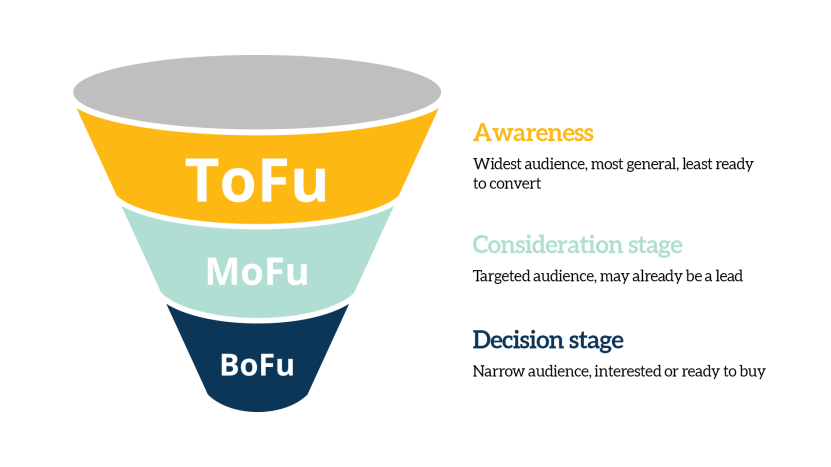
Awareness (TOFU)
At the top of the funnel, the goal is simple: get in front of the right audience before they’re actively looking to buy. SEO content, paid search, organic social, display ads, and paid social campaigns aimed at lookalike audiences all live here. The metric that matters is reach among a defined ICP, not raw traffic.
Consideration (MOFU)
Once a visitor shows interest, an email address, a return visit, a whitepaper download, the job shifts to education. Content marketing, email nurture sequences (often run as automated drip campaigns), webinars, and retargeting campaigns work this stage. The prospect is comparing options, including doing nothing at all.
This is where lead scoring starts to matter. A prospect who opens five emails and visits the pricing page twice behaves differently from one who downloaded a single ebook and went quiet, and treating them the same wastes the sales team’s time on the wrong accounts.
Decision / conversion (BOFU)
This is where a marketing-qualified lead needs to become sales-ready, fast. Manual qualification, a rep manually checking firmographic fit, company size, and intent signals, is the most common bottleneck at this stage. It’s also the easiest one to automate.
A basic AI chatbot that only answers FAQs doesn’t fix this bottleneck. The qualification logic itself needs to run automatically, not just the chat window in front of it.
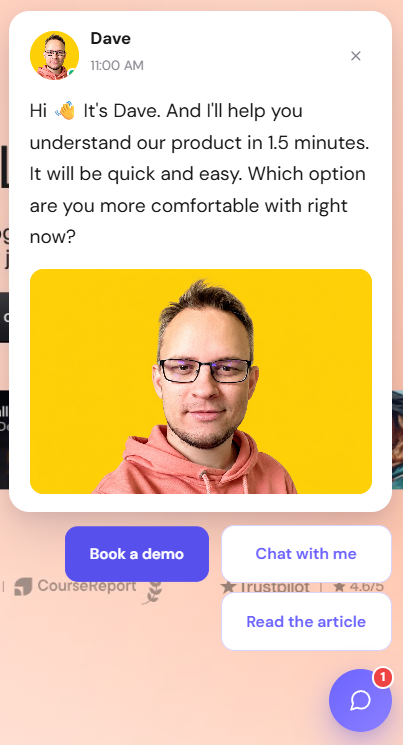
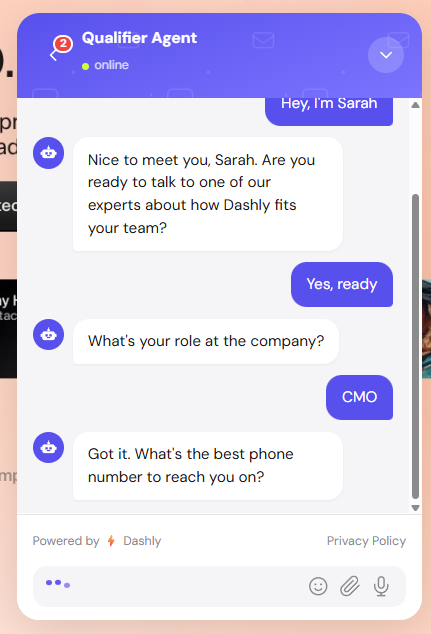
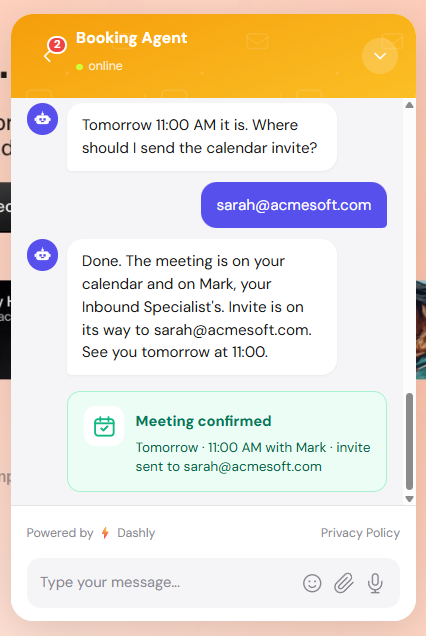
Dashly’s AI Qualifier Agent handles this stage by scoring and qualifying inbound leads against a team’s ICP criteria the moment they engage, day or night, so a rep only spends time on conversations that are already worth having.
Once a lead clears that bar, the rest of the decision stage, demo, pricing conversation, proposal, moves at whatever pace the buyer sets. This stage also overlaps heavily with conversion rate optimization (CRO): a qualified lead can still stall on a confusing pricing page or a clunky checkout flow.
Here’s how Dashly’s AI agent handles qualification and meeting booking autonomously 👇
Step 1: Engagement
Step 2: Qualification
Step 3: Booking
Retention and loyalty
The funnel doesn’t end at the sale. A customer who churns in month two costs more than the deal was worth once acquisition cost is factored in, and a customer who expands or refers others is worth several times the initial contract. Onboarding quality, proactive check-ins, and usage-based triggers all belong to this stage. Personalization, tailoring those check-ins to actual usage data instead of a generic drip, is what keeps the retention stage cheap to run.
Retention is the cheapest stage to improve and the most commonly ignored.
Digital marketing channels for each funnel stage
Different channels do different jobs at each funnel stage. Organic search (SEO) and social media marketing build awareness, content marketing and email marketing nurture consideration, conversational marketing and AI-assisted qualification close the decision stage, and lifecycle email or in-app messaging drives retention. Matching channel to stage, instead of running every channel everywhere, is what separates an omnichannel, full-funnel strategy from a pile of disconnected campaigns.
| Stage | Primary channels | What “good” looks like |
|---|---|---|
| Awareness | SEO, paid search, paid social, organic social | Reach within ICP, branded search growth |
| Consideration | Content marketing, email nurture, webinars, retargeting | Return visits, content engagement, rising lead score |
| Decision | AI or human qualification, demo, sales conversations | MQL to SQL rate, time to first response |
| Retention | Lifecycle email, in-app messaging, customer marketing | Net revenue retention, expansion rate |
B2B buyers don’t experience these channels one at a time. According to McKinsey’s 2024 B2B Pulse research, B2B customers now use an average of ten interaction channels during a single purchase decision, up from five in 2016, and 42% report using more than eleven touchpoints.
A funnel built around one channel is already out of date.
How to build a full-funnel digital marketing strategy
Building a full-funnel digital marketing strategy means auditing where prospects currently drop off, setting a measurable goal for each stage, choosing channels that match those goals, and automating the handoffs between stages so leads don’t stall waiting on a human. Most teams can run this as a seven-step process.
- Map your current funnel. List every channel and touchpoint a prospect can hit, then mark where you have no visibility at all.
- Set one goal per stage. Awareness needs a reach or share-of-search goal, not a leads goal borrowed from the decision stage.
- Audit content-to-channel fit. A bottom-funnel comparison page or landing page and a top-funnel blog post shouldn’t share the same call to action. The same logic applies to inbound marketing funnel design: channel selection and funnel stage need to be planned together, not in separate cycles.
- Fix your nurture sequences. Dashly’s lead nurturing tooling automates the consideration-stage sequence, so a prospect who goes quiet for two weeks gets a relevant nudge instead of falling out of the funnel entirely.
- Automate the MQL to SQL handoff. Speed matters more here than almost any other lever in the funnel.
- Instrument metrics per stage. A single blended conversion number hides exactly where pipeline is being lost.
- Review quarterly. A funnel built once and never revisited degrades as channels, algorithms, and buyer behavior change.
Digital marketing funnel metrics: what to track at each stage
Track a different metric at each funnel stage: click-through rate and impressions for awareness, engagement rate and lead score for consideration, MQL-to-SQL conversion rate and cost per acquisition for decision, and net revenue retention for retention. Tracking only one blended conversion rate hides exactly where the funnel is losing pipeline.
| Stage | Core metric | Why it matters |
|---|---|---|
| Awareness | CTR, impressions, branded search growth | Signals reach within the right audience, not just volume |
| Consideration | Engagement rate, lead score, content completion | Shows real buying intent forming |
| Decision | MQL to SQL rate, CAC, time to qualification | Directly tied to pipeline value |
| Retention | Net revenue retention, churn rate, LTV | Determines whether growth is profitable |
The decision-stage number is worth pinning down precisely. According to First Page Sage’s 2025 B2B SaaS benchmark, the average MQL-to-SQL conversion rate sits at just 13%, with SEO-sourced leads converting at 51% and PPC-sourced leads at only 26%. A single blended number would hide that gap entirely.
A multi-touch attribution model ties these per-stage numbers into one system, so credit doesn’t all land on the last touch before a deal closes. Without it, a paid search campaign that gets someone into the top of the funnel looks worthless next to the email that technically “closed” the deal three months later.
Where digital marketing funnels break down (and how to fix the leaks)
The most common sources of digital marketing funnel drop-off are slow lead response time, missing lead qualification, generic nurture content sent to every stage, and no clear owner for the marketing-to-sales handoff. Each one is fixable with a specific, measurable change rather than a full funnel rebuild.
Response time is the leak that costs the most pipeline for the least effort to fix. According to Gartner’s 2026 sales research, 67% of B2B buyers now prefer a rep-free buying experience, which means a slow or generic first response doesn’t just delay a deal. It actively pushes the buyer toward a competitor who answered faster or let them self-serve.
An instant, relevant first response is no longer a nice-to-have.
Two other leaks are worth naming directly. Generic nurture, the same three emails sent to a VP evaluating vendors and an intern downloading a template, treats every lead as identical when they clearly aren’t.
An undefined handoff owner is just as costly. When nobody is accountable for what happens between “marketing qualified” and “sales accepted”, leads that would have converted quietly die waiting for a follow-up that never comes.
This is the exact gap Dashly’s AI Inbound Revenue Agents are built to close. A lead that arrives at 11pm on a Saturday gets engaged, qualified, and routed the moment they show intent, instead of sitting in a queue until Monday morning.
Conclusion
A digital marketing funnel only works as a system, not a diagram. The four stages, awareness, consideration, decision, retention, matter less than whether each one has a clear channel, a clear metric, and a clear owner.
Most funnels don’t fail because a stage is missing. They fail because the handoff between stages is slow, generic, or unowned, and that’s exactly where AI-assisted qualification and nurture close a gap a purely manual team can’t close at scale.
Start with the audit from the strategy section above, pick the single leakiest stage, and fix that one first.
FAQ
A digital marketing funnel is the path a prospect takes across digital channels, from first seeing a brand to becoming a paying customer, broken into stages such as awareness, consideration, decision, and retention so each one can be measured and improved.
A marketing funnel covers the stages before a lead is qualified, awareness and consideration, while a sales funnel starts once a lead is qualified and covers demo, negotiation, and close. The two connect at the MQL-to-SQL handoff.
Most digital marketing funnels have four stages: awareness (attracting attention), consideration (building interest), decision (converting a qualified prospect), and retention (turning customers into repeat buyers).
Agencies typically map a client’s existing channels and content to funnel stages, then fix the gaps: adding retargeting for consideration, tightening lead scoring for decision, and setting up lifecycle campaigns for retention, using the client’s CRM and marketing automation tools.
No, but the linear four-box version is incomplete. Buyers now move across an average of ten channels non-linearly, per <a href=”https://www.mckinsey.com/capabilities/growth-marketing-and-sales/our-insights/five-fundamental-truths-how-b2b-winners-keep-growing” >McKinsey’s 2024 B2B Pulse research</a>, so a funnel needs multi-touch attribution rather than a single straight-line path.
The 3-3-3 rule in marketing is a content-planning framework: three content types, three distribution channels, and three stages of the buyer’s journey, awareness, consideration, decision, kept in view for every campaign so no stage or channel gets ignored.
A common B2B SaaS example: a prospect finds a blog post through organic search (awareness), downloads a guide and joins an email nurture sequence (consideration), gets qualified by an AI agent and books a demo (decision), then receives onboarding emails and usage tips after signing (retention).
No. A customer journey map documents every touchpoint a buyer has with a brand, including ones outside marketing’s control, while a digital marketing funnel focuses specifically on the stages marketing can measure and influence: awareness, consideration, decision, and retention.



![Customer engagement strategy template [expert plan]](https://www.dashly.io/blog/wp-content/uploads/2022/09/Customer-engagement-strategy-template-720x317.png)