What is a business development representative? Role, skills, and how AI is changing the job in 2026
 13 minutes
 17.08.2026
A business development representative (BDR) is the person whose job is to build pipeline before a salesperson ever gets on a call. They research accounts, start conversations with people who haven’t asked for a demo yet, and hand off qualified opportunities to an account executive. Most B2B SaaS companies with more than a handful of reps have at least one BDR, whether that person is a full human hire, or increasingly, an AI agent working alongside one.
The role sounds simple on paper. In practice, it is one of the highest-turnover, highest-pressure jobs in a sales organization, and one that’s changing faster than almost any other title in B2B revenue right now.
This guide covers what a BDR actually does day to day, how the role differs from an SDR, what it pays in 2026, and, unlike most glossary entries on this topic, how AI tools are reshaping what “BDR” even means at companies that have already adopted them.
What is a business development representative (BDR)?
A business development representative is an entry-to-mid-level sales role responsible for generating and qualifying new pipeline, usually through outbound prospecting such as cold calls, cold emails, and LinkedIn outreach. The BDR does not close deals. Their job ends once a prospect is qualified and booked for a meeting with an account executive (AE). BDRs sit at the very top of the sales funnel, before a lead becomes an opportunity.
Business development representative is the standard title for this function, though many teams shorten it to “BDR” once everyone on the team knows what it means. Some companies use “BDR” and “sales development representative” interchangeably; others draw a sharp line between outbound-focused BDRs and inbound-focused SDRs (more on that distinction below).
Because the title varies by company, job descriptions for “BDR” range from pure cold-outreach roles to hybrid positions that also triage inbound demo requests. What stays constant across almost every version of the job is the mandate: find and validate revenue opportunity before anyone else touches it.
What does a business development representative do? Core responsibilities
A BDR spends most of the week on outbound prospecting: researching target accounts, sending personalized cold emails, making calls, and reaching out on LinkedIn to book meetings for account executives. Alongside outbound, many BDRs also triage inbound requests, run lead qualification against a defined ICP, log every touch in the CRM, and hand off qualified leads with enough context that the AE doesn’t start from zero.
Break that down and five things happen on repeat, every single week.
- Account and contact research. Building a target list from an ideal customer profile, then finding the right person to contact at each account.
- Outbound prospecting. Cold calls, cold emails, and LinkedIn messages, usually run in sequences across multiple touches.
- Inbound triage. Responding to demo requests and free-trial signups fast enough that the lead doesn’t cool off before anyone replies.
- Qualification. Confirming budget, authority, need, and timeline (or whatever framework the team uses) before booking a meeting.
- CRM hygiene and handoff. Logging call notes, tagging the right fields, and briefing the AE so the second conversation doesn’t repeat the first.
A typical day
Mornings tend to go to inbound: anything that came in overnight gets a reply first, since response speed is the one variable a BDR fully controls. The middle of the day is outbound blocks, usually 60 to 90 minutes of focused calling or sequence-writing at a time. Afternoons are for follow-ups, CRM cleanup, and syncing with the AE team on anything close to booking.
Team structure varies with company size. A five-person BDR team at a mid-market SaaS company usually splits by territory or industry vertical, with one person acting as an informal lead. An enterprise business development representative role looks different again: fewer accounts, much deeper research per account, and a longer runway before a meeting even gets booked, since enterprise buying committees involve more stakeholders than a self-serve SMB deal ever will.
Whatever the team shape, the activity metrics stay similar: dials per day, response rate, and conversion rate from first touch to booked meeting. Those three numbers, tracked weekly, tell a sales manager more about team health than quota attainment alone, and on most teams today an AI sales assistant surfaces them automatically instead of a manually updated spreadsheet.
BDR vs SDR: what’s the difference?
A business development representative and a sales development representative both sit at the top of the funnel and both hand off qualified leads to an account executive. The practical difference at most companies is direction: BDRs generate new pipeline through outbound prospecting, while SDRs qualify inbound leads that marketing already generated. Plenty of teams use the titles interchangeably, so always check the actual job description.
| Dimension | Business development representative (BDR) | Sales development representative (SDR) |
|---|---|---|
| Lead source | Outbound, self-sourced | Inbound, marketing-generated |
| Primary skill | Cold outreach, account research | Fast response, qualification |
| Typical KPI | Meetings booked from outbound | Lead-to-meeting conversion rate |
| Where it reports | Often under sales | Often under marketing or sales |
The distinction gets more interesting once you add AI agents into the mix, since an AI SDR and an AI BDR raise a slightly different question than the human-role version. AI SDR vs AI BDR covers that comparison in detail, including which one to deploy first if you’re only automating one side of the funnel.
Skills a business development representative needs
The BDRs who last past year one share a specific mix of skills: sharp written and verbal communication, comfort with rejection, disciplined CRM habits, and enough product knowledge to ask a smart qualifying question instead of reading from a script. None of this is exotic. Almost none of it is taught in a classroom either.
- Cold outreach and communication. Writing an email a stranger will actually open, and staying conversational on a cold call instead of sounding scripted.
- Objection handling. Responding to “not interested” or “we already have a vendor” without freezing or over-selling.
- Discovery questioning. Asking two or three sharp questions that surface real budget and timeline, rather than working through a rigid checklist.
- CRM and data hygiene. Logging activity consistently enough that pipeline reporting is trustworthy, not guesswork.
- Resilience under quota pressure. Most days end with more “no” than “yes.” The role selects for people who don’t take that personally.
None of these skills show up on a resume as a single line item, which is exactly why interviews for the role lean so heavily on roleplay. A hiring manager would rather watch a candidate handle a cold call badly in the room than read a polished description of how they’d handle it.
Tech-stack fluency belongs on that list too. A modern BDR is expected to move comfortably between a CRM, a sequencing tool, and increasingly an AI assistant that drafts first-touch messages or flags which accounts are actually worth prioritizing that day.
BDR salary and compensation in 2026
Most of a BDR’s pay is base salary, with variable commission on top. The two combined are usually described as on-target earnings, or OTE, rather than a single flat number, and the split between them shifts as a rep moves from entry-level to senior.
An entry-level business development representative in the US earns a median base salary of $63,960, with a typical range of $56,450 to $68,260, according to Salary.com’s 2026 BDR I data. Move up to a senior, or BDR II, title and the range shifts meaningfully: Salary.com’s BDR II benchmark puts average total pay at $76,300, with a typical (25th-75th percentile) range of $69,400 to $84,400, and top earners in the 90th percentile clearing $91,775.
Commission structures typically scale with quota attainment, so a BDR who consistently overperforms their number earns meaningfully more than the base figures above suggest. Two other variables move these numbers more than title alone: location, since coastal tech hubs pay well above the national median, and industry, since financial services and enterprise SaaS tend to pay above average compared to smaller B2B companies.
None of this tells you whether a given BDR seat is worth taking, since pay alone rarely predicts whether the quota is realistic for the territory. That question matters as much to a hiring manager building the team as it does to the rep signing the offer.
How AI and BDR software are changing the role
AI is changing the BDR role by taking over the repetitive first pass of the job: triaging inbound volume, drafting outbound sequences, and scoring which accounts are worth a human’s time. The tools don’t remove the BDR from the funnel. Instead, they change where a rep’s attention goes, shifting effort away from clearing a queue and toward the highest-value conversations. In 6sense’s 2025 Science of B2B BDR Benchmark, 62% of BDR organizations reported having adopted at least one AI tool already, and BDRs were still hitting roughly 88% of quota on average despite that shift.
Adoption at that scale means the question for most sales leaders has already moved past whether to use AI in the BDR function, toward exactly where in the workflow it earns its keep.
Here’s where that plays out in practice. A high-volume inbound funnel generates far more form-fills and trial signups than a BDR team can personally triage in real time, and every minute of delay costs conversion. An AI qualifier agent solves the bottleneck directly: once an inbound lead reaches out, it responds immediately, asks qualifying questions, and only routes the ones that actually match the ICP to a human BDR. Dashly’s AI qualifier agent is built specifically for this handoff point, so the BDR’s day starts with pre-qualified conversations instead of a raw, unsorted lead list.
Here’s how Dashly’s AI agent handles qualification and meeting booking autonomously 👇
Step 1: Engagement
Step 2: Qualification
Step 3: Booking

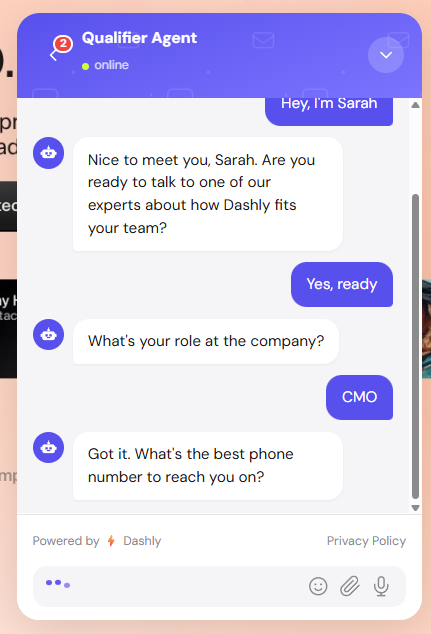
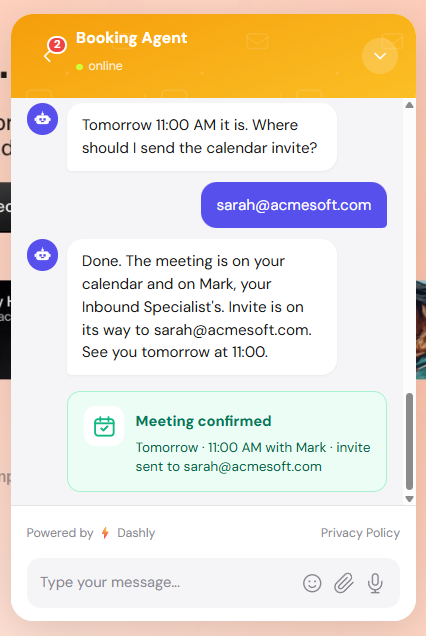
The BDR still decides how to run the conversation once it starts. What changes is that the software stops wasting their morning on contacts who were never going to buy, which relocates the rep’s judgment rather than replacing it.
A modern BDR’s tech stack reflects that split: a CRM and sequencing tool for the outbound work only a person can run well, alongside an AI sales assistant handling the triage a person shouldn’t have to.
So is AI replacing BDRs? Not entirely, and not yet. It replaces the lowest-judgment part of the job. AI SDR vs human SDR goes deeper into where AI agents currently outperform a human rep, and where a person still needs to be in the loop.

Career path: from BDR to AE or BDR manager
Most companies treat the BDR seat as a launchpad, not a destination. Career progression from here follows one of two tracks: a rep who consistently hits quota for 12 to 18 months typically moves into a closing role as an account executive, or moves up into managing a BDR team and reporting alongside the sales manager who once ran their own pipeline. Which path fits depends more on temperament than performance. Both are considered promotions.
An entry-level BDR usually starts with a smaller, well-defined territory and a simpler qualification checklist. A senior BDR carries a larger quota, often works larger or more strategic accounts, and may mentor newer reps informally before any formal management title exists. The jump from BDR to account executive is the more common next step, since it keeps the rep in a quota-carrying, revenue-facing role rather than moving them into people management.
The BDR-vs-account-executive comparison confuses newer reps more than it should. A BDR generates and qualifies the opportunity; an account executive owns the deal from first real sales conversation through signature and, usually, carries a much larger number tied to closed revenue rather than meetings booked. Moving from one to the other is a change in what you’re measured on, not just a bigger paycheck.
BDRs are, functionally, the reason a company has predictable pipeline at all. Anyone building or scaling a BDR function benefits from thinking about the role in the context of the broader system it feeds, not just the individual title. Pipeline generation strategy covers how BDR output should map to a company’s overall pipeline targets, not just activity metrics.
Where BDRs fit in your sales pipeline
A BDR sits at the very top of the pipeline, before a contact becomes a qualified opportunity. Get that stage wrong, whether through slow response times, weak qualification, or simply not enough outbound volume, and every stage after it inherits the problem, stretching the entire sales cycle longer than it needs to be. A weak top of funnel shows up three weeks later as an AE team with an empty calendar and no clear reason why, and the whole revenue team ends up debugging a problem that started at the BDR stage.
That fragility is worse than it sounds, because top-of-funnel volume rarely arrives at a steady, predictable pace. Some weeks bring a flood of inbound interest; others bring almost none, and a BDR team sized for the average ends up either overwhelmed or idle.
This is exactly why the BDR-vs-AI-agent question matters more than it looks on the surface. Companies running inbound sales motions in particular tend to have inbound volume that spikes unpredictably, well beyond what a fixed-size BDR team can triage consistently. That mismatch, more than headcount cost alone, is usually the real trigger for automating the qualification layer.
Key takeaways
A business development representative builds and qualifies pipeline before an account executive ever joins the conversation, mostly through outbound prospecting, with inbound triage layered on at many companies. The title overlaps heavily with “SDR,” pays a median of roughly $64,000 at entry level and $76,000-plus at the senior tier, and remains one of the highest-turnover seats in B2B sales.
What’s changed is what fills the BDR’s day. With most BDR orgs now running at least one AI tool, the job is shifting away from clearing a raw lead queue and toward the conversations that actually need a human judgment call.
FAQ
A BDR splits the day between outbound prospecting (calls, emails, LinkedIn outreach), triaging inbound leads, qualifying prospects, and logging everything in the CRM before handing qualified meetings to an account executive.
A BDR role is a top-of-funnel sales position focused on generating and qualifying new pipeline, usually through outbound prospecting, before passing qualified opportunities to an account executive to close.
Entry-level BDRs earn a median of about $63,960 in the US, while senior BDR II roles average around $76,300, according to Salary.com’s 2026 data. Commission on top of base pay typically scales with quota attainment.
The core skills are cold outreach and communication, objection handling, sharp discovery questioning, disciplined CRM habits, and resilience under quota pressure. Comfort with a modern sales tech stack, including AI tools, is increasingly expected too.
BDRs typically generate pipeline through outbound prospecting, while SDRs qualify inbound leads that marketing already generated. Many companies use the titles interchangeably, so the actual job description matters more than the label.
Expect questions on how you’d research and prioritize a target account list, how you handle rejection and objections, how you qualify a lead, and a live roleplay of a cold call or discovery conversation.
It’s a strong entry point into B2B sales. Reps who consistently hit quota for 12-18 months typically move into an account executive role or a BDR management track, both considered promotions from the seat.






![Build Ideal Customer Profile Like a Pro Even If You’re Not [3 Templates]](https://www.dashly.io/blog/wp-content/uploads/2021/03/ideal-customer-profile-4-720x308.jpg)

