Agentic AI for B2B marketing: a practical guide for 2026
 18 minutes
 16.06.2026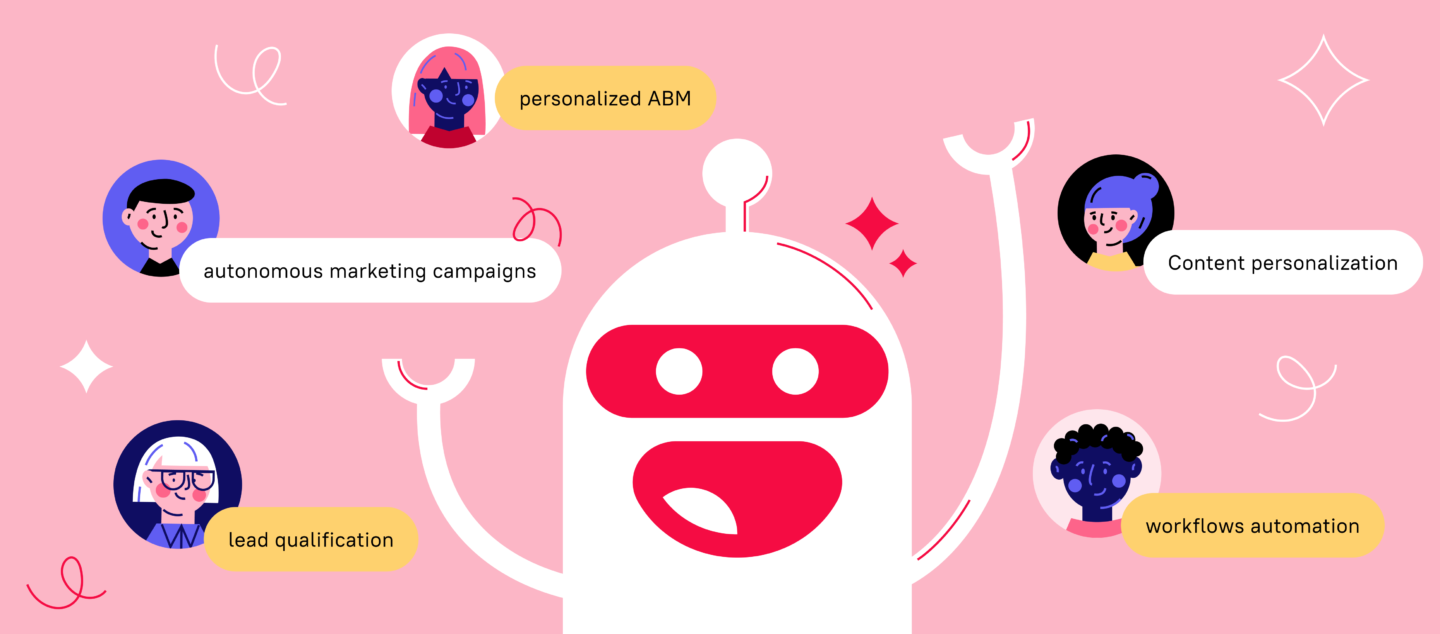
Your CRM captures every lead. Your marketing automation sends the follow-up. Your SDR team works the pipeline. And qualified buyers still go quiet before anyone with context gets back to them.
The real problem is speed and judgment, not content gaps or budget. B2B buyers in 2026 expect a response in minutes, personalized to their account and buying stage. Your team is handling hundreds of conversations simultaneously with limited hours. Rule-based automation handles the predictable parts. Every step that requires judgment sits in a human queue, and that queue is your pipeline bottleneck.
Agentic AI for B2B marketing closes that gap. By adding a decision-making layer that operates on your pipeline continuously, without waiting for someone to trigger the next action. This guide explains how it works, where it delivers the clearest ROI for B2B teams, and how to get your first deployment live in 30 days.
What is agentic AI in B2B marketing?
Agentic AI in B2B marketing refers to autonomous AI agents that pursue defined marketing goals (qualifying leads, running personalized campaigns, booking meetings) without requiring human input at each step. Unlike generative AI, which produces content on demand, or legacy automation, which executes fixed rules, agentic AI adapts its actions based on real-time signals from your CRM, website behavior, and conversation data.
The clearest way to understand agentic AI is by contrast. A generative AI tool writes the email subject line when you ask. A marketing automation platform sends it when a trigger condition fires. An agentic AI agent decides which lead to contact, drafts the message, sends it at the right moment, reads the reply, and determines the next action, without a human specifying each step.
This is the core distinction agentic AI vs generative AI researchers define as goal-oriented versus task-oriented systems. Generative AI is a tool you direct. An agent is a system that operates toward an outcome.
The mechanics follow a four-step loop that runs continuously:
- Perceive: the agent reads signals from CRM data, website behavior, email engagement, form submissions, and intent data
- Plan: it determines the most likely action toward the defined goal
- Act: it executes, sending a message, qualifying a contact, booking a meeting, or updating a record
- Learn: it adjusts based on outcome signals and applies that learning to the next decision
For B2B marketers, this maps directly to the workflows where human judgment has historically limited throughput: inbound lead qualification, ABM outreach personalization, SDR pipeline orchestration, and campaign optimization. These use cases are already in production at B2B SaaS companies today, generating measurable pipeline improvements within 30 to 90 days of deployment.
Agentic AI is the architecture that enables autonomous, goal-oriented marketing workflows. Agents perceive signals, plan actions, execute tasks, and learn from outcomes without requiring human input at each step. Agentic marketing as a practice builds on this architecture to run the entire inbound funnel autonomously.
Why B2B marketing teams are switching to agentic AI
B2B marketing teams are switching to agentic AI because rule-based automation hits a ceiling on three dimensions simultaneously: response speed, personalization depth, and operational scale. When each constraint requires human attention to resolve, the team becomes the bottleneck. No hiring plan solves a structural capacity problem at the speed B2B buyers expect.
The adoption numbers confirm the shift. McKinsey’s 2024 State of AI report found that 72% of organizations now use AI in at least one business function, up from 55% the year before. Marketing and sales were among the first enterprise functions to benefit, and agentic AI is the next layer, adding decision-making capability on top of the automation stack most teams already run.
Three specific pain points drive the switch.
Speed-to-lead. The window for engaging a qualified inbound lead is measured in minutes, not hours. Most B2B teams wait far longer. Leads sit in a queue until an SDR has bandwidth, which often means the afternoon after a morning form submission, or Monday morning after a Friday evening inquiry. An agentic AI agent responds within seconds, every time, regardless of time zone or team capacity.
Personalization at scale. Effective ABM requires tailored outreach per account: researching the company, matching messaging to the buyer’s stage, referencing specific intent signals. At 20 target accounts, a human team can do this. At 300 accounts, the personalization degrades to near-generic. Agentic AI processes account data at scale and generates personalized outreach without a proportional increase in headcount.
Campaign optimization cycles. Testing subject lines, sequences, and targeting requires someone to review data and implement winners. In most teams, this happens weekly at best. Agentic AI runs that loop continuously, testing variants, analyzing performance signals, and implementing improvements without waiting for a review meeting.
The combination of these three factors is why teams focused on AI agents for B2B SaaS report faster pipeline velocity, not just lower operational cost. The speed improvement compounds: a lead qualified in two minutes instead of two hours gets to the demo call before competitors even respond.
5 agentic AI use cases in B2B marketing (with examples)
The five highest-impact use cases for agentic AI in B2B marketing are inbound lead qualification, autonomous demand generation campaigns, personalized ABM at scale, AI-driven email automation, and SDR workflow orchestration. Each targets a specific bottleneck where human decision-making has historically limited throughput, and each can be deployed independently so teams can start with the highest-friction workflow first. Together they represent the practical scope of agentic AI in digital marketing, from inbound qualification to full-funnel campaign orchestration.
1. Inbound lead qualification at scale
Every inbound lead requires a qualification decision: does this contact match your ICP, do they have budget, are they at the right buying stage? Traditionally, this question waits for an SDR to have bandwidth. During peak demand periods or outside business hours, that wait can stretch to hours or days.
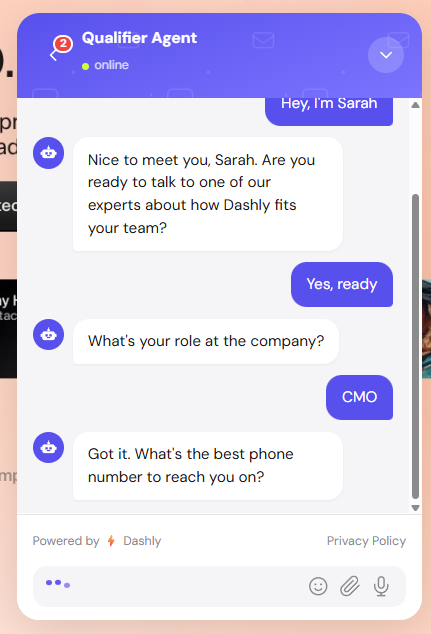
An agentic AI agent qualifies each lead the moment they engage, pulling CRM data, firmographic signals, and behavioral history to make the assessment. The lead gets a personalized response in under two minutes. The SDR team sees a pre-qualified list instead of a raw inbox.
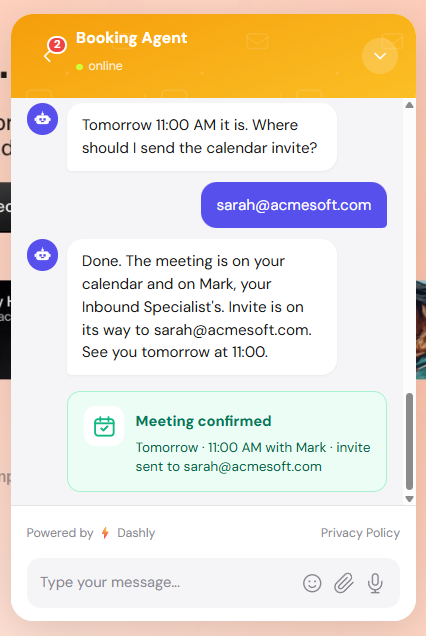
Dashly’s AI Qualifier Agent applies this logic to inbound pipeline: every visitor who starts a conversation is evaluated against ICP criteria in real time. The agent either qualifies them forward to the sales team or routes them to self-serve funnel, without human intervention for routine cases. WOWInfluencer deployed this approach and found that 82% of qualified conversations converted to next steps automatically, driving 653% ROMI in the first quarter.
Here’s what the workflow looks like:
Step 1: Engagement
Step 2: Qualification
Step 3: Booking
2. Autonomous demand generation campaigns
Demand generation campaigns require ongoing judgment calls: which segment to test next, which message variant is underperforming, when to reallocate budget from a channel that isn’t converting. Each decision sits in a queue waiting for a marketer to review the data and act.
An agentic demand gen agent monitors campaign performance continuously, identifies underperforming segments, generates alternative copy variants, tests them against the control, and implements winners. Optimization cycles that previously took weeks now happen in days.
This is one of the more concrete agentic AI marketing examples already in production at mid-market B2B SaaS companies: campaign agents that run tests and implement improvements autonomously, without waiting for the weekly performance review.
3. Personalized ABM at scale
Account-based marketing depends on tailored engagement: messaging that reflects the specific company’s situation, the buyer’s role, and the current intent signals from that account. At 50 target accounts, a small team can manage this manually. At 500, the personalization degrades to near-generic outreach with the company name swapped in.
Agentic AI:
- Processes intent data, news signals, firmographic data, and engagement history for each account simultaneously;
- Generates personalized outreach that reflects the specific context for each account: what they’ve researched, what competitors they’re evaluating, what industry events they’ve attended;
- Handles the research and drafting.
The marketer reviews and approves the strategic accounts.
This is the shift that makes ABM accessible beyond enterprise teams with 10 or more people. A two-person demand gen team can now execute personalized outreach across 500 accounts without each message becoming a template with the company name swapped in.
4. AI-driven content and email automation
Traditional marketing automation sends email A when trigger B fires. The content is static, the timing is preset, and the sequence logic is linear. If a contact deviates from the expected path, the sequence continues on its rails regardless.
An agentic AI system reads behavioral signals between sends: which pages were visited after the last email, which content was downloaded, what the CRM says about deal stage progression. It adapts the next message based on what actually happened, not what was predicted when the sequence was built.
Here’s how emails can be personalized depending on user behavior:
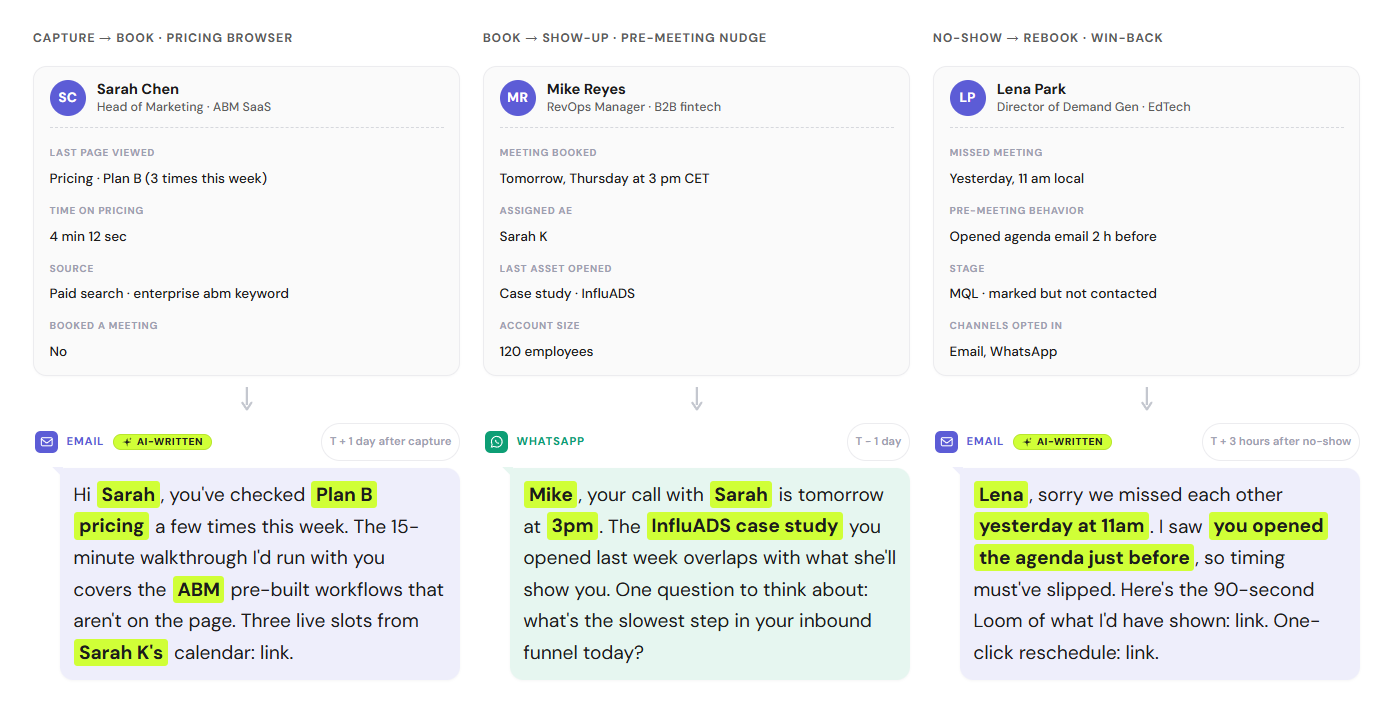
For later-funnel leads where context matters most, this adaptive approach generates significantly higher conversion rates than a static sequence. The message a VP of Engineering receives on day 14 of a trial reflects what they actually did during those 14 days, not what a generic sequence assumed they’d do.
5. Agentic AI SDR workflows
The SDR workflow (qualify, follow up, book meeting, hand off to AE) is exactly the kind of multi-step, judgment-intensive process that agentic AI is designed for. Each step requires a decision based on what the contact did last, and the full cycle repeats across hundreds of leads simultaneously.
An AI inbound SDR handles the full pipeline without human intervention for routine cases:
- Identifies the lead and qualifies against ICP
- Sends a personalized first message
- Manages the follow-up sequence
- Books the meeting and creates the CRM handoff record for the AE
The SDR team’s attention shifts to the conversations that require judgment: complex objections, strategic accounts, multi-stakeholder deals.
Here’s an example of an AI flow for booking a meeting:
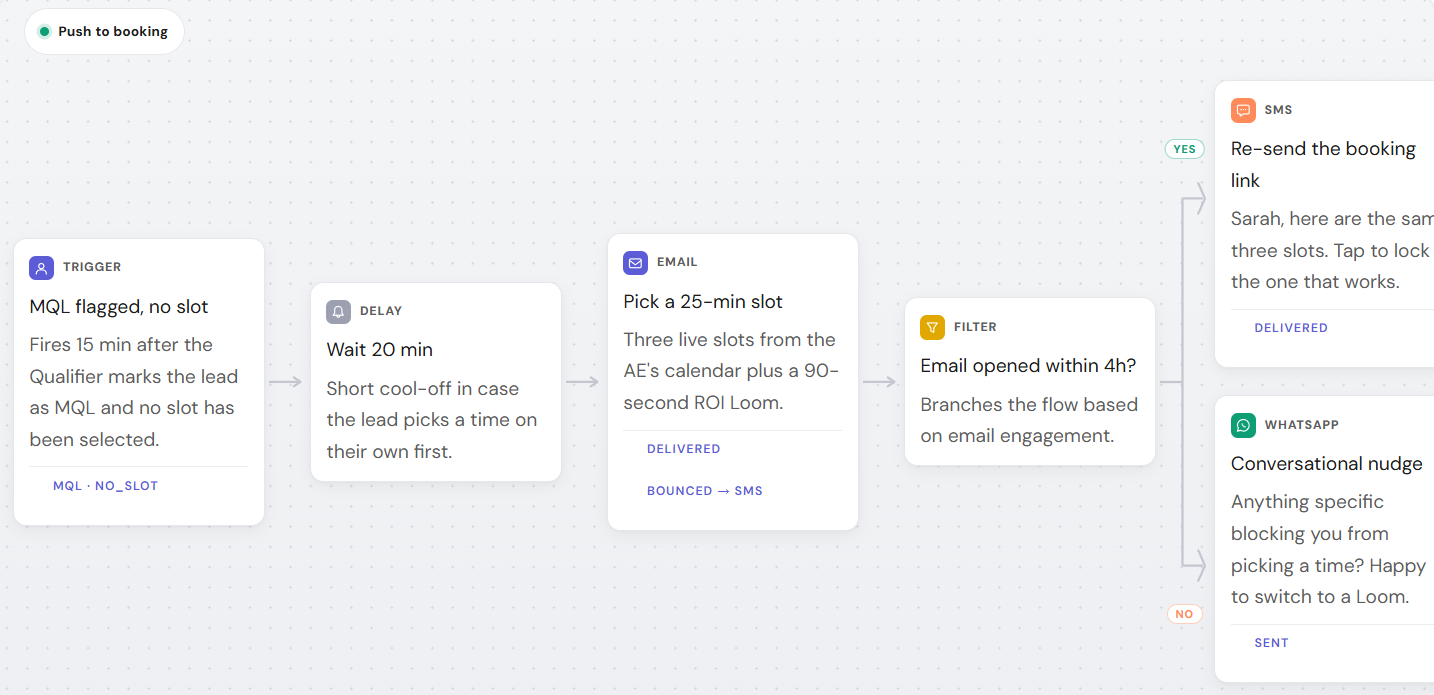
The practical impact on pipeline economics is significant. The team’s capacity shifts from routine inbound triage to the high-value conversations that actually move deals forward.

Agentic AI vs. traditional marketing automation: what actually changes
The core difference between agentic AI marketing automation and traditional marketing automation is that automation executes rules (if this, then that), while agentic AI pursues goals. Automation handles predictable, high-volume flows reliably. Agentic AI handles the judgment calls that sit outside the rules: anomalous responses, shifting intent signals, and multi-step sequences where the next action depends on what just happened.
| Dimension | Traditional MAP (HubSpot, Marketo) | Agentic AI |
|---|---|---|
| Execution logic | Rules: if X, then Y | Goals: achieve outcome Z |
| Personalization | Segment-level | Individual, per-contact |
| Response to context | Static (preset sequence) | Dynamic (adapts to signal) |
| Human involvement | Setup and monitoring | Define goals and review exceptions |
| Scalability | Unlimited for preset flows | Unlimited for judgment-intensive flows |
| Where it breaks | Complex, context-dependent journeys | Predictable, high-volume sequences |
The practical implication: most B2B marketing teams should run both. Traditional automation handles newsletter sends, nurture drips, and event-triggered messages, which are high-volume, low-variation tasks where preset rules are sufficient. Agentic AI handles inbound qualification, ABM outreach, and dynamic sequences where each step depends on what the contact just did.
The mistake is treating them as competitors. They stack. IDC research found that 41% of organizations see an increase in conversion rates after adopting agentic AI, not by replacing their existing automation, but by adding a decision-making layer on top of it.
How agentic AI works in B2B marketing workflows
Agentic AI works in B2B marketing workflows by following a four-step cycle (perceive, plan, act, learn) that runs continuously and adapts to new signals without human intervention between cycles. The agent operates 24/7, maintains context across conversations, and improves its decisions based on outcome signals from every interaction.
Perceiving signals is the input layer. The agent reads CRM data, website behavior, email engagement metrics, form submissions, calendar availability, and third-party intent data feeds. It maintains a real-time picture of each contact’s status and buying stage.
Planning the action is where the judgment happens. The agent weighs the defined goal against the available signals and determines the highest-probability next step. For a new inbound lead at 11pm, the agent decides whether to send an immediate qualification message, schedule an SDR alert for 9am, or route to an automated nurture sequence based on the lead’s firmographic profile.
Acting is where execution happens without a human approving each task. The agent sends the message, updates the CRM record, fires the trigger for the next automation step, or routes the lead to the right SDR. This is the step that scales without requiring headcount proportional to lead volume.
Learning closes the loop. The agent monitors outcome signals (did the lead respond, did the meeting book, did the deal progress) and updates its decision model based on what worked. An agent deployed on inbound qualification gets measurably better at identifying high-probability leads over its first 90 days.
Human-in-the-loop applies at two defined points: when you configure the agent’s goals and constraints (a one-time setup), and when the agent surfaces exceptions: contacts that match the ICP but show conflicting signals, high-value accounts that need a personal touch, or situations outside the agent’s operating parameters. Everything routine runs autonomously. Exceptions come to humans with context attached.
How to implement agentic AI in your B2B marketing team: 4-step framework
Implementing agentic AI in a B2B marketing team requires four steps: identify the highest-friction workflow, choose a platform that integrates with your existing stack, define guardrails for what the agent can do without approval, and establish the baseline metrics that will tell you whether it’s moving the right numbers. Before building a full agentic marketing strategy, get one workflow live. The first deployment teaches you more than any planning document.
Step 1: Identify your highest-friction workflow
The right starting point is not the most complex workflow. It is the workflow where human bandwidth is your most visible bottleneck today.
Map your current process: where do leads wait, where do responses lag, where do campaigns stall because someone’s calendar is full? For most B2B SaaS teams, the answer is inbound lead qualification. Leads arrive outside business hours, during high-volume periods, or when SDRs are on calls. That queue is visible, measurable, and directly tied to revenue.
Pick the one bottleneck that causes the most visible pipeline friction. That is the first deployment. Starting with the highest-visibility problem gives you clear before-and-after metrics and builds internal confidence for the next deployment.
Step 2: Choose the right agentic platform for your stack
Platform selection is primarily an integration decision, not a features decision. The agent is only as useful as the data it can read and the systems it can write to.
Evaluate platforms on: CRM integration depth (can it read and write deal stages, not just contact records), transparency (does it log what the agent decided and why), guardrail controls (can you define hard limits on what the agent can do without approval), and response quality on your actual leads, not demo data from a controlled environment.
For B2B SaaS teams focused on inbound pipeline, Dashly’s AI Inbound Revenue Agent handles qualification, follow-up, and meeting booking within a single platform, with full CRM sync and customizable qualification criteria. A full comparison of agentic marketing platforms covers the broader vendor landscape for teams evaluating multiple options.
Step 3: Define guardrails and human-in-the-loop checkpoints
Before deploying any agent on live leads, define explicitly what it can and cannot do without human approval. This is not caution for its own sake. Guardrails make the agent trustworthy and enable faster deployment, because the team knows exactly what it will and won’t do.
Autonomous (agent acts without approval):
- Respond to inbound leads with qualification questions
- Qualify or disqualify leads against ICP criteria
- Send follow-up messages in approved sequences
- Update CRM fields based on conversation outcomes
- Book meetings within available SDR calendar slots
Human approval required:
- Any outreach to named accounts with active deals in progress
- Messages containing pricing or discount information
- Escalation to executive stakeholders
- Any message referencing a competitor by name
Step 4: Measure ROI: Key metrics for agentic AI in B2B marketing
The metrics that matter for agentic AI are pipeline metrics, not activity metrics. More messages sent is not the goal. More qualified meetings booked is.
- Speed-to-lead: time from first contact to first meaningful response. Most teams running agentic AI on inbound qualification move this from hours to under two minutes.
- MQL-to-SQL conversion rate: the percentage of marketing-qualified leads that become sales-qualified. Better qualification and faster personalization should move this number within the first 60 days. If it doesn’t, the ICP criteria or the qualification questions need adjustment.
- Cost per qualified lead: total demand gen spend divided by SQLs generated. Agentic AI typically improves this through both volume (the agent handles more leads per unit time) and quality (pre-qualified leads require less SDR time per close).
Establish baseline measurements before deploying the agent. Without a before-state, you cannot isolate the agent’s impact from other variables in the funnel.
Realistic timeline: most B2B SaaS teams deploying agentic AI on inbound qualification see measurable improvement in speed-to-lead within the first week, MQL-to-SQL rate improvement within 30 days, and clear pipeline ROI within 60 to 90 days. The first deployment is always the steepest learning curve. The second is faster.
Agentic AI trends shaping B2B marketing in 2026
Three trends are accelerating agentic AI adoption in B2B marketing in 2026: multi-agent orchestration across the full funnel, agentic performance marketing that optimizes paid spend continuously, and dark-funnel intelligence that activates accounts before they appear in your CRM as an inbound lead. Each represents a step beyond single-agent deployments into more ambitious automation architectures, reflecting the broader shift toward growth marketing for the agentic age.
Multi-agent orchestration. The first wave of agentic AI deployed single agents on isolated workflows. A qualification agent handled inbound. A separate email agent ran sequences. In 2026, production-ready multi-agent systems coordinate across the full funnel: a lead insight agent feeds context to a qualification agent that hands off to a meeting-booking agent, all working toward a shared pipeline goal. Gartner predicts that 60% of brands will use agentic AI to deliver one-to-one customer interactions by 2028. The infrastructure to support that is being built in 2026.
Agentic performance marketing. Paid campaigns have always had optimization loops, but the loop required humans to review data and adjust bids. Agentic performance marketing agents monitor ad performance in real time, adjust targeting and creative based on conversion signals, and reallocate budget toward segments that are converting continuously, not on a weekly review cycle. The result is faster ROI on paid spend and less wasted budget on underperforming segments.
Dark-funnel intelligence. Most B2B buying activity is invisible to your CRM: buyers are researching, discussing internally, and shortlisting before they ever fill in a form. Agentic AI agents working with intent data providers can identify accounts in an active evaluation and initiate engagement before they appear as an inbound lead. This is the emerging frontier of demand generation, moving from reactive inbound to proactive outreach based on behavioral signals.
For a broader view of what’s production-ready versus early-stage in this space, the landscape of best AI B2B sales tools provides current context on vendor maturity.
Conclusion
Agentic AI in B2B marketing is ready to deploy in 2026. The teams acting now are building the pipeline advantage (faster lead response, more consistent follow-up coverage, ABM that scales past the small-team ceiling) that compounds over the next several quarters.
The practical starting point is not the most ambitious deployment. Pick the workflow where human bandwidth is your most visible bottleneck. Qualify leads in under two minutes instead of two hours. Run ABM across 500 accounts instead of 50. Test campaigns without the two-week review cycle.
The architecture is available. The playbook above covers the implementation steps. The question is which workflow you start with.
FAQ
Agentic AI in marketing refers to autonomous AI agents that pursue defined marketing goals (qualifying leads, running campaigns, personalizing outreach) without requiring human input at each step. Unlike rule-based automation, agentic AI adapts to real-time signals and makes decisions to achieve outcomes rather than executing preset instructions.
The five most proven B2B marketing use cases for agentic AI are: inbound lead qualification (responding to and qualifying leads in under 2 minutes), autonomous demand gen campaign optimization, personalized ABM outreach at scale, AI-driven email sequences that adapt to contact behavior, and agentic SDR workflows that handle the full qualification-to-booking pipeline.
Traditional marketing automation executes preset rules (if X, then Y), while agentic AI pursues goals (achieve outcome Z). Automation handles predictable, high-volume sequences reliably. Agentic AI handles judgment calls that rules-based systems cannot cover: adapting to unexpected replies, shifting intent signals, and multi-step sequences where the next action depends on what just happened.
Agentic AI is used in B2B marketing for inbound lead qualification, ABM personalization at scale, demand gen campaign optimization, adaptive email sequences, and SDR workflow automation. The core pattern is deploying an agent on any workflow where human judgment is the current bottleneck. For a full breakdown of applications, see our guide to agentic AI in marketing.
ROI varies by deployment, but the primary metrics are: speed-to-lead (typically reduced from hours to under 2 minutes), MQL-to-SQL conversion rate (typically improves as qualification quality increases), and cost per qualified lead (typically decreases as agent volume scales without proportional headcount increase). Most B2B SaaS teams see measurable pipeline ROI within 60 to 90 days of their first deployment.
Agentic marketing platforms are software tools that deploy autonomous AI agents on marketing workflows. Leading options for B2B inbound pipeline include Dashly (AI Qualifier Agent, AI SDR), Qualified (Piper AI SDR), and 6sense (intent-driven ABM). Selection depends primarily on CRM integration depth, guardrail controls, and which workflow you deploy first.
Start with the four steps covered above: (1) identify the workflow where human bandwidth is the most visible bottleneck, (2) choose a platform with the CRM integrations you need, (3) define explicit guardrails for what the agent can do without human approval, and (4) establish baseline metrics before deployment so you can measure impact. Most teams that start with inbound lead qualification see results within 30 days.



![What is sales enablement? Definite guide + Strategy + Tools for 2024 [CSO edition]](https://www.dashly.io/blog/wp-content/uploads/2021/03/sales-enablement-720x308.jpg)