Agentic marketing strategy: a 5-phase framework for B2B teams in 2026
 15 minutes
 11.06.2026
Most B2B marketing leaders have added AI to their stack. A content assistant for the writing team, a send-time optimizer for email, an AI tool for SDR outreach. What most haven’t built is a strategy for AI that acts rather than assists.
That gap is where most B2B teams are sitting right now. Generative AI handles the work that still needs a human decision at every step. Agentic AI handles the work that doesn’t: qualifying every inbound lead within 90 seconds, routing to the right SDR before a form submission is 5 minutes old, following up when there’s no reply. These two approaches need different strategies. Most companies have only built for the first one.
This guide covers the second. You’ll get a 5-phase framework for building an agentic marketing strategy, a breakdown of where AI agents deliver the most consistent pipeline impact by funnel stage, and the metrics that tell you whether the system is working.
What is an agentic marketing strategy?
An agentic marketing strategy is a marketing plan built around autonomous AI agents that execute multi-step workflows, including qualification, nurturing, outreach, and campaign optimization, without requiring human approval at each step. It differs from AI-assisted marketing in that agents take actions in external systems rather than producing content for humans to review.
A team using AI writing tools and a team with an agentic marketing strategy are not doing the same thing at different speeds. One has improved content production. The other has changed the operating model of their inbound funnel.
Agentic marketing means your AI system can receive a new lead, check ICP criteria in the CRM, send a personalized first reply, route to the right SDR tier, and trigger a follow-up sequence if there’s no response, all before your team’s morning standup. The strategy layer determines which workflows run, what the criteria look like, how success is measured, and when a human steps in.
Without the strategy, you have automation. With it, you have a system.
Why traditional marketing teams need an agentic upgrade now
Response time is one of the clearest leverage points in inbound conversion. Agentic AI closes that gap permanently, not just on the days when the SDR team isn’t backlogged.
The comparison to traditional AI-assisted marketing is instructive. Traditional AI improves throughput. Content teams produce more posts. SDRs send better outreach. But the funnel structure stays the same: lead arrives, waits in a queue, gets manually qualified, gets routed. Every handoff is a point where qualified pipeline leaks.
Agentic AI vs generative AI maps this clearly. The structural shift is between a model that produces output and one that executes workflows. For marketing strategy, that difference determines whether your response time is measured in hours or seconds, and whether pipeline capacity scales with headcount or with configuration.
Growth marketing for the agentic age isn’t about deploying more tools. It’s about building a system where your funnel runs independently of team availability.
Most B2B teams have AI tools. Few have a strategy for AI that acts without waiting for a human to review every step. That’s the operational gap an agentic marketing strategy closes.
The 5-phase agentic marketing strategy framework
An agentic marketing strategy is a structured plan for building, deploying, and measuring AI agents across your marketing and inbound funnel. Here’s the framework, phase by phase.
Phase 1: Audit your funnel for automation-ready workflows
Start with your current funnel, not with the technology. The goal is to find workflows that are high-volume, repetitive, rule-based, and speed-sensitive. Those are the ones where an AI agent changes outcomes, not just efficiency.
Four criteria for an automation-ready workflow:
- High volume. The workflow runs dozens or hundreds of times a week. Automating something that happens five times a week doesn’t move a business metric.
- Repetitive. The decision structure is consistent: if ICP score is above threshold and intent signal matches, route to tier-1 SDR.
- Rule-based. The criteria can be written as a ruleset. Workflows requiring contextual judgment or relationship history are not good automation candidates yet.
- Speed-sensitive. The faster this step happens, the better the outcome. Inbound lead qualification is the clearest example.
For most B2B SaaS teams, the audit reveals that first-response qualification is the highest-value target. It runs hundreds of times a week, has a clear ICP rubric, and every hour of delay costs pipeline. That’s where Phase 2 begins.
Phase 2: Define your agentic use cases by funnel stage
With your audit complete, prioritize 1-2 use cases for the first deployment. Score each candidate workflow on volume, speed impact, and ICP relevance, then start with the top scorer.
Don’t automate the entire funnel in Phase 2. The most common failure mode in agentic AI deployment is deploying too broadly before the configuration is tight. A misconfigured agent across 10 workflows compounds errors across all of them. One well-configured agent on one workflow gives you data to improve with.
The standard Phase 2 use case for a B2B SaaS team: inbound lead qualification and first-response. The agent receives a form submission, checks ICP fit, sends a personalized first reply, and routes to the right SDR. That single workflow typically changes pipeline economics within the first quarter.
Phase 3: Select your AI agents and tech stack
Technology choice follows use case definition, not the other way around. You’re looking for a platform that handles the Phase 2 workflow, integrates with your CRM, and lets you configure qualification logic without heavy engineering involvement.
Four capability categories to evaluate:
| Capability | What it handles | Integration need |
| AI agent platform | Conversation, qualification, routing | CRM, calendar, email |
| CRM integration | Lead enrichment, activity logging | Bidirectional sync, webhooks |
| Calendar and booking | Direct meeting scheduling | SDR calendar, confirmation flow |
| Analytics | Agent decision logging, outcome rates | Dashboard or BI tool |
For the current platform landscape by category, AI SDR tools covers available options with setup and integration specifics. For B2B SaaS context, AI agents for B2B SaaS maps how agentic AI performs across different company stages and team structures.
The critical decision at this stage is where human oversight sits. Define which workflows run fully autonomously and which have a human checkpoint before acting. For first-reply qualification, most teams start with full autonomy. For enterprise account communications, most keep a human in the loop. Draw that line before configuring.
Phase 4: Deploy, test, and configure guardrails
Phase 4 is where strategy meets the actual funnel. Start with a limited deployment: a defined traffic segment, one lead source, or one SDR queue, so you can observe outcomes before scaling.
Three non-negotiable guardrails for any agentic marketing deployment:
- Escalation logic. Every agentic workflow needs a defined trigger for human handoff. Define it by signal: enterprise domain, existing customer account, or an explicit request for a human contact.
- Audit trail. Log every decision the agent makes: input received, rule applied, action taken. You need this for debugging and for compliance in regulated industries.
- Message cap. Define the maximum number of automated touchpoints before a lead enters the human queue. Uncapped sequences damage deliverability and brand perception over time.
Test on a 2-week sample before expanding. Key metrics to watch during the test: response rate, qualification accuracy (what percentage of agent-qualified leads actually match ICP when an SDR reviews), and escalation frequency.
Phase 5: Measure, iterate, and scale
Scale after Phase 4 data confirms the agent is performing against your Phase 2 criteria. The full measurement framework is covered in the section below.
Once the first use case is stable, return to the Phase 1 audit and pick the next workflow. Each deployment teaches you something about your ICP criteria, your CRM data quality, and where your team’s escalation preferences actually sit. The fifth use case is always configured better than the first, because the data from the first four told you what to fix.
Agentic marketing use cases by funnel stage
The framework above applies to any workflow. Here’s what that looks like concretely across the three stages where agentic AI produces the most consistent B2B results. For the complete range of deployment patterns, agentic AI in marketing has the full breakdown. For pipeline-stage context, pipeline generation strategy maps how each use case connects to downstream metrics.
Top-of-funnel: inbound qualification and engagement
This is where agentic AI delivers the highest and most immediate return for most B2B marketing teams. Every inbound lead, whether a form submission, chat message, or callback request, gets an immediate response based on your ICP criteria, before your SDR opens their laptop.
Dashly’s engagement scenarios handle this at the traffic level: automated conversations triggered by visitor behavior that qualify intent before a lead fills out a form.
An example of an engagement message, personalized based on user behavior data:
Leads matching your ICP get routed to a booking flow. Leads outside ICP get deflected to self-service resources. The AI Qualifier Agent runs the qualification logic: ICP scoring, intent classification, and routing decisions in real time, on every lead, at any hour.
Here’s what the workflow looks like:
Step 1: Engagement
Step 2: Qualification
Step 3: Booking

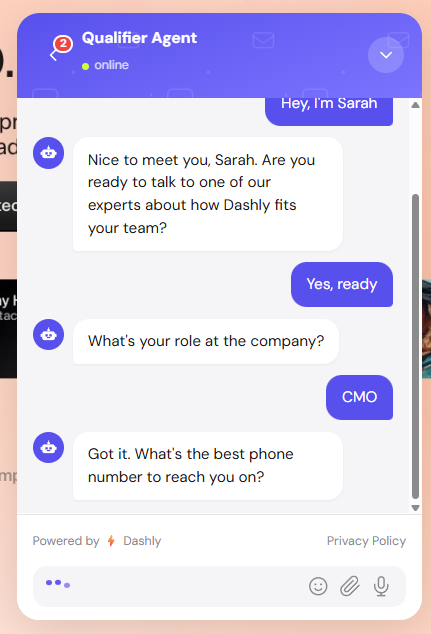
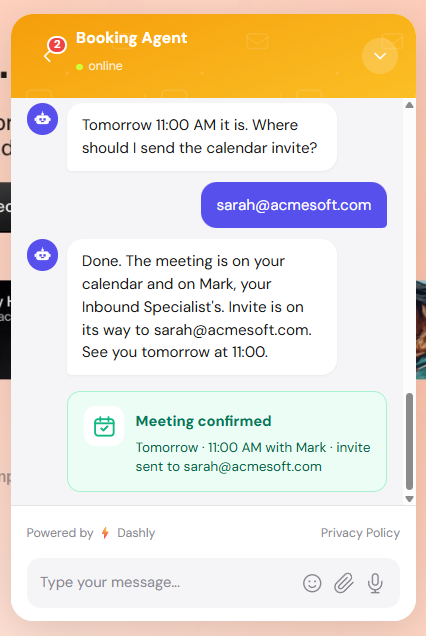
The outcome is a response rate structurally independent of SDR availability. The agent runs at 3am, during holidays, during all-hands. Every inbound lead gets the same sub-90-second response.
Mid-funnel: sales manager handoff and meeting booking
Once a lead clears qualification, the bottleneck shifts from response time to calendar coordination. The agent books the meeting directly into the manager’s calendar, no scheduling back-and-forth, no stale booking links, no lead re-warming required after a 48-hour delay.
What makes the handoff work is the lead profile. Before the SDR steps into the meeting, the system has aggregated what the agent learned during qualification: company size, role, stated use case, behavioral signals. That context surfaces in the CRM before the call. The SDR walks in with a brief on the lead rather than spending the first 10 minutes reconstructing context from form fields.
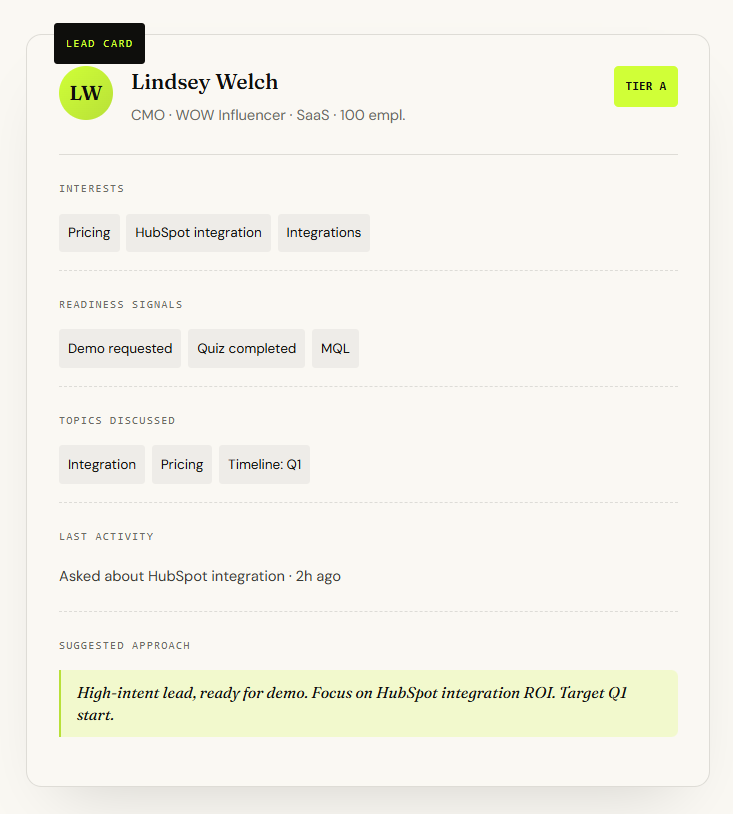
That preparation difference shows up in meeting quality and close rate, not just in scheduling efficiency.
Bottom-of-funnel: lead nurturing and re-engagement
Not every qualified lead converts on the first interaction. Agentic nurturing handles the follow-up work that SDR teams don’t have bandwidth for: timed re-engagement sequences, triggered responses to content consumption signals, re-qualification when a lead returns after going cold.
Dashly’s lead nurturing scenarios cover this layer: automated sequences that adapt based on lead behavior, with human handoff triggered when engagement signals indicate readiness to move forward.

Building the agentic marketing tech stack
An agentic marketing strategy needs four capability layers. Not four separate products, but four capabilities that may be bundled in one platform or spread across several. Evaluate against your Phase 2 use case, not a generic feature checklist.
For teams starting with inbound qualification, the first purchase is the agent platform. Everything else is integration work. Platforms that handle CRM sync without custom engineering will get you from Phase 2 to Phase 4 significantly faster than those that require a dev sprint to connect your lead data.
The agentic marketing pillar has a full breakdown of what’s currently available across these capability categories, including how platforms compare on qualification logic flexibility, integration depth, and setup complexity.
Real examples: agentic marketing strategy in action
The framework produces results. Here’s what that looks like with real numbers.
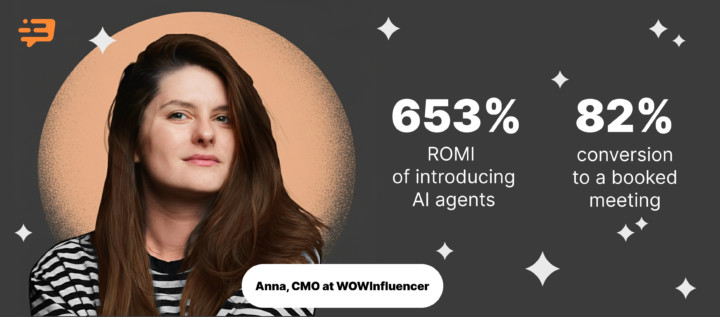
WowInfluencer: 82% conversion rate for booked calls
WowInfluencer deployed Dashly’s AI Inbound Revenue Agent to handle inbound qualification. The result was an 82% conversion rate for booked calls with qualified leads. The agent qualified, routed, and booked without SDR involvement in the first touchpoint.
That number reflects what happens when a Phase 2 use case (first-response qualification) runs against precise ICP criteria, consistently, on every lead. The 82% isn’t a product claim. It’s the output of Phase 1 through Phase 4 executed correctly.
Real estate team: lower cost per meeting, same response quality
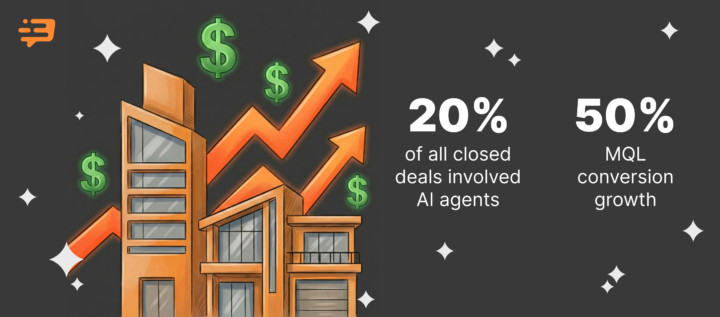
A real estate team using Dashly reduced the cost of each qualified inbound meeting while maintaining response quality. The real estate case study details the setup: agentic qualification running on inbound chat and form submissions, with escalation logic for high-value accounts. As a result, 20% of company deals came via Dashly’s AI agents. Leads are processed instantly, contacts caught with context, so managers get to the call prepared. That’s the operating model shift an agentic marketing strategy actually produces.
B2B SaaS: AI-driven cost reduction without coverage loss
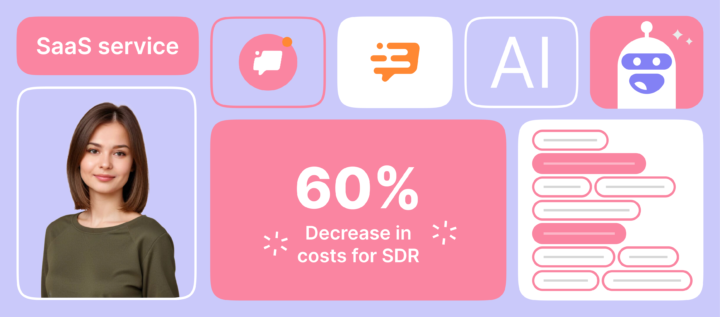
A B2B SaaS team used Dashly to reduce inbound qualification costs without reducing coverage. Details are in the AI cost reduction case study. The core finding: when agentic systems handle the volume work, human capacity concentrates on the high-value interactions where judgment matters.
For more details, check out our full case studies:
For 8 more documented examples across industries, see the agentic marketing examples breakdown.
How to measure agentic marketing performance
Generic marketing KPIs don’t tell you whether your agentic system is working. You need metrics specific to agent performance and funnel impact.
- First-response time. Target under 90 seconds from lead submission to first meaningful reply. This is the agent’s primary output metric. Consistent times above 5 minutes indicate a configuration or integration problem that needs to be diagnosed before scaling.
- Qualification accuracy rate. Of the leads the agent marks as qualified, what percentage actually match ICP when an SDR reviews them? Target 80% or above. Below 70% means ICP criteria need tightening. Above 95% may mean the criteria are too conservative and good leads are being filtered out.
- Pipeline velocity. Days from first inbound touch to opportunity created. Compare the agent-handled cohort to your pre-agent baseline. This is the business impact metric. The others are leading indicators.
- Cost per qualified meeting. Total cost of the inbound qualification workflow divided by meetings booked with qualified leads. This number should decrease over time as configuration improves and false-positive qualification rates drop.
- SDR efficiency ratio. Meetings booked per SDR per week, before and after deployment. If the agent is working correctly, SDRs should be running more meetings with less time spent on qualification work each week.
Track all five weekly for the first 90 days after Phase 4 deployment. That’s the window where configuration changes have the most direct impact on metrics.
Common mistakes when building an agentic marketing strategy
Deploying without defined ICP criteria. The most common failure mode. If the agent can’t apply a consistent ICP scoring rule, every downstream decision compounds the error. Write the criteria explicitly and test them against 50 historical leads before configuring the agent.
Skipping guardrails on outbound communications. An agentic system that sends follow-up messages without a cap or escalation trigger will over-contact leads and damage deliverability. The Phase 4 guardrails aren’t optional. They’re what keep the system from running against your brand reputation.
Measuring generic marketing KPIs. CTR and open rate tell you nothing about whether the agent is working. Track first-response time, qualification accuracy, and pipeline velocity. Those are the metrics tied to actual agent performance.
Automating too many workflows at once. Start with one high-value workflow, get it right, then expand. Teams that run agentic AI across 6 workflows simultaneously end up with 6 mediocre configurations instead of one strong one.
Avoid these mistakes by trusting AI implementation to an experienced team.
Conclusion
Agentic marketing strategy isn’t about adding more AI tools. It’s about building a system where AI agents handle the high-volume, rule-based work in your funnel: qualification, routing, follow-up, meeting booking. Your team focuses where human judgment matters.
The 5-phase framework gives you the structure: audit your funnel first, define 1-2 use cases, select the right stack, deploy with guardrails, and measure against agent-specific KPIs. Most B2B marketing teams are still at the generative AI for content stage. The teams building agentic strategies now will have a 12-month head start on everyone catching up.
Three metrics tell you it’s working: first-response time under 90 seconds, qualification accuracy above 80%, and pipeline velocity that beats your pre-agent baseline.
An agentic marketing strategy is a marketing plan built around autonomous AI agents that execute multi-step workflows including qualification, nurturing, outreach, and meeting booking, without requiring human approval at each step. It differs from AI-assisted marketing in that agents take actions in external systems rather than producing content for humans to review and act on.
AI-assisted marketing improves what humans do: better content, smarter send times, more personalized outreach templates. Agentic marketing changes what humans do: AI agents handle the repetitive, rule-based, high-volume steps autonomously, and human marketers focus on strategy, relationships, and judgment. The funnel structure changes, not just the throughput.
Phase 1: Audit your funnel for automation-ready workflows (high-volume, repetitive, rule-based, speed-sensitive). Phase 2: Define 1-2 agentic use cases by funnel stage. Phase 3: Select your AI agents and tech stack. Phase 4: Deploy with guardrails including escalation logic, audit trail, and message caps. Phase 5: Measure against agent-specific KPIs, iterate, and scale to additional workflows.
Four capability layers: an AI agent platform for conversation and qualification logic, CRM integration for bidirectional lead sync, a calendar tool for direct meeting booking, and analytics for decision logging and outcome tracking. For a current platform comparison, <a href=”/blog/ai-sdr-tools/”>AI SDR tools</a> covers available options with setup and integration details.
Five metrics: first-response time (target under 90 seconds), qualification accuracy rate (target 80% or above), pipeline velocity (days from first touch to opportunity created), cost per qualified meeting, and SDR efficiency ratio (meetings per SDR per week). Track all five weekly for the first 90 days after deployment. That’s the window where configuration improvements have the most direct impact on results.