AI sales assistant: what it is, how it works, and how to choose one in 2026
 13 minutes
 15.07.2026
Most “AI sales assistant” content answers a vendor question: which tool should you buy. Few answer the reader’s actual question first, which is simpler: what is this thing, and is it the same as the AI SDR everyone is also talking about. This guide answers both, then gives you a way to choose.
You will get a working definition, the three types of AI sales assistant on the market today, the features worth paying for, and a checklist for evaluating vendors including the data-privacy questions most buyers forget to ask.
What is an AI sales assistant?
An AI sales assistant is software that uses natural language processing and machine learning to support a human sales rep during calls, meetings, and follow-up, rather than replacing the rep entirely. It listens to conversations, extracts data, drafts follow-ups, and surfaces coaching in real time. The rep still owns the relationship and the close.
That “supports, doesn’t replace” distinction matters because the market uses “assistant” and “agent” almost interchangeably, and they are not the same thing.
An AI sales assistant augments a human rep. An AI agent (like an AI SDR) can run an entire task end to end on its own, qualifying a lead, booking a meeting, or answering a support question with no rep in the loop. Assistants sit inside a rep’s workflow; agents replace a workflow step.
Sales reps and RevOps leaders are the primary users. A rep uses the assistant during a call or between calls. RevOps evaluates and rolls it out across the team, usually inside the CRM the team already runs on.
One more term worth flagging: “virtual sales assistant” often means something different, a remote human contractor hired through a staffing agency to handle prospecting admin, scheduling, and CRM upkeep, not software. If that is what you are looking for, you want a VA staffing service, not an AI platform. Everything on this page is about the software category.
How AI sales assistants work
AI sales assistants work by transcribing calls and messages with natural language processing, extracting structured data (next steps, objections, competitor mentions) from that unstructured text, then pushing it into the CRM and surfacing real-time prompts back to the rep. The mechanism stays the same whether it’s parsing a call, a chat, or an email thread, every customer interaction gets pulled into one structured record. The difference is what each vendor does with the output.
Three things happen under the hood:
- Speech-to-text and NLP convert the raw conversation, call audio, chat transcript, email thread, into structured signal: who said what, which objections came up, what the buyer’s timeline looks like.
- The model classifies that signal against rules a sales manager configured: budget range, competitor names to flag, a specific phrase that should trigger a coaching nudge.
- The assistant acts on the classification. It might auto-fill CRM fields, draft a follow-up email, or push a whisper prompt into the rep’s headset mid-call. That drafting step usually runs on a generative AI model tuned to sales-specific data, the same underlying technology behind tools like ChatGPT, rather than a separate custom-built engine.
None of this requires the rep to do anything differently. That’s the whole point.
Conversation intelligence, the layer that reads sentiment and flags risk across a whole deal, runs on top of the same transcript data. It’s a feature of the assistant, not a separate category.
Types of AI sales assistants
AI sales assistants fall into three types by where they sit in the funnel: inbound lead qualification assistants, real-time call coaching assistants, and CRM copilot assistants that automate admin work. Most vendors specialize in one, even though buyers often assume the category is a single product.
Inbound lead qualification assistants
This type engages website visitors and inbound leads the moment they show intent, asks qualifying questions in a natural back-and-forth instead of a form, and routes only the leads that clear a bar to a rep’s calendar. It’s a direct speed-to-lead play: response time is measured in seconds instead of the hours a rep would otherwise take working through an inbox. It’s also the least covered type in most “AI sales assistant” roundups, which skew heavily toward outbound call tools.
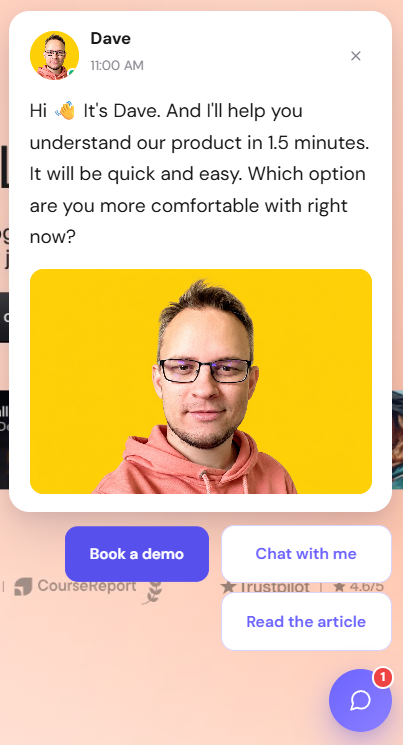
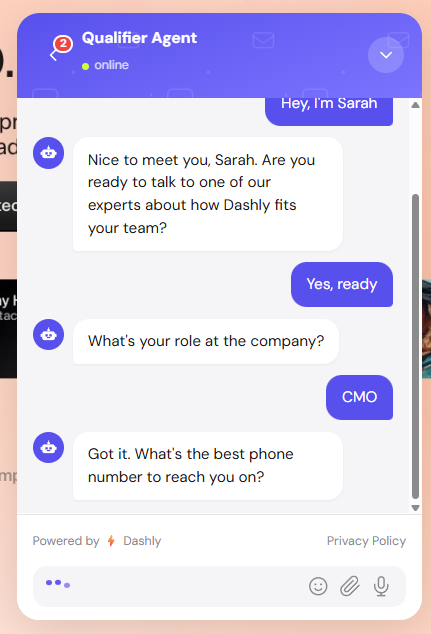
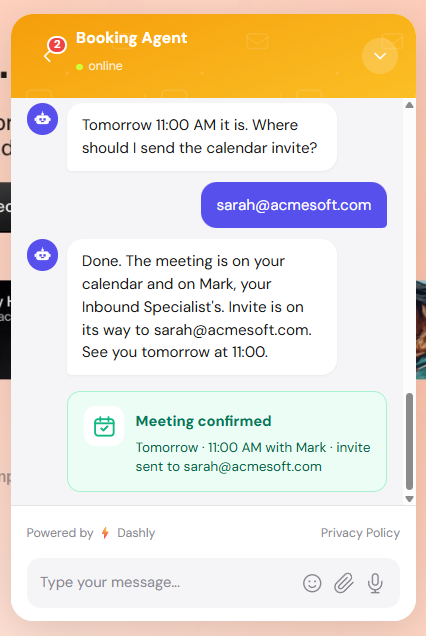
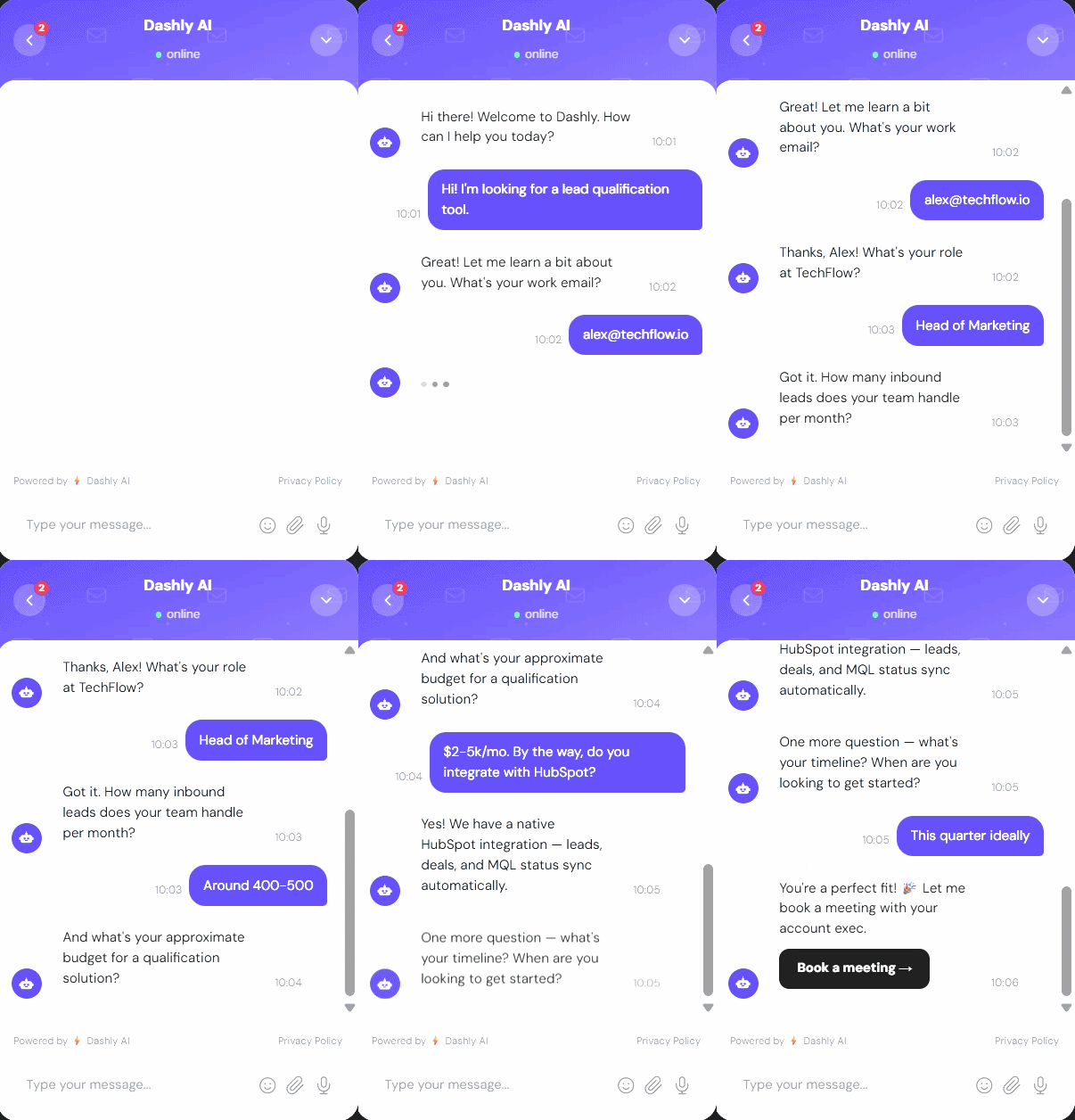
Dashly’s AI Qualifier Agent is a concrete example: once a visitor starts a conversation, it asks budget, timeline, and fit questions, tags the lead as MQL or not against criteria a sales manager sets, and hands qualified leads straight to booking, no manual triage in between. The rep sees a pre-qualified conversation summary before the call starts, not a raw lead record.
Here’s what the workflow looks like:
Step 1: Engagement
Step 2: Qualification
Step 3: Booking
Real-time call coaching assistants
A live-call assistant listens to the call itself and surfaces prompts to the rep in the moment, a competitor mention to address, a pricing objection script, a reminder to ask about timeline. Dialpad and Gong-style tools are the best-known examples. They’re built for outbound and inside-sales teams running a high volume of live calls.
CRM copilot and admin-automation assistants
A CRM copilot reduces the admin load around a call rather than the call itself: auto-generated call notes, auto-filled CRM fields, drafted follow-up emails. The same structured output feeds deal insights and sales forecasting dashboards RevOps already relies on, without a rep manually updating a single field. Pipedrive’s built-in AI features are the clearest example of this pattern, wired directly into a CRM most SMB and mid-market teams already use.
| Type | Sits where | Best for | Example |
|---|---|---|---|
| Inbound qualification | Website chat, inbound forms | Teams drowning in inbound volume, slow to respond | Dashly AI qualifier agent |
| Real-time call coaching | Live outbound/inbound calls | High-volume outbound and inside-sales teams | Dialpad, Gong-style tools |
| CRM copilot | Post-call, inside the CRM | Teams whose reps lose hours to admin work | Pipedrive AI features |
Key features to look for
The features that separate a genuinely useful AI sales assistant from a demo-only product are native CRM write-back, real-time (not batch) processing, transcription accuracy above roughly 90%, and a documented data-retention and access policy. Most vendor pages lead with the AI model; RevOps and sales enablement teams should test these four first instead.
- Native CRM write-back. The assistant should push structured fields, not just a summary paragraph, into HubSpot, Salesforce, or Pipedrive automatically.
- Real-time vs. batch processing. A coaching assistant that surfaces a prompt 10 seconds after the moment has passed isn’t a coaching assistant. Ask for a live demo on an actual call, not a recorded sample.
- Transcription accuracy. Below roughly 90% accuracy, downstream classification (objections, competitor mentions) starts producing noise the rep learns to ignore.
- Data privacy and retention policy. Where is call and CRM data stored, who can access it, and is it used to train the vendor’s model on your data by default.
Vendor comparison sites can help narrow the list before a demo call. A roundup like this best AI sales tools breakdown for B2B teams is a reasonable starting shortlist, though it should be treated as a starting point, not a substitute for testing accuracy and write-back on your own CRM data.
Top use cases
The four use cases where AI sales assistants deliver measurable results are lead qualification and scoring, meeting scheduling and follow-up, call coaching and objection handling, and CRM data-entry automation. Each maps to a different type from the section above.
Lead qualification and scoring
An inbound qualification assistant asks the same questions a rep would ask on a discovery call, but does it the moment a visitor shows intent, at any hour, for every visitor at once.
In Dashly’s Tranio case study, AI agents running this exact scenario brought 69% of all leads in a one-month snapshot and stayed the top source at every funnel stage from first contact through booked call. Visitor-to-MQL conversion rose from 0.06% to 0.09%, a 50% improvement, without adding headcount.
Meeting scheduling and follow-up
Once a lead clears qualification, the assistant books directly into a rep’s calendar and sends a confirmation, cutting the back-and-forth email thread that usually sits between “qualified” and “on the calendar.”
Call coaching and objection handling
A live-call assistant flags a competitor mention or a pricing objection as it happens and surfaces the script a top rep would use, so a new hire performs closer to a tenured rep on their first calls.
CRM data-entry automation
Auto-generated call notes and auto-filled deal fields remove the 15 to 20 minutes of admin work reps typically do after every call, time that otherwise comes out of prospecting.
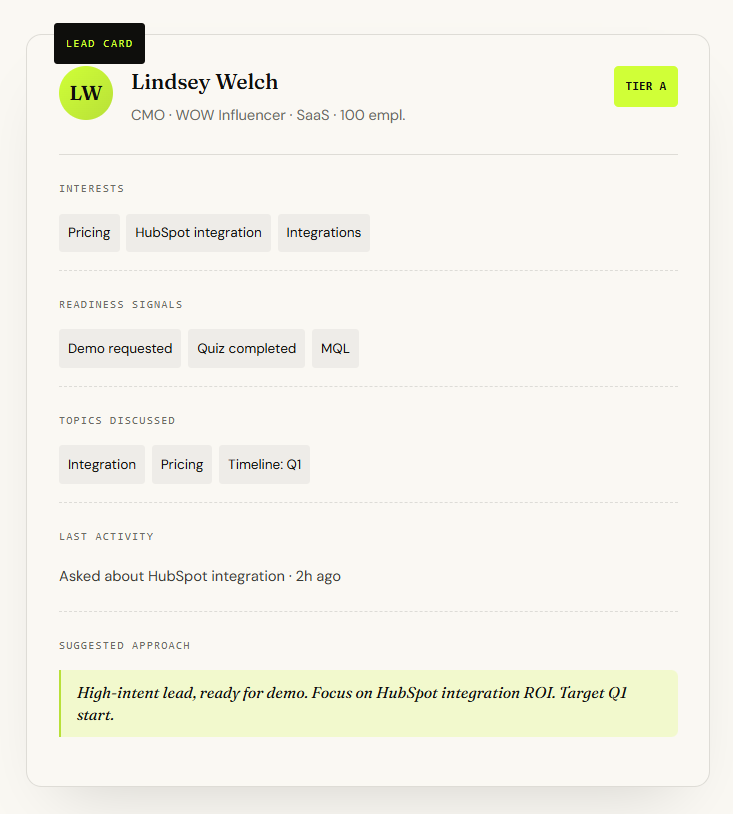
Here’s a lead card in Dashly filled with collected data about a person:
Benefits and ROI
The measurable benefit of an AI sales assistant is time reclaimed from admin work and a faster, more consistent qualification step, both of which show up directly in pipeline conversion rather than in soft productivity claims.
Sales teams that adopt AI are already seeing this at the revenue line, not just the productivity line. Salesforce’s 2024 State of Sales report found that 83% of sales teams using AI saw revenue growth that year, versus 66% of teams without it, and reps on AI-enabled teams were 2.4 times less likely to report feeling overworked (Salesforce, 2024).
The knock-on effects compound further down the funnel. Cleaner, earlier qualification data gives RevOps better pipeline visibility, removes a manual triage step from the sales cycle, and eventually shows up in win rate and quota attainment, though those are lagging indicators worth tracking over a full quarter rather than week one.
Two numbers to ask any vendor for before you buy: what does transcription and classification accuracy look like on a real call from your industry, and what does time-to-value look like for a rep in week one, not month three.
How to choose an AI sales assistant for your team
Choosing an AI sales assistant comes down to matching the type to your actual bottleneck, testing accuracy on your own calls before buying, and getting a straight answer on data retention, not the fastest demo or the longest feature list.
Start with the bottleneck, not the tool. A team missing inbound leads overnight needs a qualification assistant. A team with strong inbound but inconsistent call quality needs coaching. A team buried in CRM admin needs a copilot. Buying the wrong type is the most common mistake, usually because the buyer read a listicle ranked by vendor size rather than by problem fit.
- Which of the three types (qualification, coaching, copilot) matches your actual bottleneck this quarter, not a future one.
- Does the vendor’s transcription and classification accuracy hold up on a real call from your industry, tested live, not on a canned demo.
- What is the vendor’s data-retention policy, and is your call and CRM data used to train their model by default.
- Does it write back natively to the CRM your team already uses, or does it require a middleware integration.
- What does rollout look like in week one for a rep, not the sales engineer running the demo.
If the bottleneck turns out to be the qualification step specifically, the rollout playbook matters as much as the tool choice. A 30-day AI SDR rollout plan covers the sequencing most teams get wrong: turning on every automation at once instead of proving one scenario first.
Whichever type you land on, ask for references from a company similar to yours in size and sales motion before signing. A demo built around a canned scenario looks equally impressive across every vendor; a reference call from someone running the same CRM and deal volume as you won’t.
For teams still building a shortlist, an AI SDR tools directory is a faster way to compare vendors side by side than reading eight separate product pages.
AI sales assistant vs AI SDR: what’s the difference
An AI sales assistant supports a human rep inside an existing workflow, while an AI SDR (or AI sales agent) runs an entire workflow step autonomously, qualifying a lead or booking a meeting with no rep involved until the handoff. The two categories get confused because both show up under “AI for sales” search results.
The test is simple: if removing the AI stops a task from happening at all, it’s an agent. If removing the AI just means a human does that step manually again, it’s an assistant.
A rep using a call-coaching assistant still runs the call. An AI SDR platform runs the entire first-touch qualification conversation itself and only brings in a human once a lead is sales-ready.
This isn’t just semantics. Budgeting for an assistant seat per rep is a different conversation with finance than budgeting for an agent that owns an entire funnel stage, and vendors price the two very differently.
The categories aren’t mutually exclusive inside one team. A company can run an AI sales agent to handle first-touch inbound qualification autonomously, then hand a qualified lead to a rep whose calls are supported by a coaching assistant. Most B2B SaaS teams end up combining both once they’ve solved the initial bottleneck.
Conclusion
An AI sales assistant supports a rep, it doesn’t replace one, and that single distinction should drive most of your buying decision. Match the type (qualification, coaching, or copilot) to your actual bottleneck before comparing vendors on features.
Test transcription and classification accuracy on a real call before signing, and get a straight answer on data retention. If the bottleneck turns out to be inbound qualification specifically rather than live-call support, that’s a different category, the AI SDR or AI agent, worth reading about separately in our AI SDR agent guide.
FAQ
An AI sales assistant is software that uses natural language processing to support a human sales rep during calls and follow-up, transcribing conversations, extracting data, and surfacing coaching in real time. It augments a rep rather than replacing one.
There is no single best option because the three types (inbound qualification, real-time call coaching, CRM copilot) solve different problems. The best choice depends on which bottleneck, missed inbound leads, inconsistent call quality, or CRM admin load, is costing your team the most this quarter.
No. An AI sales assistant supports a human rep inside an existing workflow. An AI SDR (or AI sales agent) runs an entire workflow step autonomously, such as qualifying a lead or booking a meeting, with no rep involved until handoff.
Pricing varies by type and vendor, from per-seat call-coaching add-ons inside an existing CRM to standalone platforms priced on lead or conversation volume. Most vendors require a demo call to quote, since pricing depends on call volume and CRM integration scope.
Most established vendors offer native write-back to HubSpot, Salesforce, or Pipedrive. Confirm the integration writes structured fields automatically rather than just a summary a rep has to copy in manually.
It depends on the vendor’s data-retention and model-training policy, which is why asking directly is a required step, not optional. Confirm where call and CRM data is stored, who can access it, and whether it is used to train the vendor’s model on your data by default.
Native CRM write-back, real-time rather than batch processing, transcription accuracy above roughly 90%, and a clear data-retention policy. Ask about these four before evaluating which AI model the vendor uses.
Indirectly, yes. Cleaner qualification and call data feeds deal insights and forecasting dashboards automatically, giving RevOps better pipeline visibility without a rep manually updating fields. The effect on forecast accuracy usually shows up over a full quarter, not the first week.






![25 growth hacking books [recommended by Dashly growth hackers]](https://www.dashly.io/blog/wp-content/uploads/2023/05/Growth-Hacking-Books-720x317.png)

