Agentic AI vs generative AI: Key differences, use cases, and which to deploy first (2026)
 13 minutes
 11.06.2026
Every AI vendor demo looks roughly the same: a chat window, a quick response, a satisfied customer. The problem is that “quick response” is doing two entirely different jobs depending on which AI architecture is running underneath. One produces output and waits. The other executes a workflow and keeps going.
That distinction, generative AI versus agentic AI, determines whether you are deploying a tool or an agent, whether a human needs to review every step or just set the goal, and whether your “AI initiative” will flatten your content backlog or change the economics of your inbound pipeline.
This article covers both from first principles:
- What each architecture actually does;
- Five structural differences that matter in production;
- How they complement each other;
- Decision framework for which to deploy first in a B2B context.
What is generative AI?
Generative AI is a class of AI models that produce new content, text, images, code, or audio, in response to a prompt. The model takes input, processes it through a neural network trained on large datasets, and generates output. One prompt in, one output out, interaction complete.
The mechanism is a large language model (LLM) predicting the most likely next token given the input and training data. ChatGPT, Claude, Gemini, Midjourney, and GitHub Copilot are all generative AI in practice.
For business applications, generative AI excels at tasks where the value is in the output itself:
- Content creation,
- Summarization,
- Translation,
- Code generation,
- Q&A.
Give it a brief, get a draft. Give it a customer query, get a response suggestion. Give it a codebase, get a refactoring recommendation.
What generative AI cannot do is act on its own output. It does not schedule the meeting it suggested, send the email it drafted, or verify whether the recommended approach actually worked. It produces content and stops.
What is agentic AI?
Agentic AI is a system built on top of a generative AI model that can plan multi-step workflows, use external tools (APIs, databases, calendars, browsers), maintain state across interactions, and execute actions toward a defined goal without step-by-step human instruction.
The key addition is a loop. Agentic systems observe an outcome, decide what to do next, execute, observe again, and continue until the goal is reached or a stopping condition triggers. This plan-act-observe cycle is what separates an agent from a prompt.
A practical example: an agentic AI system handling inbound lead qualification reads a new form submission, checks the CRM for existing records, scores the lead against qualification criteria, routes it to the right SDR, sends a personalized follow-up, and logs the activity. All without a human touching the workflow.
Generative AI is the brain. Agentic AI is the executive function.
Agentic AI vs generative AI: 5 core differences
The distinction comes down to five structural properties that determine how each architecture behaves, where it adds value, and how it fails. Understanding these properties tells you which fits a given workflow before you build anything.
| Property | Generative AI | Agentic AI |
| Autonomy | Responds to a prompt | Pursues a goal across multiple steps |
| Memory | Context window only (temporary) | Persistent memory across sessions |
| Output | Produces content | Executes actions in external systems |
| Human involvement | Required at every step | Set goal and guardrails, then runs autonomously |
| Error recovery | Cannot self-correct | Observes results and adjusts |
1. Autonomy
Generative AI is reactive. It waits for a prompt, produces output, and stops. Agentic AI is proactive: given a goal, it generates its own sub-tasks, executes them in sequence, and reports when done. The difference is who drives the workflow.
2. Memory
Generative AI operates within a context window, typically 8k to 128k tokens, that resets between sessions. Agentic AI maintains persistent memory. It remembers that it already contacted this lead, that this customer complaint is still open, or that this campaign ran last quarter. That memory makes multi-session workflows possible.
3. Output type
This is the most critical difference for business applications. Generative AI produces text. Agentic AI takes actions. It calls an API, updates a CRM record, sends a message, triggers a workflow, or books a calendar slot. The output is not a document but a change in an external system.
4. Human involvement
Generative AI requires a human at every turn to direct the next step. Agentic AI requires a human to set the goal and define the guardrails, then runs autonomously. For high-volume repetitive tasks, this is the difference between a tool and an agent.
5. Error recovery
Generative AI has no feedback loop. If its output is wrong, a human must notice and re-prompt. Agentic AI observes its own outputs, detects when something did not work, and retries or escalates based on configured logic.
How generative AI and agentic AI work together
Generative AI and agentic AI are not competing architectures. Every production agentic system runs a generative AI model at its core. The generative model handles natural language understanding, reasoning, and content generation. The agentic layer adds planning, tool orchestration, memory, and execution.
Think of it as a two-layer system:
- The LLM interprets the goal, reads the customer’s intent, drafts the message, and decides what action to take next.
- The agent framework executes that decision: calls the API, updates the database, triggers the next workflow step.
A concrete example: Dashly AI inbound revenue agents uses a large language model to read a visitor’s chat message and determine qualification intent. The agentic layer then retrieves the visitor’s session history, scores the lead against ICP criteria, routes to the correct SDR, and sends a personalized follow-up.
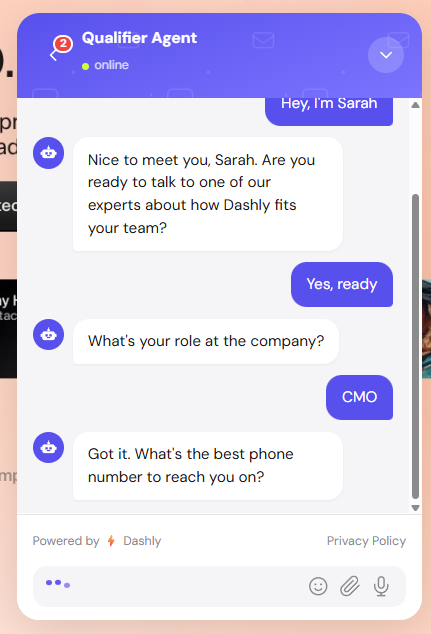
Here’s an AI agent powered by LLM has a conversation with a user:

Neither layer alone completes the task. The generative model without the agentic layer produces a draft response. The agentic layer without the generative model has no way to interpret unstructured input.
Use cases: When to use generative AI, when to use agentic AI
The right choice depends on whether the task requires output or action, and whether human review at each step is a feature or a bottleneck.
When generative AI is the right choice
Generative AI fits tasks where the value is in the output and a human will review or act on that output before it reaches a customer or external system.
Strong use cases:
- Content creation at scale (product descriptions, blog drafts, ad copy variants),
- Code completion and review,
- Document summarization,
- Knowledge base answers for internal teams,
- Customer support response suggestions that agents approve before sending.
Any one-shot task where context resets between interactions and no downstream system action is required is a generative AI fit.
The failure mode to avoid: using generative AI for high-volume, time-sensitive customer interactions where human review at every step creates the delay that costs conversions.
When agentic AI is the right choice
Agentic AI fits tasks that are high-volume, repetitive, multi-step, and where speed to the next action matters more than human approval at each step.
Strong use cases:
- Inbound lead qualification (responding within seconds, scoring, routing),
- Customer journey orchestration (triggered follow-up sequences, proactive re-engagement at risk signals),
- Meeting scheduling,
- Support ticket triage and deflection,
- Campaign optimization loops that run on performance signals.
The WowInfluencer case study illustrates the outcome: Dashly’s AI agent achieved an 82% conversion rate for booked calls with qualified leads. That result requires speed and persistence across multiple touchpoints, not a single generated response.
Industry examples
Financial services teams use agentic AI for KYC document intake, fraud alert triage, and loan inquiry qualification. Generative AI handles the compliance-reviewed client communication drafts.
E-commerce companies deploy agentic AI for cart abandonment re-engagement sequences and post-purchase upsell triggers, while generative AI writes the personalized product recommendations those sequences deliver.
Healthcare uses agentic AI for appointment scheduling and triage routing; generative AI drafts the patient communications.
Agentic AI vs generative AI in B2B marketing and inbound sales
Generative AI makes B2B marketing content faster and more personalized.
Agentic AI changes the funnel’s operating model entirely, replacing the manual handoff between lead capture and SDR engagement with an automated, sub-second qualification and routing workflow.
The difference is not a matter of efficiency. It is a different picture of what the inbound process looks like.
With generative AI, a marketing team writes better copy faster. An SDR gets smarter outreach templates. A content team produces three times more articles per quarter. These are real productivity gains. But the funnel structure stays the same: lead arrives, sits in queue, waits for human qualification, gets routed.
With agentic AI, the funnel structure changes. Every form submission, chat message, and callback request gets an immediate, qualified response based on your ICP criteria, before the SDR opens their laptop. The lead gets routed, the follow-up goes out, and the calendar slot gets offered, all within the first two minutes of expressing intent.
That speed differential compounds. See agentic AI marketing examples for documented outcomes across industries. For the strategy layer, agentic marketing covers how deployment changes the team’s operating model.
Which should your team deploy first?
The answer depends on three variables: goal clarity, data readiness, and risk tolerance. Work through these in order before committing budget or engineering time.
Step 1: Goal clarity. Can you describe the target workflow in procedural terms? “Respond to every inbound form submission within 90 seconds, qualify against these five ICP criteria, route to the right SDR tier, send a follow-up if no reply within 4 hours.” If yes, agentic AI fits. If the goal is “help our team produce better content,” generative AI fits first.
Step 2: Data readiness. Agentic AI needs structured inputs and defined outputs: a CRM schema, a qualification rubric, a routing table. Generative AI needs a good system prompt and sample outputs. If your CRM data is inconsistent and your qualification criteria exist only as tribal knowledge, start with generative AI to improve content quality and formalize your criteria. Then move to agentic.
Step 3: Risk tolerance. Agentic AI takes actions on your behalf. A misconfigured agent can send the wrong message to a thousand leads before anyone notices. Generative AI produces a draft that a human approves. For regulated industries or high-stakes customer touchpoints, deploy agentic AI only when your guardrails, escalation logic, and audit trails are in place.
A practical sequence for B2B SaaS:
- GenAI first: content, sales enablement copy, and internal knowledge retrieval, tasks where human review is part of the workflow anyway.
- Agentic AI second: first-response and qualification for inbound leads, where the criteria are clear and the volume makes manual handling the bottleneck.
For teams evaluating agentic AI in marketing, inbound qualification and routing is almost always the right starting point. For a breakdown of the tooling market, AI SDR tools covers what is available and what to evaluate.
What can go wrong: risks specific to each type
Both architectures carry distinct failure modes that do not cancel each other out. Generative AI fails with confident-sounding wrong outputs. Agentic AI fails by executing the wrong workflow correctly, at scale, before anyone notices. Knowing the failure modes before deployment is not optional, it is the difference between a controlled rollout and a support incident.
Generative AI risks
Hallucination. Large language models produce plausible-sounding content that can be factually wrong. In a customer-facing context, this is brand and legal risk. Mitigation: human review on outputs before they reach customers, retrieval-augmented generation (RAG) for factual queries against proprietary data.
Brand voice drift. Generative AI defaults to polished, generic prose. Without a strong system prompt and editorial standards, outputs flatten your brand into something indistinguishable from every other AI-generated page.
Copyright and compliance exposure. For regulated industries, LLM-generated content touching customer data requires review against GDPR, HIPAA, and sector-specific requirements. Model training data provenance remains a legal grey area.
Agentic AI risks
Compounding errors. Agentic systems chain steps. A wrong classification in step 1 becomes a wrong action in step 2, a wrong message in step 3, and a confused customer in step 4, before any human sees what happened. Mitigation: human-in-the-loop checkpoints on high-stakes steps, especially outbound communications.
Scope creep. Production agentic systems have access to tools and APIs. A misconfigured permission set lets an agent read data it should not, modify records outside its intended scope, or trigger downstream workflows that are hard to reverse.
Governance and auditability. When an agentic system makes a hundred decisions per hour, “who decided what” becomes a compliance question. Audit logs, decision trails, and escalation rules are not optional for enterprise deployments.
How Dashly’s AI Inbound Revenue Agent works
Dashly’s AI inbound revenue agents are an agentic AI system built on a large language model, designed to handle qualification, routing, follow-up, and scheduling autonomously at the top of the B2B inbound funnel. The generative model reads and interprets unstructured visitor messages. The agentic layer executes: scores the lead, routes to the right SDR, sends the follow-up, books the meeting.
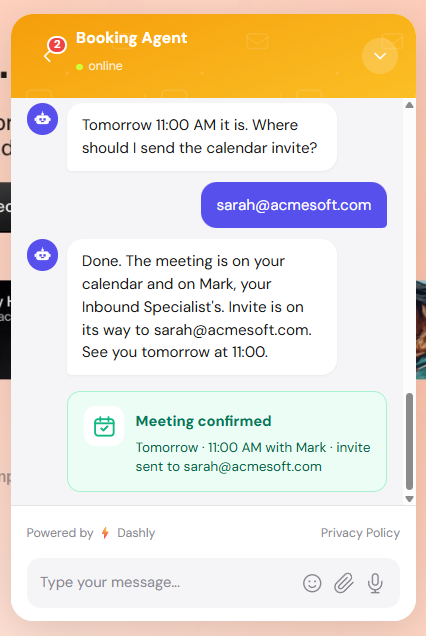
Here are steps Dashly AI agents take on:
Step 1: Engagement
Step 2: Qualification
Step 3: Booking

In practice, it has:
- Delivered an 82% conversion rate for booked calls with qualified leads (WowInfluencer case study),
- Reduced the cost per inbound meeting for a real estate team while maintaining response quality (real estate case study),
- Helped B2B teams cut customer support costs without reducing coverage (AI cost reduction case study).
Every inbound lead gets a response within seconds. Every qualified lead gets routed before your SDR opens their inbox.
Conclusion
Generative AI produces content when you ask for it. Agentic AI executes workflows toward a goal. They are not competing choices: every production agentic system runs a generative model at its core, and most effective AI stacks use both.
For B2B teams, the deployment sequence matters more than the architecture debate. Start with generative AI where human review is already part of the workflow. Move to agentic AI when you have clear qualification criteria and a high-volume process where speed compounds into pipeline. The architecture is not the point. What it does to your conversion rate is.
Generative AI produces new content (text, code, images) in response to a prompt and stops. Agentic AI pursues a goal across multiple steps, using tools, persistent memory, and external system access to take actions without human input at each step. Every production agentic system runs a generative model at its core, but adds planning and execution on top.
Yes, and in production systems they always do. The generative model handles natural language understanding, reasoning, and content generation. The agentic layer adds persistent memory, tool use, multi-step planning, and execution. A generative model alone produces output. The agentic layer turns that output into action in an external system.
Start with generative AI for tasks where human review is already part of the workflow: content creation, code review, internal Q&A. Move to agentic AI once your qualification criteria are defined and you have a high-volume, repetitive process where manual handling is the bottleneck. Agentic AI without structured inputs and clear criteria produces compounding errors, not automation.
Predictive AI uses historical data to forecast outcomes (churn probability, lead score, demand) without generating content or taking autonomous action. Generative AI creates new content. Agentic AI executes multi-step workflows. In a complete B2B stack, predictive AI feeds signals into agentic workflows (“this lead has a 78% close probability, prioritize now”) that the generative model communicates and the agentic layer routes and acts on.
A marketing team using generative AI asks it to draft five email subject line variants, reviews them, and picks one. A team using agentic AI deploys a system that runs the A/B test, monitors open rates in real time, shifts send volume to the winning variant, and delivers a performance summary by end of day. For more on <a href=”/blog/agentic-ai-in-marketing/”>agentic AI in marketing</a> and how it changes the team’s operating model, see the full breakdown.



![4 steps as Chief Marketing Officer at a new company [Expert guide]](https://www.dashly.io/blog/wp-content/uploads/2022/10/4-steps-as-Chief-Marketing-Officer-at-a-new-company-Expert-guide-720x317.jpg)

![21 proven tools for your 2025 marketing tech stack [Recommended by market experts]](https://www.dashly.io/blog/wp-content/uploads/2022/08/martech-stack-999-720x317.png)