Lead generation funnel: how to build one that converts in 2026
 13 minutes
 14.08.2026
Most B2B websites lose qualified buyers before a human ever sees their name. A visitor checks pricing, reads a case study, then leaves without filling out a form. A lead generation funnel is the system that is supposed to catch that visitor, qualify them, and hand them to sales with enough context to close.
Most funnels leak at exactly that handoff.
This guide covers what a lead generation funnel actually is, how it differs from a sales funnel and a pipeline, the three stages every funnel runs through, and a five-step process for building one that converts instead of just collecting names. You’ll also see real conversion benchmarks by stage, the mistakes that quietly cap funnel performance, and how AI agents are changing what counts as “fast enough” for lead response in 2026.
What is a lead generation funnel?
A lead generation funnel is the structured path that turns an anonymous website visitor into a sales-ready lead, moving them through awareness, capture, and qualification before a rep gets involved. It combines content, a capture layer such as forms or chat, and scoring rules that filter out unqualified traffic.
The one thing to remember: this only earns the name “funnel” once capture, qualification, and handoff work as a single system. Bolt them together from three disconnected tools and leads fall through the seams between them.
A lead generation funnel differs from a sales funnel or a pipeline, even though the three terms get used interchangeably. Some teams just call it a lead funnel. It covers only the first half of the buyer’s journey and stops the moment a lead is confirmed qualified, not once a deal closes.
Lead generation funnel vs. sales funnel vs. pipeline
A lead generation funnel captures and qualifies leads. A sales funnel tracks the entire buyer journey from first touch to closed deal. Inside a CRM, a pipeline is simply the operational view of open deals, organized by stage and dollar value. They overlap, but each one answers a different question for a different owner. Get the vocabulary wrong internally and your sales process metrics stop lining up with what marketing reports.
Marketing typically owns the lead generation funnel. Sales owns the pipeline. The sales funnel sits across both and is usually what leadership reviews when forecasting revenue. Confusing the three is harmless in conversation, but costly once it shows up in how you measure success, because “funnel conversion rate” means something different depending on which funnel you mean.
| Term | What it tracks | Owned by | Ends when |
|---|---|---|---|
| Lead generation funnel | Anonymous visitor to qualified lead | Marketing | Lead is marked sales-qualified |
| Sales funnel | First touch to closed deal | Marketing and sales | Deal is won or lost |
| Pipeline | Open deals in progress | Sales | Deal moves to closed-won or closed-lost |
For a full breakdown of how these get confused in practice, see sales funnel vs. pipeline.
The 3 stages of a lead generation funnel
Every lead generation funnel runs through three stages: top of funnel (TOFU), where strangers become aware of a problem; middle of funnel (MOFU), where they evaluate options and get qualified; and bottom of funnel (BOFU), where a qualified lead is handed to sales for a decision. Each stage needs a different tactic, not the same content repeated three times.
Top of funnel (TOFU): awareness and capture
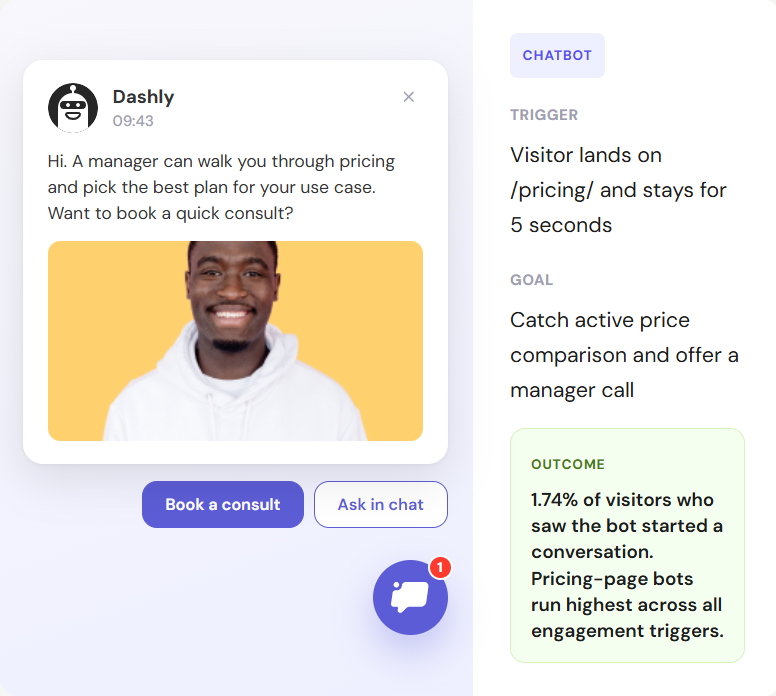
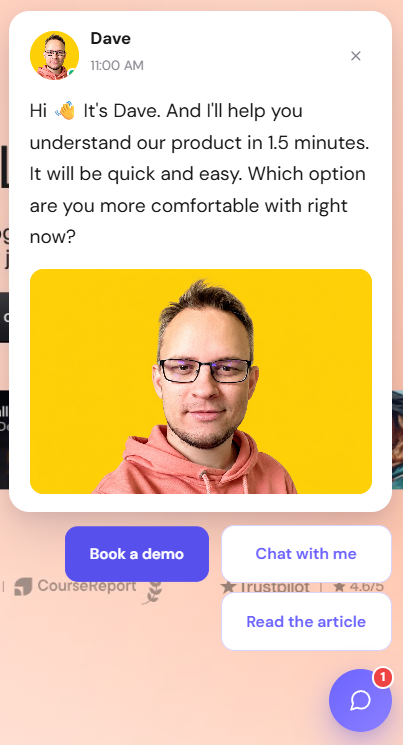
TOFU is where a stranger first learns your product category exists. Content marketing built around a specific pain point, comparison pages, and paid social do the awareness work better than generic thought leadership. The part most B2B sites get wrong is capture: static forms only catch visitors who are already convinced enough to type in their email. A proactive chat prompt on a pricing or comparison page catches everyone else, the visitors who have a question but won’t fill out a form to ask it.
Here’s an example of an engaging message based on user behavior:
Middle of funnel (MOFU): qualification and nurture
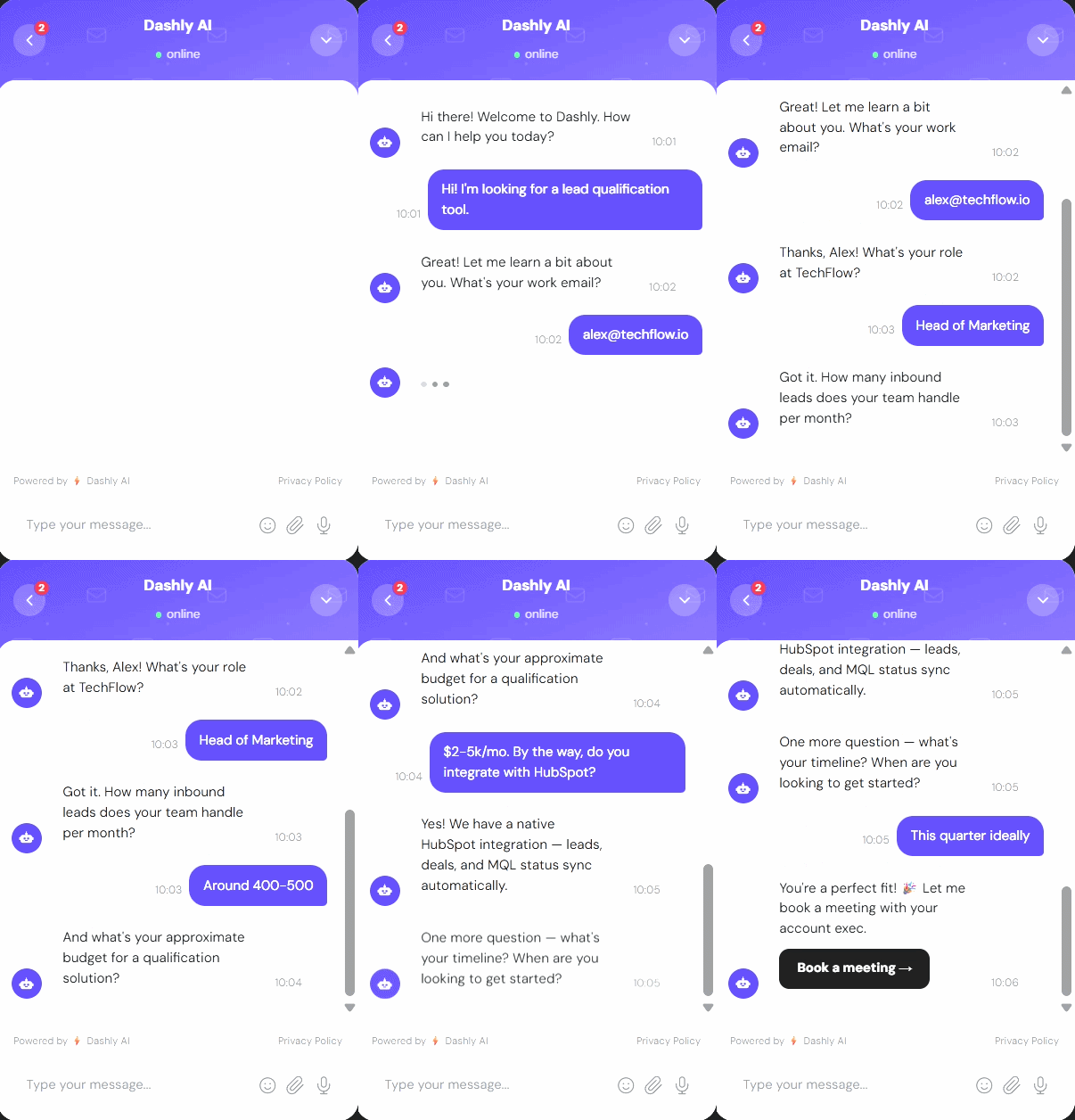
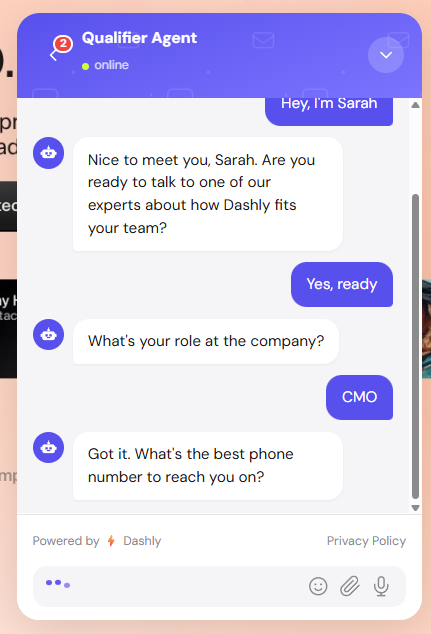
MOFU is where a captured lead either turns into pipeline or quietly disappears. Manually triaging every inbound lead does not scale past a handful of conversations a day, and it’s the reason most SDR teams are perpetually behind. An AI qualifier agent handles this instead, asking the same qualifying questions a human SDR would (budget, timeline, use case, company size) directly in chat or email, then scoring the lead before a rep ever looks at it.
Case studies and product demos do more work here than another blog post. A lead comparing options wants proof a similar company got results, not more theory.
Bottom of funnel (BOFU): conversion and handoff
BOFU is the handoff itself: a qualified lead moves from marketing’s system into a rep’s calendar or CRM record. This is where funnels lose the most value silently, because a lead sitting in a queue for hours has already cooled off. The stage should end in a booked meeting or a direct conversation, not another form.
How to build a lead generation funnel: 5 steps
Building one means sequencing five decisions in order: define your ICP, build a capture layer that isn’t just static forms, automate qualification, nurture leads who aren’t ready yet, and hand off to sales with full context. Skip a step and the funnel leaks somewhere in the middle.
1. Define your ICP and target keywords
Start with your target audience, not what content to publish. A tight ideal customer profile (company size, industry, buying trigger) tells you which potential customers are worth targeting and which traffic to ignore even if it converts. See lead generation strategies for how to translate an ICP into a channel mix.
2. Build the capture layer
Landing pages, lead magnets, and gated content still work, but they only catch visitors who are ready to trade an email for information. Pair static forms with a conversational capture option, live chat or a proactive trigger, so visitors with a specific question can ask it instead of bouncing.
3. Automate lead qualification and scoring
Define what “qualified” means in specific, checkable terms before a single lead comes in: company size range, role, stated budget, timeline. Then let AI-based scoring, like the qualification approach described above, apply those rules consistently to every lead instead of leaving it to whichever rep happens to pick up the conversation first.
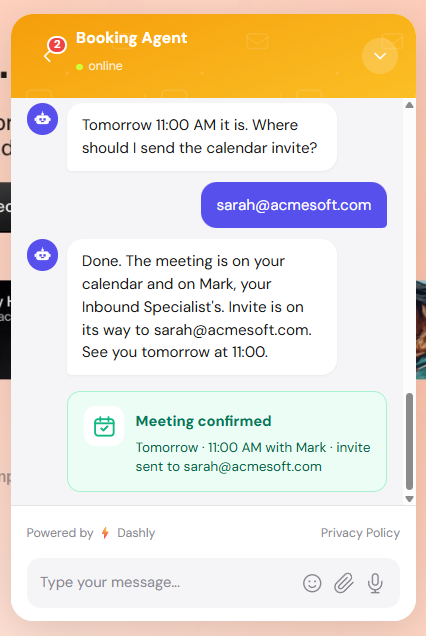
Here’s how Dashly’s AI agent handles qualification and meeting booking autonomously 👇
Step 1: Engagement
Step 2: Qualification
Step 3: Booking
4. Nurture with multi-channel sequences
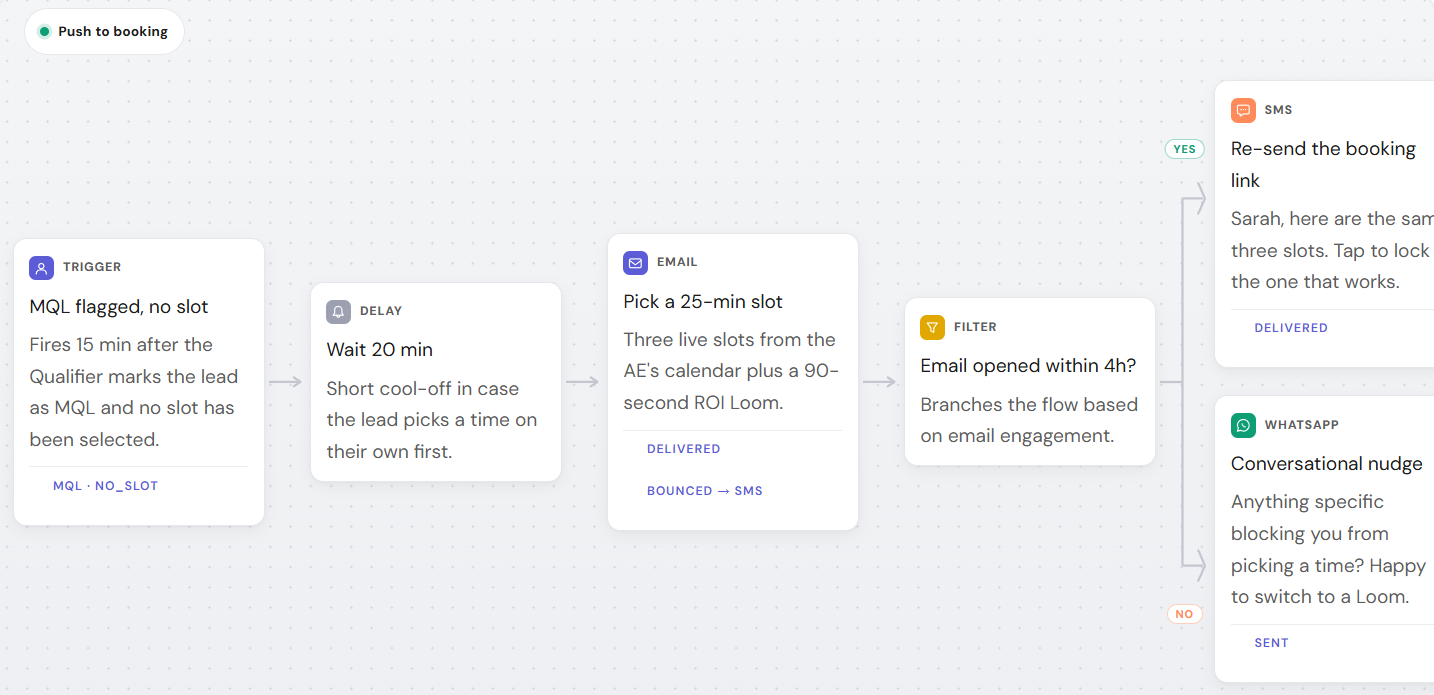
Not every qualified lead is ready to talk to sales immediately. Email marketing, in-app messages, and WhatsApp follow-ups build trust and keep the conversation warm until timing improves, without demanding a rep’s time on every touch.
Here’s an example of an AI nurturing flow for booking a meeting:
5. Hand off qualified leads to sales with full context
The handoff should carry the whole conversation history, not just a name and an email address. A unified lead profile that captures every touchpoint means a rep opens the first call already knowing what the lead asked, instead of repeating the qualification questions from scratch.
A mid-market B2B SaaS company selling to marketing teams, for example, might run comparison-page SEO for TOFU, an AI agent on the pricing page for MOFU qualification, and route anyone with a stated budget straight to a rep’s calendar for BOFU. None of that requires new headcount, just sequencing the five steps above correctly.
Lead generation funnel benchmarks and metrics that matter
The four benchmarks worth tracking are lead-to-MQL rate, MQL-to-SQL rate, cost per lead, and how fast your team responds to a new lead, because response speed changes the other three more than almost any other variable. Most teams only measure volume, which hides exactly where a funnel is actually leaking.
Across B2B SaaS, the average MQL-to-SQL conversion rate is 13%, according to First Page Sage’s 2019-2025 benchmark data. If your funnel sits meaningfully below that, the problem is usually qualification criteria that are too loose, not a lack of traffic.
Tightening the definition of “qualified” before adding another campaign fixes more funnels than another landing page ever will. It also makes cost per lead a more honest number, since a cheap lead that never converts was never actually cheap.
Response speed is the other lever, and it moves the number further than most teams expect. A 2026 benchmark of 939 B2B companies found leads contacted within five minutes closed at 32%, compared with 12% for leads contacted after 24 hours or more, a 2.6x gap driven entirely by timing (Optifai, 2026).
None of this works without attribution across the whole path. If a lead’s chat conversation, email opens, and pricing-page visits sit in three different tools, you can’t tell which stage is actually leaking. A unified view of the same lead across every channel is what makes stage-by-stage benchmarking possible in the first place, instead of a guess.
How AI is changing the lead generation funnel in 2026
AI agents collapse the time between a visitor showing intent and a rep getting a qualified conversation, which is the single biggest lever in the benchmarks above. Instead of a lead sitting in a queue until an SDR has capacity, an agent responds, asks the qualifying questions, and scores the lead in the same conversation.
That shift also changes what “automated” means for lead generation. Older automation ran on if-this-then-that rules and static drip sequences; see automated lead generation for how that model has evolved. An AI agent instead holds a real conversation, adjusts its questions based on what the visitor says, and only escalates to a human when the lead is actually ready.
It also means funnel activity doesn’t stop at 5 p.m. A visitor researching at midnight gets the same qualifying conversation as one at 10 a.m., which matters more than it sounds once you consider how much B2B research now happens outside standard business hours.
This is also where the handoff problem from BOFU gets solved structurally rather than through better process documentation. An AI SDR that already qualified the lead in chat can route it to the right rep with full context attached, instead of a human SDR re-asking questions the visitor answered an hour earlier.
Common lead generation funnel mistakes
The most common mistakes here are treating the funnel as a straight line, chasing lead volume over quality, reusing one offer at every stage, and leaving no clear line between marketing-qualified and sales-qualified. Each one caps conversion no matter how much top-of-funnel traffic comes in.
- Treating the funnel as a straight line. Real buyers loop back to research after a demo, drop off, and return weeks later. A funnel built only for a linear path misses them on re-entry.
- Optimizing for lead volume instead of quality. More top-of-funnel traffic without tighter qualification just moves the bottleneck downstream to sales.
- Using the same offer at every stage. A visitor who just discovered the category and one about to sign a contract need different content, not the same ebook.
- No clear line between MQL and SQL. If marketing and sales define “qualified” differently, both sides think the funnel is broken when the real issue is a mismatched handoff bar.
- No attribution across touchpoints. Without a single view of a lead across chat, email, and paid, it’s impossible to tell whether TOFU, MOFU, or BOFU is where conversion actually breaks down.
The biggest mistake in most lead generation funnels is the slow, manual handoff between marketing-qualified and sales-qualified, exactly where a warm lead has time to go cold.
Fixing the handoff usually does more for conversion than adding another traffic source. For more on where funnels stall operationally, see lead funnel management.
Conclusion
A lead generation funnel only works when its three stages connect: capture at the top, real qualification in the middle, and a fast, context-rich handoff at the bottom. Most of the conversion you’re leaving on the table comes down to speed and qualification, not traffic, and the benchmarks above show exactly how much that costs.
Start by fixing the handoff before you add another channel. It’s usually the cheapest fix with the biggest visible impact on how many qualified leads actually turn into meetings. For the full set of metrics to track by stage, see sales funnel metrics.
Frequently asked questions
A lead generation funnel is the system that turns anonymous website visitors into sales-ready leads through three stages: awareness and capture, qualification and nurture, and handoff to sales. It combines content, a capture layer, and scoring rules into one repeatable process.
A lead generation funnel ends once a lead is confirmed qualified. A sales funnel continues through the rest of the buyer’s journey, from that qualified lead all the way to a closed deal, and is usually shared between marketing and sales.
Most lead generation funnels have three stages: top of funnel (awareness and capture), middle of funnel (qualification and nurture), and bottom of funnel (conversion and handoff to sales). Each stage needs its own content and tactics rather than one message repeated three times.
Building a lead generation funnel means defining your ICP, building a capture layer beyond static forms, automating lead qualification, nurturing leads who aren’t ready yet, and handing off qualified leads to sales with full conversation context attached.
Across B2B SaaS, the average MQL-to-SQL conversion rate is 13%, according to First Page Sage’s benchmark data. Funnels with tighter qualification criteria and faster lead response, under five minutes, tend to convert well above that average.
AI agents cut the time between a visitor showing interest and a qualified conversation from hours to minutes. They ask qualifying questions directly in chat, score leads automatically, and hand off to sales with the full conversation attached instead of a bare contact form.
Yes. LinkedIn works well for top-of-funnel awareness and for warming up a specific ICP through content and outreach, but it still needs a capture and qualification layer on your website or landing page to turn that attention into a scored, sales-ready lead.
Lead generation captures and qualifies a new contact. Lead nurturing is what happens after: keeping a qualified-but-not-ready lead engaged through email, in-app messages, or WhatsApp until they’re ready to talk to sales.
Case studies and product demos build trust faster than generic content, because a prospect comparing options wants proof a similar company got results, not more theory.




![Inbound marketing funnel: Stages, strategy & how to build one [2026]](https://www.dashly.io/blog/wp-content/uploads/2025/03/building-your-inbound-marketing-funnel-a-caring-step-by-step-guide-3-720x405.jpg)
![9 steps to master the growth hacking canvas strategy for your business [free template]](https://www.dashly.io/blog/wp-content/uploads/2023/05/Growth-hacking-canvas-free-templates-720x317.png)

