Inbound lead generation services: 10 best tools for B2B [2026]
 21 minutes
 15.05.2026
![Inbound lead generation services: 10 best tools for B2B [2026]](https://www.dashly.io/blog/wp-content/uploads/2026/05/lead-generation-services-cover-1440x634.jpg)
Inbound lead generation services help B2B companies capture, qualify, and route website visitors who already show buying intent. They range from AI-powered chat agents and lead routing tools to full-service agencies that run your entire inbound funnel.
Your website generates qualified traffic every day. Visitors read your content, check your pricing, and compare your product against alternatives. Some fill out a demo request form. Most don’t.
And the ones who do fill out that form? Research published in the Harvard Business Review found that companies responding within one hour are seven times more likely to qualify the lead than those responding later. Wait 24 hours, and conversion probability drops near zero.
Inbound B2B lead generation services close that gap. Some capture leads the moment they show intent. Some build the organic pipeline that keeps bringing qualified visitors. Some route a form submission to the right rep and get a meeting on the calendar before the lead closes the browser tab.
This guide compares 10 inbound lead generation services built for B2B SaaS. For each one: what it does, who it’s designed for, current pricing, and verified G2 ratings. Plus a quick comparison table and a five-question framework for picking the right fit.
What are inbound lead generation services?
Inbound lead generation services are tools, platforms, or agencies that help you attract and convert leads who have already shown interest. They work with traffic you’ve already earned: visitors who arrived through search, content, referrals, or direct intent.
Inbound lead generation is a pull model. The buyer moves toward you by reading your blog, checking your pricing page, or starting a live chat. Your service’s job is to catch that signal and convert it into a qualified lead or a booked meeting.
That’s the direct contrast to outbound: a push model where your team initiates contact through cold calls, email prospecting, or paid ads reaching people who weren’t searching for you. Both have a place in B2B pipeline strategy. Inbound just costs less and converts better at scale.
Inbound leads cost 61% less to acquire than outbound leads, according to HubSpot’s State of Marketing research. They also arrive with context: they’ve evaluated competitors, read your content, and often made most of the decision before reaching out.
There are four categories of inbound lead generation services worth understanding before you choose:
- AI qualification tools — capture and qualify leads in real time, directly on your site. No 24-hour form lag. No leads going cold while waiting for SDR follow-up.
- SEO and content marketing platforms — build the organic pipeline. Every well-ranked post pulls in visitors who are actively searching for solutions like yours, around the clock.
- Email marketing and nurturing tools — work the leads you’ve already captured. Behavior-triggered sequences move subscribers from interest to buying intent over days or weeks.
- Lead routing and scheduling tools — eliminate the delay between a lead showing intent and a rep making contact. Speed often determines whether you win or lose the deal.
Most B2B teams need more than one category. The rest of this guide helps you figure out which combination fits your channel mix, team structure, and budget.
Types of inbound lead generation services
Not all inbound lead generation services do the same thing. Before comparing tools, it helps to know which category solves your specific bottleneck. See the inbound marketing funnel guide for context on how these fit together.
- AI agents and chat tools (Dashly, Qualified, Drift) — qualify and route leads in real time on your website. Best for SaaS teams with high traffic and short sales cycles.
- SEO and content platforms (Semrush, HubSpot Marketing Hub) — build organic inbound traffic through search rankings. Best for teams with a 3-6 month growth horizon.
- Email and nurture tools (ActiveCampaign) — convert trial users and subscribers into paying customers. Best for products with freemium or trial-led growth.
- Landing page builders (Leadpages) — capture leads through high-converting offer pages. Best for teams running paid traffic or webinar campaigns.
- Intent data and enrichment (Clearbit/Clay, Warmly) — identify anonymous visitors and score them by buying signals. Best for RevOps and sales-led growth teams.
- Lead gen agencies (Callbox, Belkins) — full-cycle inbound: strategy, content, and lead delivery. Best for companies without an in-house marketing team.
Quick comparison: 10 best inbound lead generation services
| Tool | Best for | Category | Starting price | G2 rating |
|---|---|---|---|---|
| Dashly | AI inbound revenue agents (engage, qualify, book) | AI Agents / Conversational | Contact for pricing | 4.7/5 |
| HubSpot | All-in-one inbound marketing | CRM + Marketing Hub | $15/mo | 4.4/5 |
| Qualified | AI pipeline cloud for Salesforce teams | AI qualification / Conversational | Custom | 4.9/5 |
| Drift | Enterprise ABM + chat | Conversational marketing | Custom | 4.4/5 |
| Semrush | SEO & content marketing | SEO platform | $117/mo | 4.5/5 |
| ActiveCampaign | Email automation & nurturing | Email marketing | $15/mo | 4.5/5 |
| Leadpages | Landing pages & lead capture | Conversion optimization | $37/mo | 4.3/5 |
| Chili Piper | Lead routing & scheduling | Speed-to-lead | $30/seat/mo | 4.6/5 |
| Clearbit / Clay | Intent data & enrichment | Data enrichment | Custom / $149/mo | 4.4/5 |
| Warmly | Signal-based anonymous visitor pipeline | Intent data / Pipeline | From $700/mo | 4.8/5 |
1. Dashly — AI inbound revenue agents
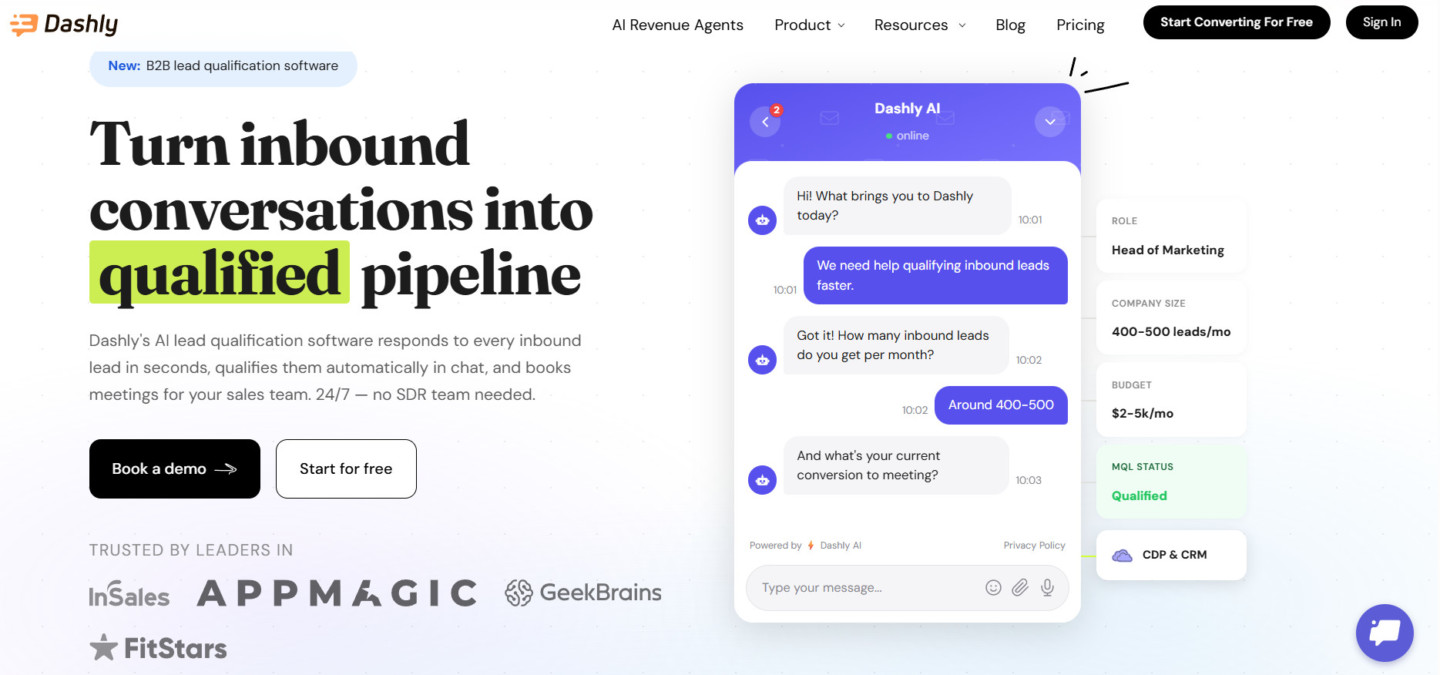
Most inbound tools solve one part of the problem. Dashly covers the full cycle. It’s a platform of four AI agents that engage a visitor, qualify them against your ICP, answer product and pricing questions, and book a meeting, all within a single conversation, with no SDR touching the process until a meeting is confirmed.
The four agents work in sequence:
- Engagement scenarios — start a personalized chat based on the visitor’s current page, traffic source, and time on site. Not a generic “How can I help?” The message matches what that specific visitor is doing at that moment.
- Qualifier Agent — runs through ICP criteria in natural conversation: company size, industry, tech stack, use case. It identifies fit in seconds and scores the lead before any rep sees it.
- Support Agent — answers product and pricing questions during the qualification flow, so the conversation doesn’t stall on details your SDR would otherwise handle manually.
- Booking Agent — offers calendar slots from Google Calendar, Calendly, or Cal.com and confirms the meeting without the lead leaving the chat.

Beyond your website, Dashly covers WhatsApp, Telegram, Instagram, Facebook, email, and SMS from a single inbox. Its native customer data platform builds a unified lead profile from every touchpoint, so your CRM gets clean, consolidated data rather than fragmented records from six different channels.
It connects to 22+ CRMs including HubSpot, Salesforce, Pipedrive, and AMO CRM with bidirectional sync. Multi-channel nurture sequences run automatically after a meeting is booked, reducing no-shows through reminder messages across whichever channel the lead prefers.
Dashly customers see an 82% MQL-to-meeting conversion rate. The platform replaces 1.5+ FTE in SDR work, with a payback period of two to five months.
Best for: B2B SaaS (MarTech, Sales Tech, HR Tech) and Real Estate with 50,000+ monthly visitors, sales cycles of one month or longer, and ACV above $500.
The comparison that matters: versus Qualified, Dashly covers the full inbound cycle without a Salesforce dependency and from $500/month rather than $5,000. Versus Drift, it targets mid-market rather than enterprise ABM, avoids the six-figure price tag, and closes the gap between website visit and booked meeting in a single conversation.
See how Dashly’s AI agent team handles automated lead generation from first visit to booked demo.

2. HubSpot Marketing Hub — all-in-one inbound platform
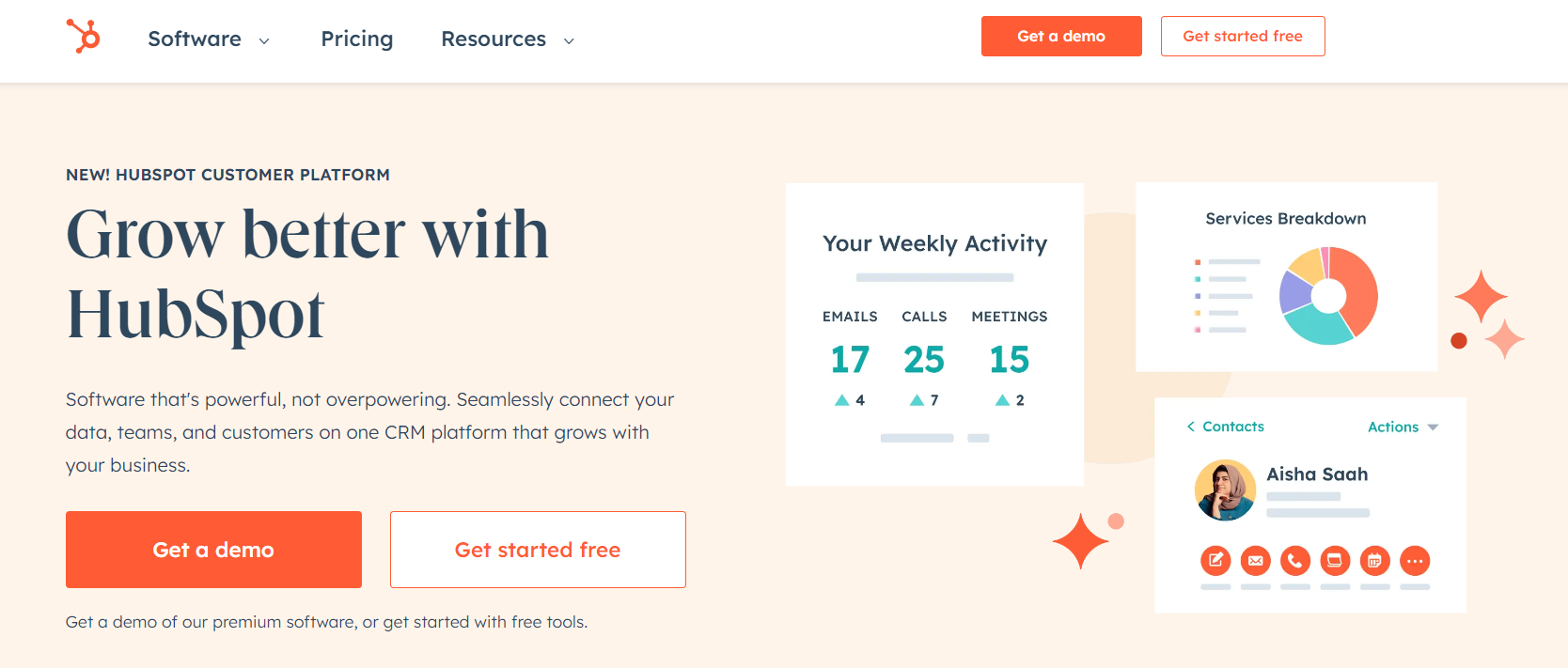
HubSpot is the closest thing B2B SaaS has to a single-platform inbound marketing solution. One login covers CRM, blogging and SEO tools, landing pages, email sequences, a chatbot builder, and conversion reporting. The value proposition is consolidation: replacing a five-tool stack with one shared data model.
What it does for inbound lead generation:
- Blogging and SEO tools with topic cluster mapping and internal linking recommendations
- Form builder and behavior-triggered pop-ups for on-site lead capture
- Lead scoring and lifecycle stage automation — MQL to SQL triggers based on page visits, form fills, and email behavior
- Email workflows that fire based on site activity, form submissions, and CRM data
- HubSpot Bot, a no-code chatbot that qualifies visitors and routes them to reps or meeting links
Best for: Growing B2B SaaS teams that want a unified platform across marketing, sales, and service without stitching together a multi-tool stack. Works best for teams already investing in content-driven inbound marketing.
The tradeoff: HubSpot’s chatbot handles basics but wasn’t built for deep B2B qualification. Teams where chat-to-meeting conversion is the primary metric typically layer a specialized tool like Dashly on top for the qualification and booking layer.
3. Qualified — AI pipeline cloud for Salesforce teams
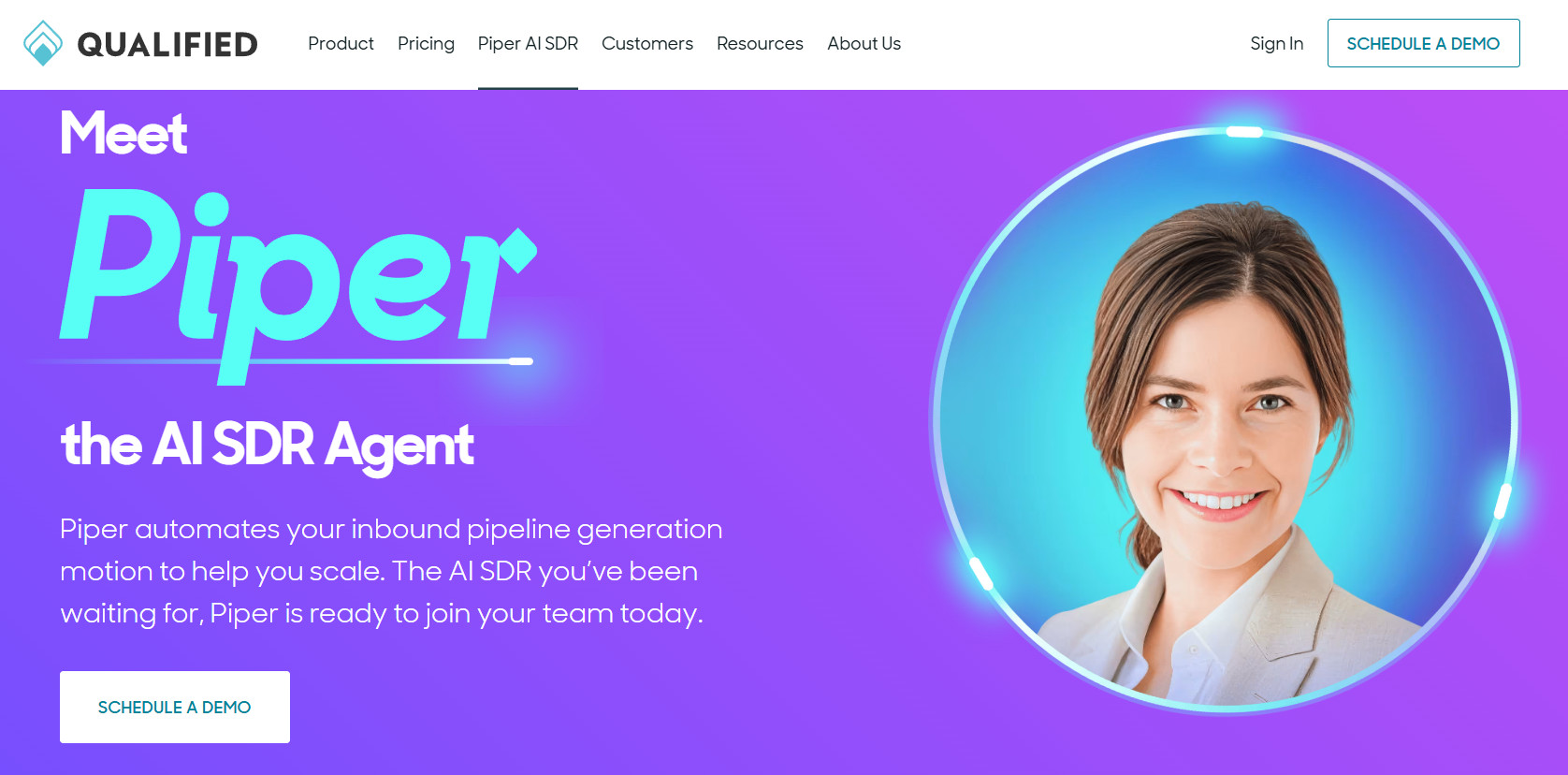
Qualified is an AI pipeline cloud built for B2B companies running Salesforce as their CRM. It identifies which accounts are visiting your site, surfaces buyer signals from first-party and third-party intent data, and deploys Piper, its AI sales agent, to start a real-time conversation with those visitors and book a meeting before they leave.
What it does for inbound lead generation:
- Piper AI Agent — starts personalized conversations based on who the visitor is and what they are doing on site, drawing directly on Salesforce account data
- Buyer signals — combines site behavior, third-party intent data, and Salesforce history to score and prioritize in-market accounts
- Real-time meeting booking — presents calendar slots during the conversation and routes to the right AE based on account ownership in Salesforce
- Salesforce-native data model — pipeline activity stays in Salesforce with no secondary CRM or sync delay
Best for: Enterprise B2B SaaS companies with Salesforce as the CRM and a named-account ABM motion. The Salesforce-native architecture is the default choice for RevOps teams that need all pipeline activity in one system.
G2: 4.9/5 (700+ reviews) | Pricing: Custom. Qualified targets enterprise accounts; entry-level typically starts around $5,000/month.
The tradeoff: The pricing and Salesforce dependency rule it out for SMB and mid-market teams not already in the Salesforce ecosystem. For B2B SaaS without a Salesforce requirement, Dashly covers the same real-time qualification and booking workflow at a lower price point with broader channel coverage.
4. Drift — conversational marketing for enterprise ABM
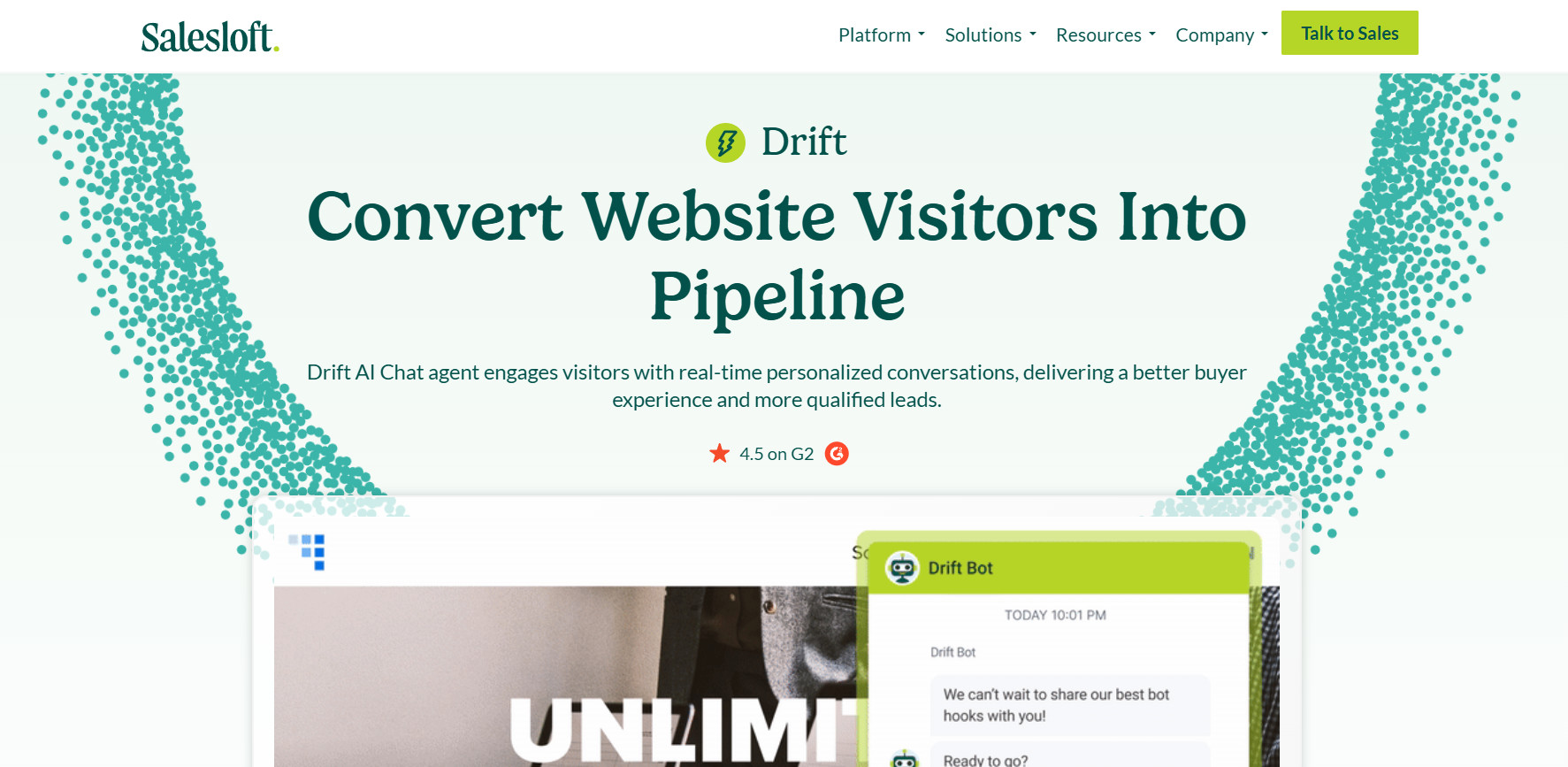
Drift built its platform around account-based marketing. The core concept: identify which target accounts are browsing your site by IP, then show them a personalized message from the right rep, rather than a generic chat widget that every visitor sees.
What it does for inbound lead generation:
- Intent-based routing — identifies the visiting company and triggers an account-matched conversation
- Meeting scheduling directly from the chat widget
- ABM playbooks with custom conversation flows per target account list
- Native Salesforce and HubSpot integration for account-level data sync
Best for: Enterprise B2B teams with ACV above $20,000 and a defined ABM program. The account personalization features pay off when you’re targeting a specific list of named accounts, not broad inbound volume.
G2: 4.4/5 (1,200+ reviews) | Pricing: Custom (Drift is now owned by Salesloft). Market estimates put entry-level around $2,500/month.
The tradeoff: The cost and setup complexity rule it out for SMB and mid-market SaaS. Most of the account personalization value requires a defined account list, which doesn’t apply to teams running high-volume inbound.
5. Semrush — SEO and content marketing platform
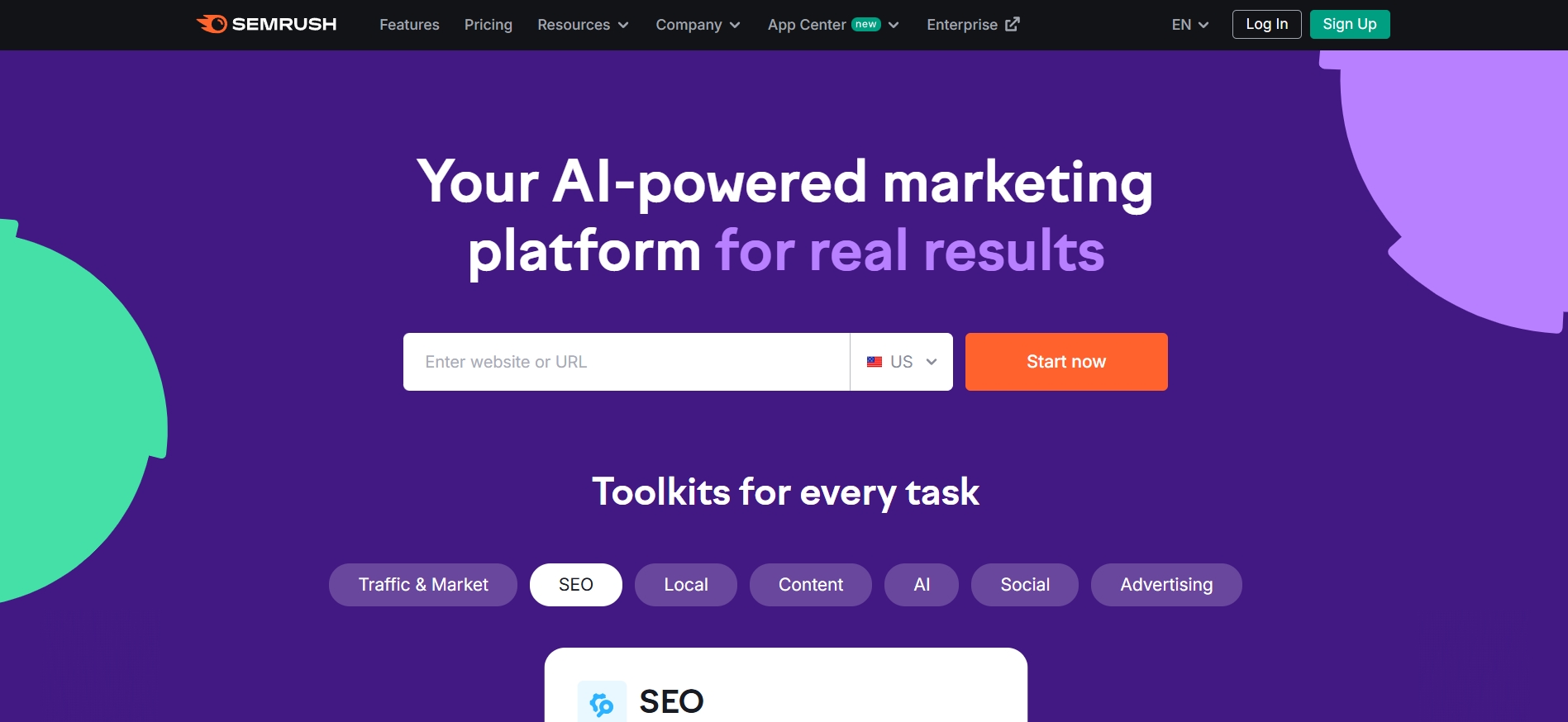
Organic search is the only inbound channel that compounds. A blog post ranking in position one for a buyer-intent keyword keeps generating leads without additional spend. Semrush is the platform that finds those keywords, shows you what’s suppressing your current rankings, and tracks whether your positions improve over time.
What it does for inbound lead generation:
- Keyword research and competitive gap analysis — surfaces topics competitors rank for that your site doesn’t
- Site audit identifying technical SEO issues that suppress rankings
- Content marketing toolkit with topic clusters, content briefs, and on-page optimization guidance
- Backlink analysis and link gap tools to grow domain authority
- Position tracking for target keywords across search engines
Best for: B2B SaaS teams building inbound pipeline through organic content. Semrush handles the research and optimization layer. You still need a capture tool to convert that traffic into leads once it arrives.
The tradeoff: Semrush builds the organic pipeline but doesn’t capture or qualify leads on its own. Pair it with Dashly or a similar service to close the loop between organic traffic and booked meetings.
6. ActiveCampaign — email marketing and lead nurturing
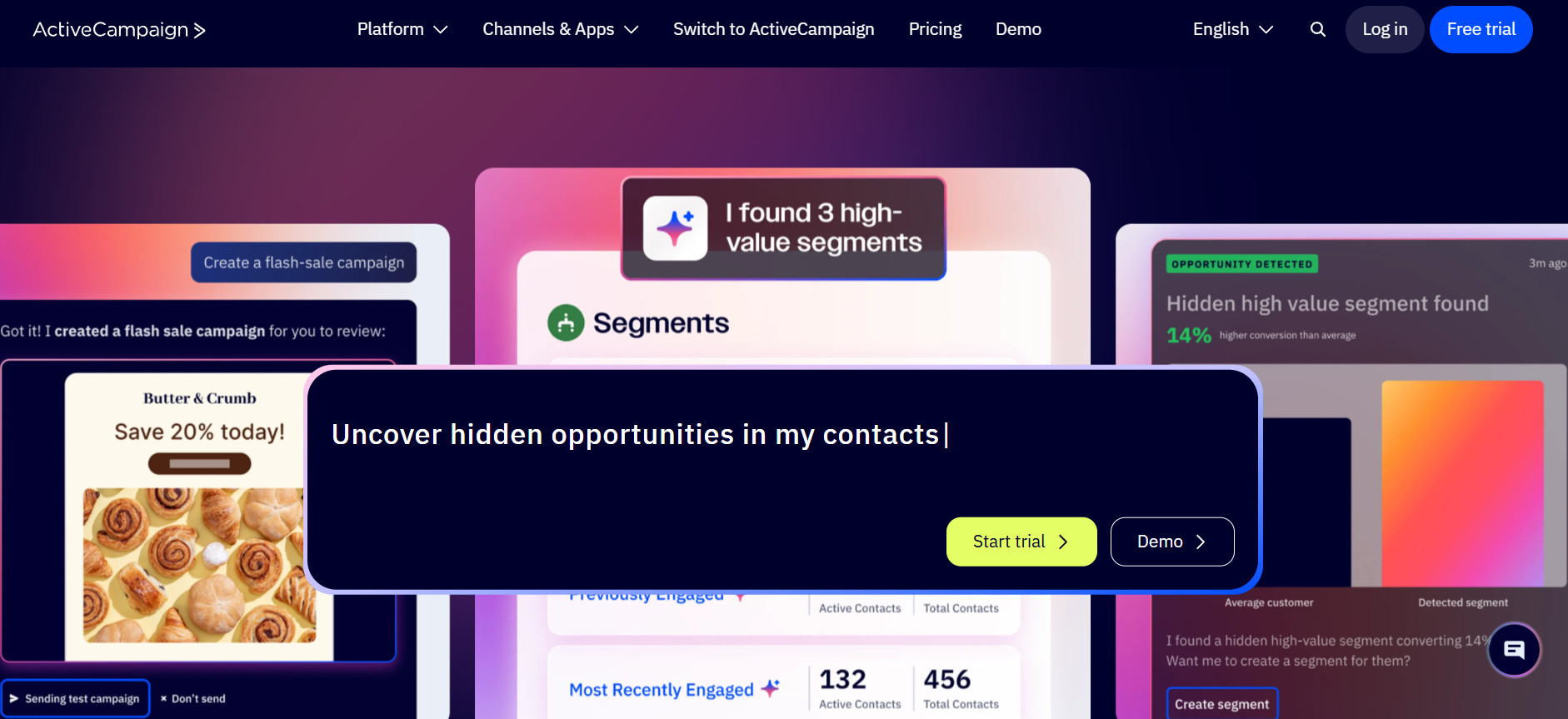
Not every inbound lead is ready to buy when they first show up. A visitor downloads your pricing comparison guide, then goes quiet for three weeks. A trial user logs in twice, then stops. ActiveCampaign handles the middle-of-funnel stage: keeping those leads engaged until they’re ready for a sales conversation.
What it does for inbound lead generation:
- Email automation with multi-branch if/then logic — not just linear drip sequences, but flows that adjust based on actual behavior
- Lead scoring that adjusts based on email opens, link clicks, page visits, and form submissions
- Built-in CRM with deal tracking for smaller sales teams
- Site tracking — records which pages a contact visits after subscribing and fires automations accordingly
- A/B testing for subject lines, content, and send timing
Best for: B2B SaaS with sales cycles of three months or more, where leads need multiple content touchpoints before they’re ready for a conversation. Works well paired with a separate top-of-funnel capture tool.
The tradeoff: No built-in chatbot or on-site capture widget. You need a separate integration to bring chat leads and form leads into ActiveCampaign’s nurturing sequences.
7. Leadpages — landing pages and lead capture
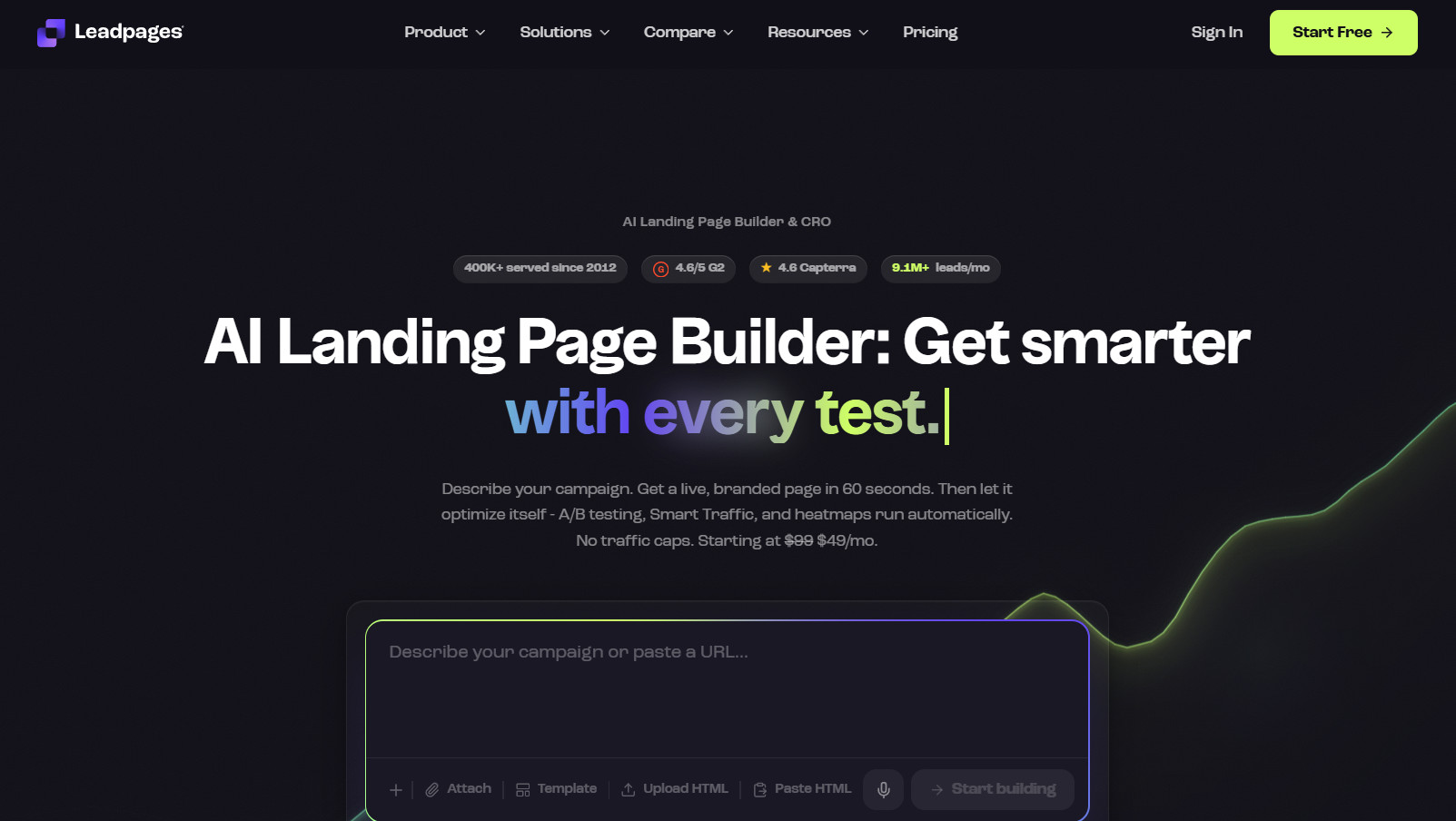
When your PPC campaign or content offer needs a dedicated conversion page, Leadpages builds it without involving a developer. Drag-and-drop editor, conversion-tested templates, and a pop-up builder that installs on your existing site pages, not just pages hosted on Leadpages.
What it does for inbound lead generation:
- Drag-and-drop page builder with 200+ templates sorted by conversion rate
- A/B testing with automatic traffic splitting between variants
- Pop-ups and alert bars triggered by exit intent, scroll depth, or time on page
- Lead magnet delivery — automatically sends a PDF, guide, or checklist when someone subscribes
Best for: Marketing teams that launch a lot of PPC or content download campaigns and need fast, testable landing pages without engineering dependencies.
The tradeoff: Leadpages captures leads. It doesn’t qualify them, route them, or follow up automatically. You need other tools in the stack to do anything useful with the contacts after capture.
8. Chili Piper — inbound lead routing and scheduling
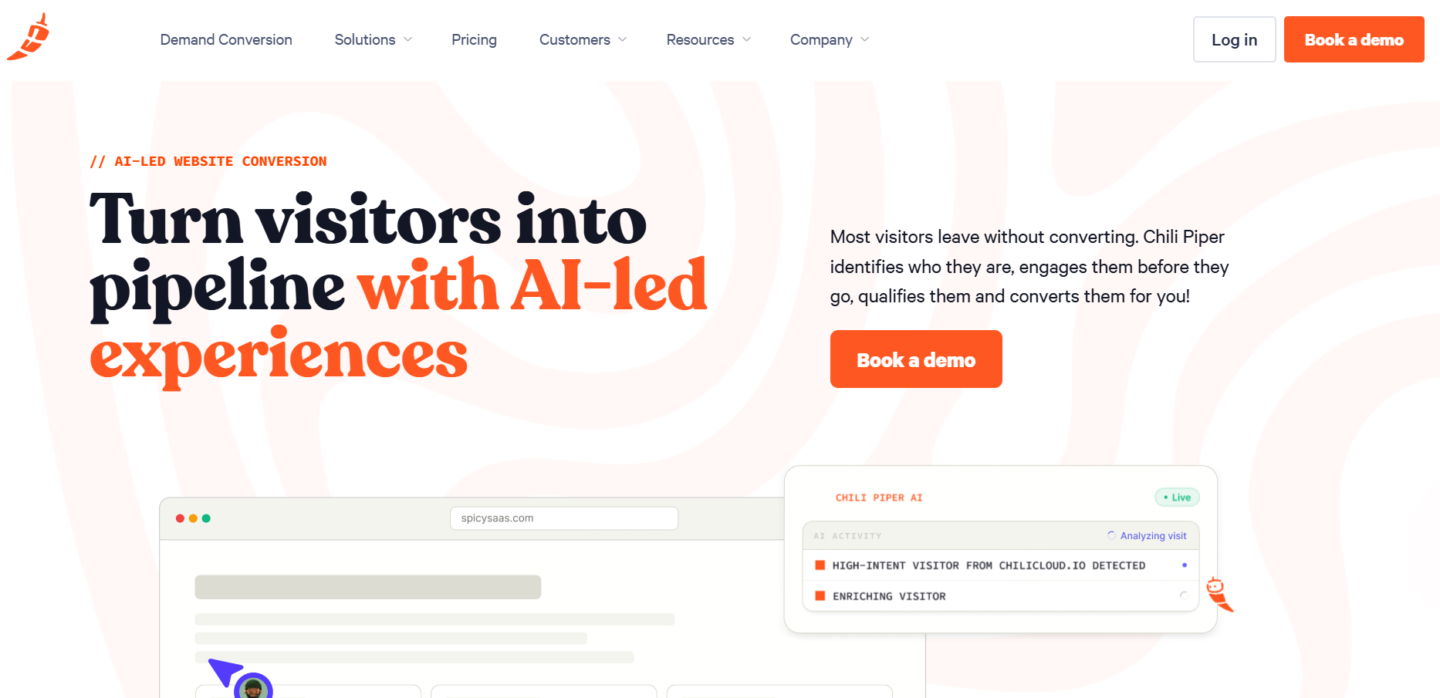
A lead submits your demo request form. In most B2B SaaS companies, what follows is: a Slack notification, an SDR picks it up sometime in the next few hours, sends a Calendly link, and waits. The lead has moved on.
Chili Piper replaces that sequence entirely. The moment a form is submitted, it shows the lead available calendar slots, routes the meeting to the right rep based on your rules, and books it before the lead leaves the page.
Research published in the Harvard Business Review found that leads contacted within one hour are 7x more likely to be qualified than those reached later. Chili Piper targets the first-five-minutes window.
What it does for inbound lead generation:
- Instant Booker — presents calendar slots immediately after form submission, while the lead is still on the page
- Lead routing rules by territory, account ownership, round-robin, or custom logic
- Concierge — live booking widget for high-intent pages like pricing or ROI calculators
- Salesforce and HubSpot sync to keep routing logic current with CRM data
Best for: B2B SaaS with separate SDR and AE roles where form-fill to first-contact delay is costing demos. Pairs well with Dashly for teams who want AI lead qualification and lead appointment setting from chat conversations alongside form routing.
The tradeoff: Chili Piper routes and schedules form submissions. It doesn’t capture leads from chat conversations or qualify them without a form. For teams getting inbound leads from multiple channels, a broader tool is needed alongside it.
9. Clearbit / Clay — intent data and lead enrichment
A lead submits your form with a name, work email, and company name. Your SDR has almost nothing to work with. Clearbit and Clay fill in what’s missing before the first conversation happens: company size, industry, funding stage, job title, tech stack, and which specific pages that lead visited.
Clearbit is now a part of HubSpot. Clay is a standalone enrichment and workflow automation tool. Both solve the same core problem: inbound lead data is sparse, and sparse data means poor prioritization.
What they do for inbound lead generation:
- Website visitor identification — reveals the company behind anonymous IP traffic on your site
- Form shortening — removes fields that enrichment fills automatically, which increases form completion rates
- Lead enrichment — adds company size, industry, funding stage, tech stack, and job function
- Intent signals — shows which pages a lead visited, how many times, and in what order
Best for: B2B SaaS with strict ICP requirements, where knowing a lead’s company size and tech stack before the first call determines whether to prioritize or deprioritize them.
The tradeoff: Both tools enrich leads you’ve already captured. They don’t generate inbound leads on their own and work best as a data layer on top of a capture and qualification tool.
10. Warmly — signal-based pipeline from anonymous traffic
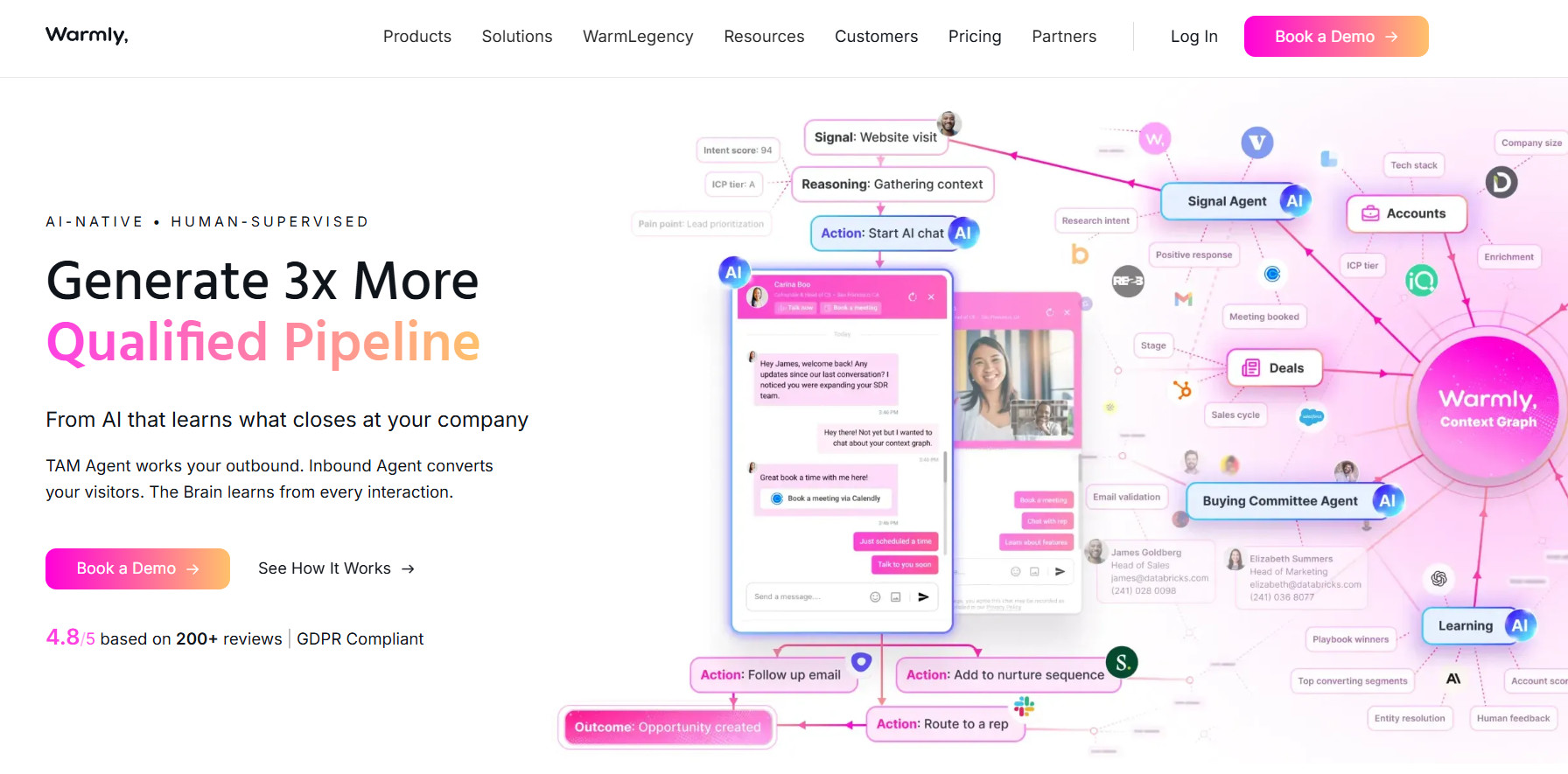
Most inbound tools wait for a visitor to fill out a form. Warmly doesn’t. It de-anonymizes website visitors at the person and company level using LinkedIn and B2B data sources, surfaces intent signals from their on-site behavior and third-party data, then automatically engages them via AI chat or routes a real-time Slack alert to the right SDR before the visitor closes the tab.
What it does for inbound lead generation:
- Person-level de-anonymization — identifies the individual visitor (name, LinkedIn profile, job title) alongside the company, not just the IP address
- Intent signal scoring — combines pages visited, return frequency, and time on site with third-party intent data to prioritize in-market accounts
- AI chat engagement — starts a conversation with the visitor based on their signal score and ICP fit, without waiting for a form fill
- SDR orchestration — sends a real-time Slack alert to the right rep with the visitor’s LinkedIn profile, company context, and pages viewed so they can engage immediately
Best for: B2B SaaS mid-market teams with 5,000+ monthly visitors who want to capture pipeline from anonymous traffic before competitors do. Works well when your ICP is defined and you have SDRs available to act on real-time signals.
The tradeoff: Warmly works best when you have a tightly defined ICP. Without targeting criteria, you engage too many low-fit visitors and create noise for your SDR team. It also doesn’t run email nurture sequences on its own. Pair it with ActiveCampaign or HubSpot for follow-up after the first touch.
How to choose the right inbound lead generation service
Five questions narrow the decision faster than any feature comparison matrix.
1. What’s your primary inbound channel?
SEO and content driving most traffic: start with Semrush to find the right keywords, then add Dashly to qualify visitors arriving from organic search in real time. Email list as the main asset: ActiveCampaign handles nurturing and lead scoring. Site chat as the capture point: Dashly for full-cycle AI qualification, Qualified for Salesforce-native enterprise pipeline. Routing speed is the bottleneck between form and first contact: Chili Piper.
2. Do you need a tool or an agency?
No marketing team and need pipeline within 60 days: a signal-based tool like Warmly can surface in-market accounts from your existing traffic in days, with no content production required. For fully outsourced execution including content creation and email campaigns, a B2B lead generation agency is the alternative. Agencies charge for execution. Tools charge for usage. At scale, tools give better unit economics.
3. What’s your speed-to-lead target?
If you need to respond within five minutes (the threshold that has the biggest impact on inbound conversion), static forms with manual follow-up don’t get you there. You need a lead qualification tool that qualifies in real time plus booking automation that confirms the meeting before the lead goes cold. Dashly handles qualification and booking within a single chat conversation. Chili Piper eliminates delay from form-based submissions.
4. What’s your existing tech stack?
Deep in the HubSpot ecosystem: Marketing Hub adds inbound capability without a second data silo. Salesforce as the CRM: Drift and Dashly both offer native Salesforce integrations. No CRM or a lightweight setup: ActiveCampaign includes a basic CRM alongside email. Whichever direction, avoid tools that require a full re-implementation of your contact and deal data to function.
5. What’s your budget?
- Under $100/month: Leadpages (from $37) + ActiveCampaign Starter (from $15). Captures leads through landing pages and nurtures them by email.
- $100 to $500/month: HubSpot Starter. More automation, more channels, and a shared CRM-plus-marketing data model in one platform.
- $500+/month: Semrush Pro for organic pipeline plus Dashly for real-time qualification and booking.
- $2,000+/month: Drift for named-account ABM, Qualified for Salesforce-native enterprise pipeline, or Dashly at full scale for high-traffic B2B SaaS. Warmly fits here too at teams with high visitor volume and active SDR coverage.
Choose based on where leads are dropping off
The ten inbound lead generation services in this list cover every part of the funnel: organic traffic, on-site capture, real-time qualification, email nurturing, lead routing, and data enrichment. Most teams benefit from two or three working together.
If your traffic is solid but demos aren’t getting booked, the gap is usually speed and qualification logic. A lead is warmest within the first few minutes of showing intent. Waiting on manual follow-up costs conversions you’ve already paid for with ad spend or content production.
Dashly’s AI agents handle capture, qualification, support, and booking within a single conversation, around the clock. No SDR touches the process until a meeting is on the calendar.
Inbound lead generation services FAQs
Inbound lead generation services are tools, platforms, or agencies that help businesses attract and convert leads who have already shown intent. They work with traffic already earned through search, content, referrals, or direct interest. The four main categories are AI chatbot and qualification tools, SEO and content platforms, email marketing and nurturing tools, and lead routing and scheduling tools. Unlike outbound services that cold-contact prospects, inbound services capture and convert buyers who are actively looking.
Inbound services capture leads who find you through content, SEO, referrals, or direct search. They raise their hand first. Outbound services generate leads by initiating contact through cold calls, email prospecting, paid ads, or purchased lists. Inbound leads cost 61% less to acquire (HubSpot) and close faster because they arrive with buyer context. Outbound gives more control over targeting and timing. Most B2B SaaS teams with solid content use inbound as the primary channel and outbound to fill gaps.
Costs vary by category. Entry-level tools like ActiveCampaign Starter and Leadpages Standard start around $15 to $37 per month. Mid-tier platforms like HubSpot Starter run $15 to $800+ per month depending on tier and usage. SEO platforms like Semrush start at $117 per month. Routing tools like Chili Piper start at $30 per seat per month. Enterprise and custom platforms like Drift and Qualified use custom pricing, typically $2,500 to $5,000+ per month. Signal-based pipeline tools like Warmly start at $700 per month. Most B2B SaaS teams build a two to three tool stack covering capture, nurturing, and routing.
For teams prioritizing chat qualification and demo booking, Dashly covers the full inbound cycle with four AI agents: engage, qualify, support, and book. It produces 82% MQL-to-meeting conversion for qualifying customers and replaces 1.5+ FTE of SDR work. For all-in-one inbound marketing, HubSpot consolidates CRM, content, email, and chat in one platform. For email-heavy nurturing with long sales cycles, ActiveCampaign has the deepest automation. The right answer depends on where leads currently drop off in your funnel.
The most effective inbound lead generation channels for B2B SaaS are: SEO content targeting buyer-intent keywords, a website chatbot or AI agent that captures and qualifies visitors in real time, gated lead magnets on landing pages, behavior-triggered email nurture sequences, LinkedIn content, and webinars. The goal is to appear when buyers are actively researching solutions like yours, then convert that interest before it cools.
Track three numbers: cost per inbound lead (tool spend divided by leads generated), lead-to-MQL conversion rate (what percentage of inbound leads meet your qualification criteria), and speed-to-first-response (how quickly a qualified lead enters a conversation). For services covering qualification and booking, also track MQL-to-meeting rate and meeting show rate. Compare these metrics before and after each tool, and against your outbound benchmarks, to see where inbound creates leverage.






![What is inbound sales? The complete B2B guide [2026]](https://www.dashly.io/blog/wp-content/uploads/2025/03/7-caring-inbound-sales-strategies-to-elevate-your-revenue-in-2025-6-1-720x405.jpg)

