Sales funnel stages explained: what they are and how to move buyers through each one (2026)
 19 minutes
 28.05.2026
Most B2B deals die because the team loses the buyer somewhere between first contact and a signed contract. A prospect reads a blog post, visits the pricing page, and disappears, not because a competitor was better, but because no one followed up in time, the demo was too hard to book, or the nurture sequence covered the wrong topic for their role.
Understanding sales funnel stages gives your revenue team a precise diagnostic map: it shows exactly where buyers drop off and what to fix first. This guide covers the four core stages, what changes in B2B SaaS, the metrics that matter at each step, and the tactics that move buyers forward faster.
What is a sales funnel?
A sales funnel is the structured path a potential buyer takes from first hearing about your product to making a purchase. The funnel shape reflects a simple reality: many prospects enter at the top through content, ads, or referrals; fewer engage deeply; a smaller number reach a decision; and a subset actually buy.
A sales funnel models the full buyer journey as a narrowing path from broad awareness to purchase, organized into discrete stages that each have their own buyer mindset, conversion metric, and set of tactics that work.
For a deeper grounding in the concept and its history, the guide on what is a sales funnel covers the full framework. This article focuses specifically on the stages: what happens at each one, how to measure it, and how to improve it.
One distinction worth establishing early: a sales funnel and a sales pipeline are not the same thing:
- A funnel maps the buyer’s journey from stranger to customer.
- A pipeline maps your team’s active deals, their stages, and their probability of closing. Conflating the two leads to reporting errors and misaligned teams. The full comparison is a few sections below.
The 4 core sales funnel stages
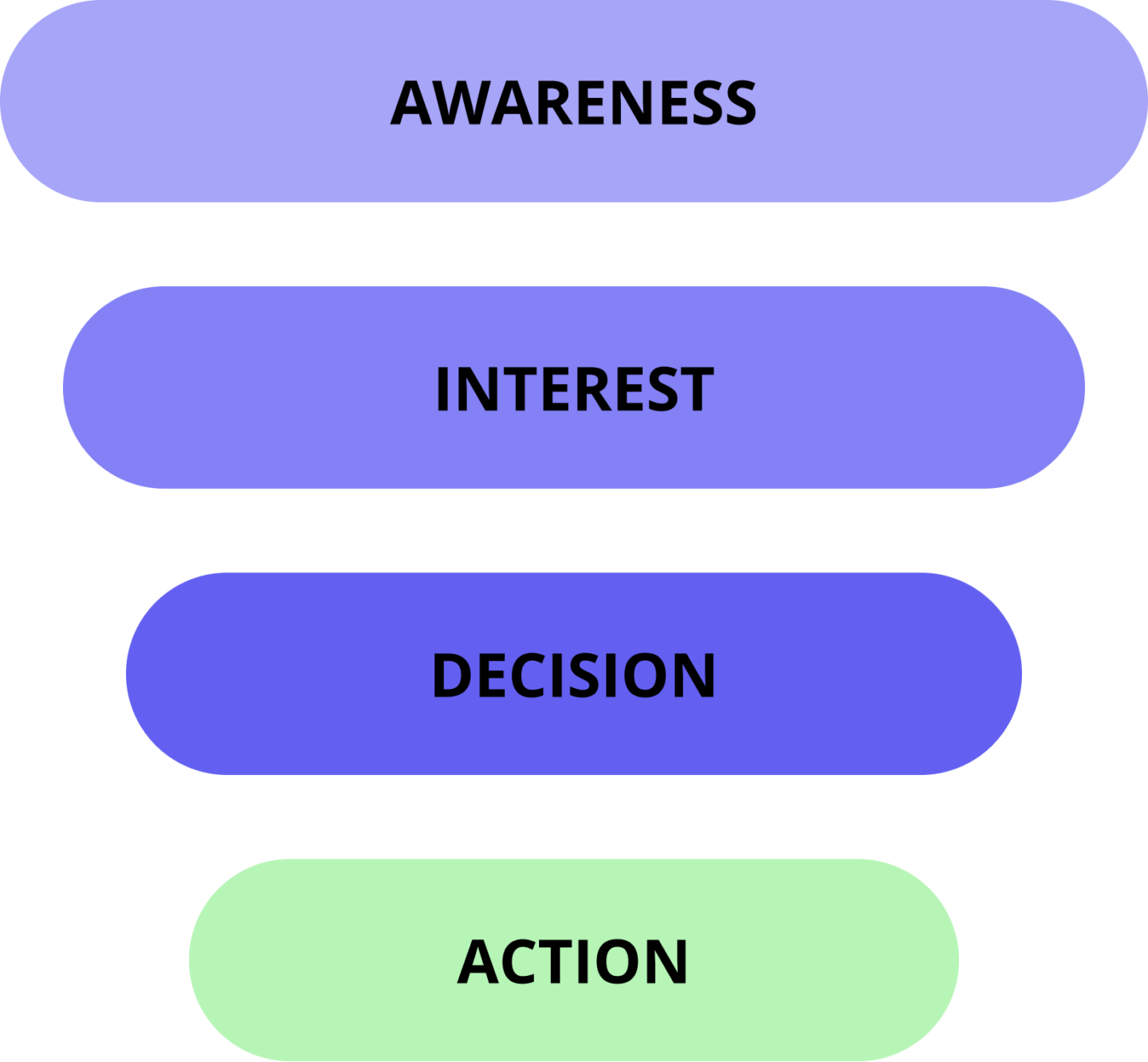
The four stages of a sales funnel are Awareness, Interest, Decision, and Action. Each describes a distinct buyer mindset, a different set of needs, and a different set of tactics that move prospects forward. Sending the wrong message at the wrong stage is one of the most common ways B2B teams waste budget and lose pipeline that was reachable.
For real-world scenarios across different industries and company sizes, the guide to sales funnel examples walks through specific cases with conversion benchmarks at each stage.
Stage 1: Awareness
At the Awareness stage, prospects are looking for information. They may have a problem they haven’t fully articulated yet, or they’re exploring a solution category without a specific vendor in mind. They don’t know your product exists.
Your goal here is discovery and initial credibility.
The channels that work:
- SEO-driven content,
- Paid search,
- Social media,
- Podcast sponsorships.
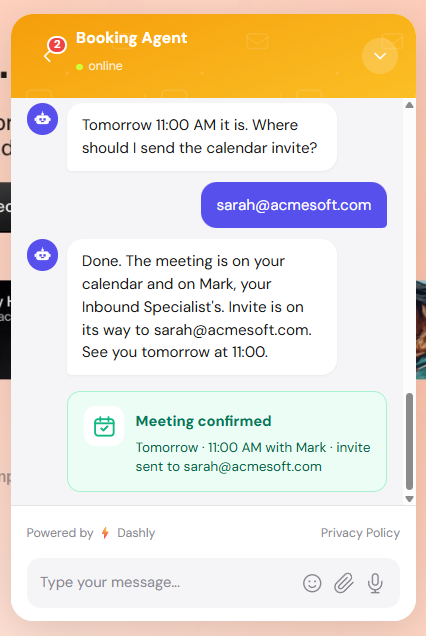
For B2B SaaS teams with inbound website traffic, proactive AI agent triggers on landing pages are an underused tool at this stage. An agent that opens a qualifying conversation when a visitor lands on a relevant page captures leads that would otherwise bounce without a trace.
What success looks like: a first-time visitor lands on your site through a blog post, an ad, or a referral. They leave with your brand in mind and a reason to return. Failure looks like a high bounce rate, low email capture, and paid campaigns that generate clicks but no meaningful engagement downstream.
Stage 2: Interest (consideration)
A buyer at the Interest stage is aware of your product and actively evaluating it against alternatives. They’re reading reviews, comparing features, downloading guides, and engaging with email sequences. Their attention is earned but not committed.
Lead nurturing does the heavy lifting here. Email sequences, case studies matched to the buyer’s industry, and live chat conversations all keep the prospect engaged through what can be a weeks-long evaluation.
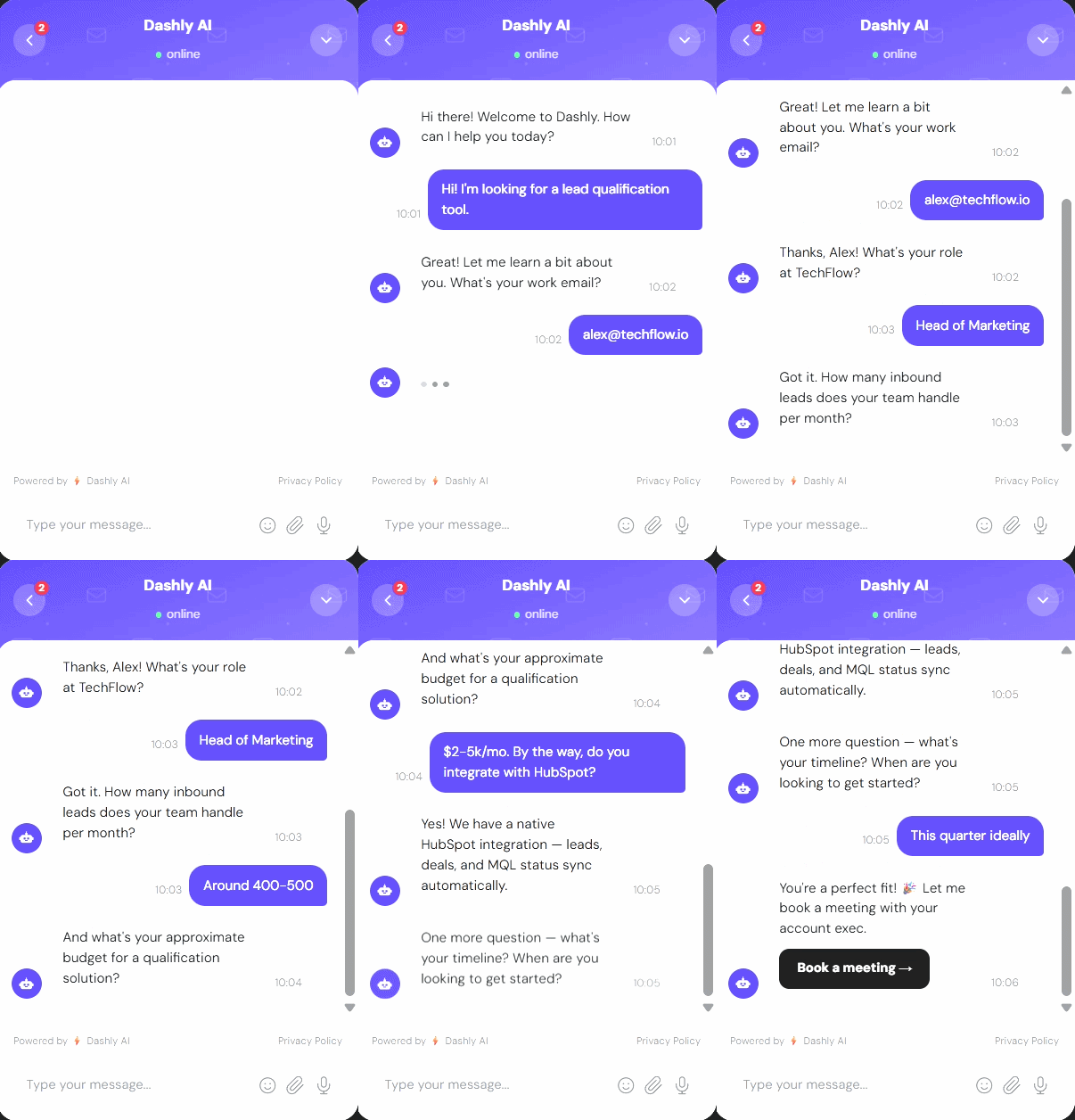
Here’s how Dashly’s AI agent qualifies a visitor on the website:
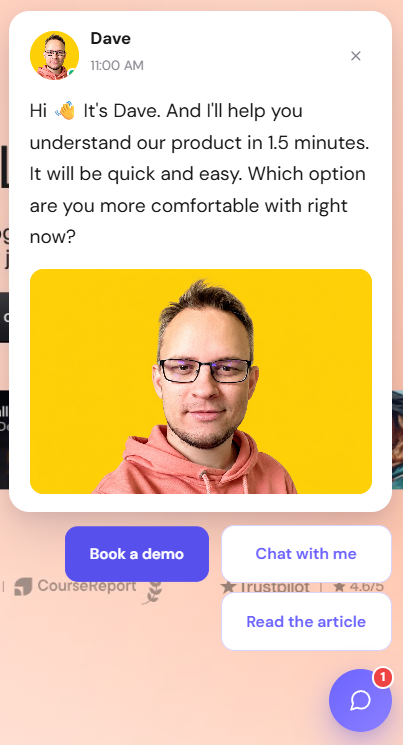
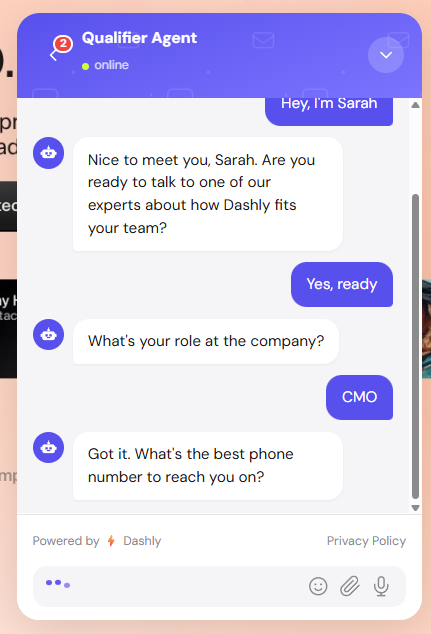
The buyer persona becomes critical: a VP of Sales evaluating a pipeline tool wants ROI math and peer benchmarks; a developer evaluating an API integration wants documentation and sandbox access. The same message does not move both forward.
Sales funnel content at this stage should address objections before the buyer voices them. “How does your tool handle enterprise data privacy?” and “What does implementation actually look like?” are questions that affect deals when a buyer finds a competitor that answered them in a well-written case study and moves on without saying a word.
Stage 3: Decision
The Decision stage is where the buyer has shortlisted options and is ready to choose. They may be in a formal RFP process or comparing two platforms side by side. A demo or a free trial is the standard conversion mechanism at this stage.
Speed is the biggest variable.
According to LeanData’s lead response research, the probability of qualifying an inbound lead drops steeply after the first 5 minutes. In a competitive B2B market, slow follow-up is a silent deal killer. An AI agent that responds to a demo request within seconds, qualifies the lead against ICP criteria, and books a meeting on the right rep’s calendar removes the single biggest friction point at the Decision stage.
Stage 4: Action (purchase)
The Action stage is the conversion event: the prospect becomes a customer. In B2B SaaS, this is contract signing, first payment, or account activation. It’s the bottom of the funnel, but not the end of the story.
Customer lifetime value is built in the period right after Action. Fast onboarding, a clear success path, and proactive check-ins in the first 30 days cut churn before it becomes visible in retention numbers. Teams that treat Action as the final stage consistently underinvest in onboarding and miss the expansion revenue that comes from customers who hit early success milestones.
Sales funnel vs sales pipeline: what’s the difference?
Sales funnel and sales pipeline are used interchangeably across most revenue conversations. They measure different things.
A funnel describes the buyer’s journey and where prospects drop off.
A pipeline describes your team’s active deals, their stages, and their probability of closing. Conflating the two leads to reporting errors, misaligned OKRs, and CRM setups that measure the wrong things.
| Sales funnel | Sales pipeline | |
|---|---|---|
| Perspective | Buyer’s journey | Rep’s activity |
| Tracks | Prospect behavior and drop-off points | Active deals by stage and value |
| Primary question | Where are buyers falling out? | What deals are active and will they close? |
| Primary user | Marketing + Revenue leadership | Sales rep + Sales manager |
| Measured by | Conversion rates between stages | Pipeline value, close rate, deal velocity |
A sales funnel measures how a large pool of potential buyers narrows to paying customers. A sales pipeline measures the specific deals your team is actively working. One is population-level; the other is deal-level.
In CRM tools like HubSpot or Salesforce, the term CRM sales funnel stages usually refers to deal pipeline stages: Lead, Qualified, Demo, Proposal, Closed Won. These map to the Decision and Action phases of the buyer journey, not to the full four-stage funnel. Revenue leaders who manage only the pipeline miss leakage happening in Awareness and Interest, long before a lead becomes a named opportunity.
B2B SaaS sales funnel: what changes from the classic model
The classic four-stage funnel assumes a mostly linear path. B2B SaaS funnels are rarely linear. Three structural differences change the shape, the timing, and the conversion math for software companies selling to other businesses.
Longer decision cycles. Mid-market B2B deals take an average of 84 days to close. Enterprise deals routinely run 6 to 12 months. The Interest and Decision stages stretch across many touchpoints, not a single conversation. Nurture strategies designed for a two-week evaluation consistently underperform against buyers who need 12 weeks of engagement before they’re ready to decide.
Multiple stakeholders. According to Gartner’s B2B buying research, the average buying group for a mid-market SaaS purchase involves 6 to 10 decision-makers. Your funnel must engage the champion, the economic buyer, the IT lead, and the end users who will influence the final call. A single-threaded sales approach consistently fails at Decision even when the product is clearly better.
Product-led growth adds a trial stage. Many B2B SaaS companies insert a free trial or freemium tier between Interest and Decision, where buyers self-qualify through product usage before speaking to a human. Teams that don’t actively nurture trial users toward activation lose most of this cohort silently.
Speed-to-lead is the most controllable conversion lever in an inbound B2B funnel. LeanData’s research shows that the odds of qualifying a lead drop steeply after the first 5 minutes. An AI agent that responds the moment a lead raises their hand, regardless of time zone or rep availability, is the practical solution to this problem.
Some teams focused on scale and self-serve adoption run an inverted sales funnel model, where the high-volume customer base comes from the bottom (self-serve PLG) and the top is a smaller, curated set of high-value enterprise targets. This is the inverse of a traditional sales-led funnel and requires completely different metrics and motion.
In operational terms, B2B SaaS digital sales funnel stages are typically described as ToFu, MoFu, and BoFu: Top, Middle, and Bottom of Funnel. These map directly to Awareness (ToFu), Interest and Decision (MoFu), and Action (BoFu). Most SaaS revenue teams segment their campaigns, content, and reporting by these three zones, with specific conversion KPIs at each level.
Marketing and sales funnel: how they connect
Marketing owns the top of the funnel; sales owns the bottom. The gap between them, where a marketing-qualified lead (MQL) should become a sales-qualified lead (SQL), is where most B2B SaaS companies lose the most pipeline. This marketing and sales funnel alignment problem costs revenue teams an estimated 10% to 20% of their pipeline annually in leads that were misrouted, never followed up, or duplicated across both teams.
- Marketing generates leads through content, paid channels, and brand campaigns.
- Leads become MQLs when they cross a scoring threshold based on job title, company size, intent signals, and engagement depth.
- Sales takes over when an MQL matches the ideal customer profile (ICP) strongly enough to warrant a direct conversation.
- The handoff is where most of the friction accumulates.
The “black hole” problem is real. MQLs passed to sales with no context, no routing logic, and no follow-up SLA sit uncontacted for hours or days. By then, the buyer has already spoken to a competitor. According to Salesforce’s 6th State of Sales report, the average sales rep spends only 28% of their week actually selling. The rest goes to admin, research, and manual tasks, including time that should go to responding to fresh inbound MQLs.
AI agents close this gap. When a visitor fills a form, starts a chat, or requests a demo, an AI agent qualifies the lead against ICP criteria, routes the conversation to the right rep, and books a meeting, all before a human has been notified. The result: no black hole, no lead decay, and a structured MQL-to-SQL handoff that scales across business hours and time zones.
Key benchmarks for this transition in B2B SaaS: MQL-to-SQL conversion rates typically run between 13% and 28%, according to HubSpot’s B2B marketing benchmarks. Average time between MQL creation and first human contact at most companies: 42 hours. With AI-assisted qualification, that drops to under 5 minutes.
Key metrics to track at each sales funnel stage
Tracking the right metrics at each stage is how you find the leak. Most revenue teams measure the top of the funnel (traffic, leads) and the bottom (close rate, revenue) but not the conversion rates between stages. That gap in measurement is why funnel problems persist for quarters before anyone traces them back to their source.
Effective sales funnel management means setting benchmarks for each stage transition, reviewing them monthly, and setting alerts when a conversion rate drops below threshold.
Awareness (ToFu)
- Organic traffic and CTR: how many visitors enter the funnel through search, and what percentage click through from the SERP to your content
- Cost per lead (CPL): what paid channels cost to generate one lead, benchmarked by channel and segment so you know where to scale spend
- Brand search volume: a leading indicator that awareness campaigns are compounding; tracked via Google Search Console month over month
Interest (MoFu)
- MQL conversion rate: percentage of leads that reach marketing-qualified status; B2B SaaS benchmark is 13% to 28%
- Email open and click-through rate: engagement signal during nurture sequences; a click-through rate below 2% usually signals a messaging mismatch, not a volume problem
- Content engagement rate: time on page, scroll depth, and guide download rates indicate whether your content earns consideration or just generates sessions that bounce
Decision (MoFu/BoFu boundary)
- SQL conversion rate: percentage of MQLs that pass sales qualification and enter active pipeline
- Demo show rate: B2B SaaS benchmark is 50% to 70%; below 50% signals either low-fit MQLs entering the pipeline or too much friction in the booking flow itself
- Trial activation rate: for product-led funnels, the percentage of signups that reach a defined first-value moment within 7 days of signup
Action (BoFu)
- Close rate: B2B SaaS benchmarks sit in the 20% to 30% range for fully qualified SQLs; significant deviation in either direction usually points to an ICP or qualification problem upstream
- Sales cycle length: average days from first contact to closed-won; mid-market B2B benchmark is approximately 84 days
- Net revenue retention (NRR): what a customer is worth after 12 months including expansion and churn, the most forward-looking indicator of how well the funnel is delivering the right buyers
How to optimize each sales funnel stage
Better funnel performance comes from systematic work on each stage, not from pushing more leads into the top and hoping more close at the bottom. Most companies have a single stage that leaks significantly more than the others. Finding and fixing that stage delivers more revenue than any amount of additional top-of-funnel spend.
Top of funnel (Awareness)
Invest in SEO content that maps to buyer intent, not just search volume. A buyer searching “what is a sales funnel” is at Awareness. A buyer searching “best sales funnel tool for B2B SaaS” is close to Decision. Both need content, but the content looks completely different: the first needs definition and clarity, the second needs comparison, ROI data, and a clear path to a conversation.
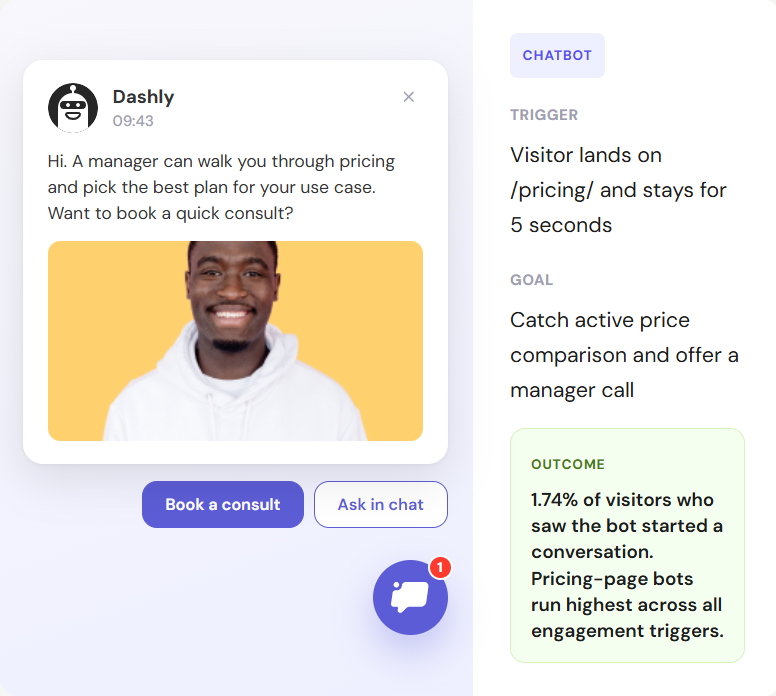
Use proactive chat triggers on high-intent pages. An AI agent that opens a conversation when a visitor spends 45 seconds on a pricing page captures leads that would otherwise leave silently. Based on Dashly’s internal customer data, visitors who engage with a chat on a pricing page convert at 3x to 5x the rate of those who don’t.
Here’s how personalized engaging messages work in Dashly:
Run retargeting campaigns for visitors who don’t convert on first visit. ToFu visitors rarely buy immediately. A retargeting sequence that surfaces a relevant case study to someone who read a blog post 7 days ago pulls them back into the funnel at Interest, which is exactly where they were already heading.
Middle of funnel (Interest and early Decision)
Build email nurture sequences by segment, not by mailing list. A sequence for startup founders should look different from one for enterprise RevOps leads. Segment by job title, company size, and intent signal at minimum. Generic newsletters don’t move qualified buyers forward, they just keep your unsubscribe rate low.
Use AI qualification to route leads immediately. An inbound lead that matches your ICP should be booked into a demo, not left to download another ebook. Leads that don’t match ICP criteria should enter a lighter nurture track rather than consuming SDR time that could go to stronger prospects.
AI-powered qualification in real time
Personalize case studies to the buyer’s vertical. A FinTech VP evaluating a pipeline tool is not moved by an eCommerce success story. Mapping your case study library by industry and company size, and surfacing the right one in the right nurture sequence, is one of the highest-leverage MoFu tactics available.
Bottom of funnel (Decision and Action)
Reduce friction in demo booking. If a prospect has to send three emails to schedule a call, a meaningful percentage will choose a competitor that offers a self-serve calendar link. One fewer click between “I want to talk” and “I have a meeting booked” compounds across every BoFu lead every week.
Build an automated sales funnel that keeps prospects moving when your team is offline. This matters most for international markets, cross-time zone deals, and inbound leads that arrive over the weekend. An AI agent that qualifies and books around the clock removes one of the most common BoFu friction points entirely.
Follow up within 5 minutes of any inbound signal. This is the single highest-leverage action at BoFu. The LeanData data cited earlier shows a steep drop in contact probability after the 5-minute mark. At 30 minutes, the odds of a meaningful conversation are a fraction of what they were at 5 minutes.
Across all stages
- Audit conversion rates between each stage quarterly; a drop in MQL-to-SQL rate usually means the MQL definition has drifted, not that sales is underperforming
- Align marketing and sales on the ICP definition and the lead scoring model; misalignment between these two teams is the root cause of most chronic funnel inefficiency
- Use lead scoring to route high-scoring leads to direct sales outreach and lower-scoring leads to automated nurture, so SDR capacity goes to prospects most likely to convert
Tools that support each sales funnel stage
No single platform covers the entire funnel effectively. Most B2B SaaS revenue teams run a stack of connected tools, with different platforms doing the heavy lifting at different stages.
Awareness (ToFu)
- SEO and content platforms: Ahrefs, Semrush for keyword research, content gap analysis, and organic performance tracking
- Paid advertising: Google Ads, LinkedIn Ads for demand generation campaigns and retargeting to website visitors who didn’t convert
- Landing page tools: for personalized entry points by segment, campaign, or intent signal that improve first-touch conversion rates
Interest and Decision (MoFu)
- CRM platforms: HubSpot and Salesforce are the two dominant tools for tracking HubSpot sales funnel stages and Salesforce sales funnel stages, managing MQL-to-SQL handoffs, and conversion reporting by stage
- Email automation: for segment-specific nurture sequences through the Interest and early Decision phases
- AI qualification agents: Dashly’s AI Inbound Revenue Agent qualifies inbound leads in real time against ICP criteria and routes them to the right path without human intervention, closing the MQL-to-SQL gap that CRMs can measure but can’t solve on their own
Action (BoFu)
- Meeting scheduling: for frictionless demo booking directly from chat, email, or landing page, without email ping-pong
- E-signature and payment tools: to reduce the gap between verbal agreement and signed contract
- Onboarding automation: to ensure new customers reach a first-value milestone within the first 14 days, reducing early churn before it becomes visible
For a full breakdown of the category options available today, the guide to best AI tools for sales funnel automation covers the leading platforms by funnel stage with pricing and use-case comparisons.
Conclusion
The sales funnel is the most practical diagnostic tool a revenue team has. Run the conversion numbers through each stage, find the worst conversion rate, and fix it. That is the entire optimization framework.
Four takeaways from this guide:
- The four stages, Awareness, Interest, Decision, and Action, define what buyers need at each point in the journey. Your message, channel, and tactic must match the stage or you’re spending budget on the wrong move.
- B2B SaaS funnels have longer cycles, multiple stakeholders, and often a trial stage between Interest and Decision. Track each sub-stage separately or you’ll miss where the real leakage is.
- The MQL-to-SQL handoff is the most common breakage point in B2B inbound funnels. AI qualification closes it by responding, qualifying, and routing in under 5 minutes instead of 42 hours.
- Metrics are your map. Conversion rates between every stage, reviewed monthly against benchmarks, tell you where to invest and what to cut.
If you want to see how AI agents work inside a live B2B inbound funnel, see how Dashly moves leads through each stage.
Frequently asked questions
The four stages are Awareness, Interest, Decision, and Action. At Awareness, buyers discover your product through content, ads, or referrals. At Interest, they evaluate your product against alternatives and engage with nurture content. At Decision, they shortlist options and go through a demo or trial. At Action, they purchase. Each stage has distinct buyer needs and requires different messages and tactics.
A sales funnel maps the buyer journey from stranger to customer, measured by conversion rates between stages. A sales pipeline maps your team’s active deals and their probability of closing. A funnel is population-level measurement; a pipeline is deal-level management. Revenue leaders need both: the funnel to find where buyers drop off, the pipeline to forecast and manage individual deals.
In CRM platforms like HubSpot or Salesforce, the term sales funnel stages usually refers to deal pipeline stages: Lead, Qualified, Demo, Proposal, Negotiation, and Closed Won or Closed Lost. These map to the Decision and Action phases of the buyer journey, not the full four-stage funnel. Most CRMs let you customize stage names and set conversion benchmarks for each transition.
No. The classic model uses 4 stages (Awareness, Interest, Decision, Action), but many B2B SaaS teams use 5 or 6 stages to match their CRM or PLG motion. Common additions include a Consideration stage between Interest and Decision, a Trial stage for product-led growth funnels, or a Retention stage after Action. The number of stages matters less than having clear conversion metrics for each transition you define.
Calculate stage conversion rate as: (prospects who moved to the next stage divided by total who entered the current stage) multiplied by 100. For example, if 500 leads reach the Interest stage and 100 become MQLs, the conversion rate is 20%. Track this for every stage transition, set benchmarks from industry data, and review monthly. A drop in any single rate is a diagnostic signal that points to where to focus optimization.
A B2B SaaS sales funnel has a longer middle section than a consumer funnel. The Awareness stage looks similar: content, ads, events. The Interest stage extends across 4 to 8 weeks of multi-stakeholder nurturing. Many SaaS funnels insert a free trial between Interest and Decision, where buyers self-qualify through product usage. The Action stage often includes a procurement and legal review step that extends the cycle by additional weeks.
AI agents accelerate the funnel at three points. At Awareness, they engage website visitors proactively with qualifying questions, capturing leads that would otherwise bounce. At Interest and Decision, they qualify inbound leads against ICP criteria in real time, route high-fit prospects to a demo booking flow, and hand context to the right rep. At the MQL-to-SQL handoff, they replace the average 42-hour follow-up lag with a sub-5-minute response, which is the highest-leverage improvement for any B2B inbound funnel.