AI SDR best practices: a 30-day implementation playbook
 14 minutes
 09.09.2026

AI SDR best practices come down to one sequence: launch the agent on a single inbound segment, record a baseline before it goes live, prepare its knowledge and rules in advance, test it, and review results every week against that baseline. Teams that follow this sequence get a working funnel in about 30 days. Teams that skip it end up with a pilot nobody reviews.
The gap between the two groups shows up fast. In the first, every inbound lead gets an answer in seconds, qualified leads book meetings on their own, and reps spend their time on calls. In the second, the tool runs in the background for a few months and then quietly gets switched off.
For the underlying definition, start with what an AI SDR is.
AI SDR best practices at a glance
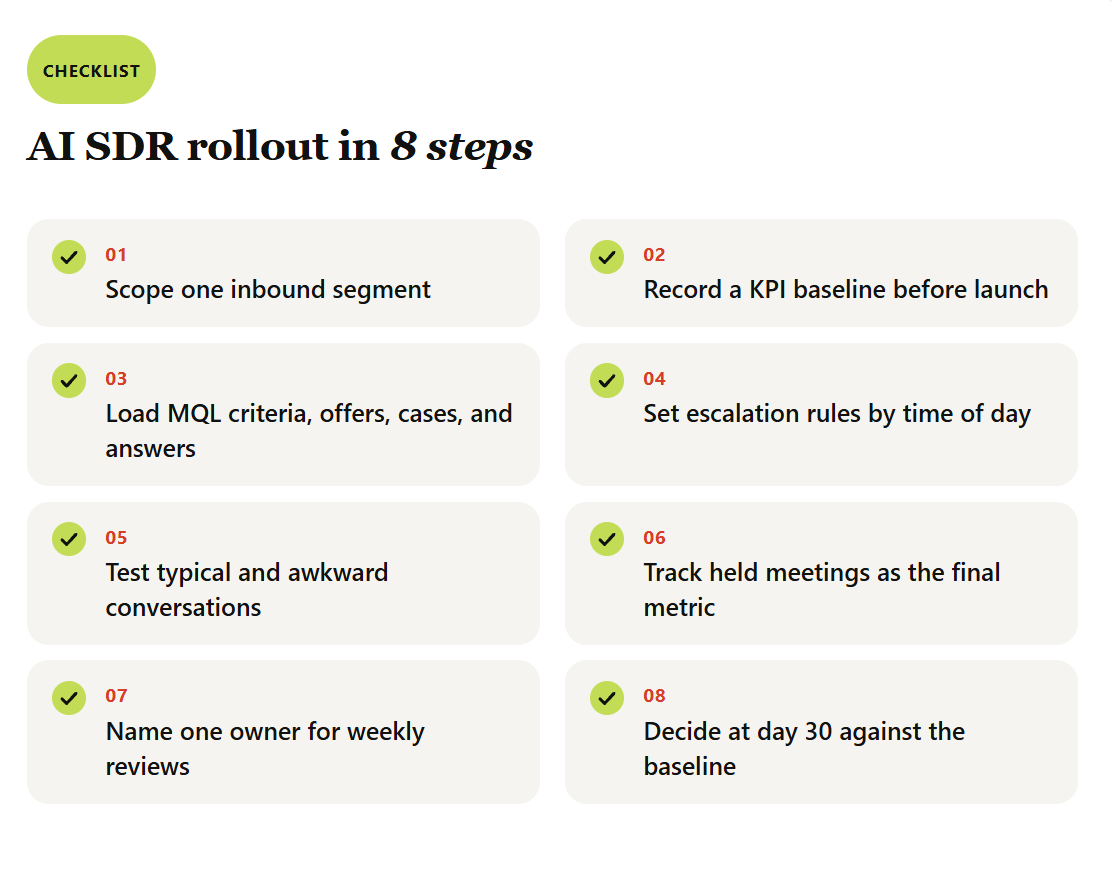
- Scope the first rollout to one inbound segment: one lead source, one region, or one ICP tier.
- Record a baseline for 2-3 KPIs before the agent goes live.
- Prepare the agent’s context: MQL criteria agreed with sales, offers, case studies, and answers to product questions.
- Write escalation rules that depend on the time of day, so no lead is left without a reply.
- Test the agent on typical and awkward conversations before it talks to real leads.
- Track held meetings as the final metric, with booked meetings as the step before it.
- Name one owner who reads conversations and reviews KPIs every week.
- At day 30, decide to scale, adjust, or stop based on the baseline rather than anecdotes.
Why most AI SDR rollouts stall before they scale
Most AI SDR rollouts stall because the pilot never had an exit condition. A team launches the agent, sees a few good conversations, and calls it a success without a baseline to compare against. Without a KPI review inside the first 30 days, a pilot turns into a permanent pilot.
Teams that are ready usually have an executive sponsor who reviews the pilot personally, a reasonably clean CRM, and a sales team that knows why the pilot exists before the first agent-booked meeting lands on their calendar.
Adoption itself is rarely the issue. 83% of sales teams using AI saw revenue growth, compared with 66% of teams without it, according to Salesforce’s 2024 State of Sales Report. Once most competitors run some form of AI, the difference comes from execution: a defined scope and an owner who stays involved after week one.
The building blocks of an AI SDR that works
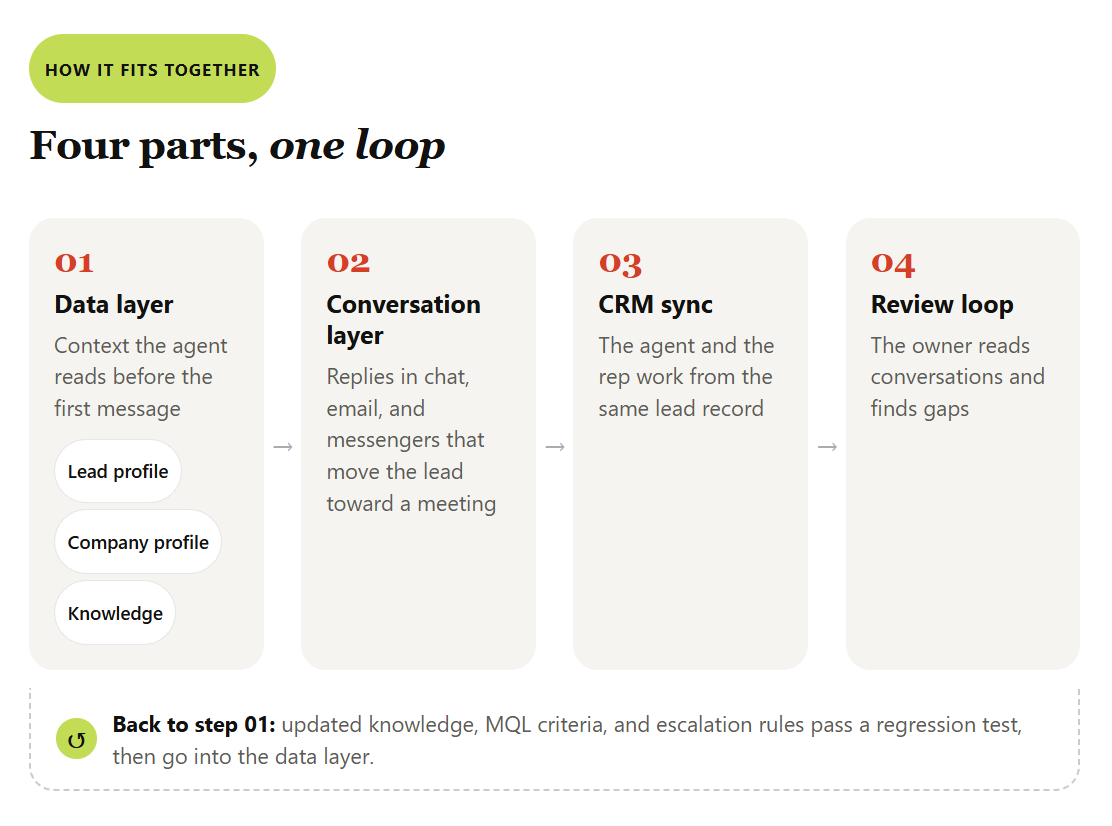
An AI SDR works only as well as its weakest part: the data layer, the conversation layer, CRM sync, or the review loop.
The data layer is the context the agent reads before it writes the first message. It answers three questions. Who is the lead: behavior on the site, past conversations in every channel, CRM data, enrichment, and derived attributes such as intent and lead tier. Who the agent speaks for and what it sells: positioning, ICP, offers, case studies, MQL criteria, tone of voice, team calendars, and escalation rules. What it can answer: documentation, help center articles, and FAQs.
Lead scoring is one part of that profile. The lead tier tells the agent where to route the lead, and the rest of the profile tells it what to say. An agent with a full profile opens the conversation with context and never asks a question the data already answers.
The conversation layer is what the lead experiences: replies in web chat, email, and messengers that answer the actual question and move toward a meeting. Vendor demos show this layer at its best, so test it on real traffic.
CRM sync keeps the agent and the rep on the same lead record in real time. Broken sync makes reps stop trusting the agent mid-rollout: the agent books a meeting the rep never sees.
The review loop closes the system. The pilot owner reads conversations, finds where the agent lacked an answer or misjudged a lead, and updates the knowledge, MQL criteria, and escalation rules. The agent gets better because the team improves its context, on a schedule the team controls. In Dashly’s AI SDR agent, every change to the agent passes a regression test set before release.
What to prepare before launch
Most of the work in an AI SDR implementation happens before the agent talks to a single lead. Gaps in preparation show up later as wrong answers or leads left waiting.
Prepare these inputs before week two:
- MQL criteria agreed with sales. Which answers make a lead worth a rep’s time, written together with the people who take the meetings.
- Knowledge for answers. Product documentation, help center articles, and the questions your team answers every week.
- Offers and case studies. What the agent can propose to each segment, and which customer stories fit which type of lead.
- Tone of voice. How your company writes to prospects, with examples of good replies.
- Escalation rules. Which questions go to a person, who receives them, and what happens outside working hours.
- Team calendars. Which reps take which meetings, so the agent books into real availability.
- CRM access. Which fields the agent reads, which it writes, and where a booked meeting appears for the rep.
MQL criteria deserve the most attention. VoiceFirst, a cloud communications platform, defined them from four signals: the lead’s role, the main use case, the expected task volume, and the estimated number of platform users. Criteria at that level of detail let the agent qualify in conversation instead of through a long form.
A 30-day rollout plan for AI SDR implementation
A 30-day AI SDR rollout plan has four stages: scope and baseline in week one, configure and connect in week two, test and run a live pilot on a limited segment in week three, and review results against the baseline in week four. Compressing these stages leaves the pilot without a fair test.
Week 1: scope and baseline
Pick one lead segment, such as one region, one lead source, or one ICP tier. Agree on 2-3 KPIs and record the current value of each before touching the tool. Without a pre-rollout baseline, week four’s results have nothing to compare against.
Week 2: configure and connect
Connect the AI SDR to the CRM and to the channels the segment uses, and load the inputs from the preparation checklist. Then set escalation rules by time of day. During working hours the agent hands the conversation to a rep right away. At night and on weekends it notifies the rep and keeps the conversation going.
Week 3: test and run the pilot
Run the test conversations described in the next section before the agent meets real leads. Then let it work the chosen segment live, with the owner reading transcripts daily for the first few days and weekly after that. Fix knowledge gaps and escalation rules as they surface, and hold off on expanding scope until the review.
Week 4: review and decide
Compare results against the week-one baseline on the agreed KPIs, and leave anecdotes out of the decision. Scale, adjust, or stop the pilot, and document the reasoning either way, so the next rollout doesn’t repeat the same blind spots.
How to automate SDR workflows with an AI SDR
Automation works best when the split between agent and people is explicit. From day one, the agent can take over:
- The first reply to every inbound lead, within seconds and at any hour
- Qualification in conversation against your MQL criteria
- Answers to product questions from the knowledge you prepared
- Booking the meeting into the right rep’s calendar
- Reminders between booking and the call, so the meeting takes place
Reps keep the meeting itself, escalated conversations, and deals that need negotiation. The agent brings the lead to the call, and a person sells on it.
Map this plan to your funnel before locking the week-one scope, so the KPIs match how your team sells.
How to test the agent before it talks to leads
Testing before launch catches the mistakes that are expensive to make in front of a real prospect. Run the agent through a set of test conversations that cover typical and awkward cases:
- A qualified lead who asks for a demo straight away
- A product question the knowledge doesn’t cover
- A lead who clearly falls outside your ICP
- A request to talk to a person at 11 pm on a Saturday
- A returning lead whose earlier conversation is already in the CRM
For each case, write down the expected behavior before running it. When the agent lacks an answer, it should ask a clarifying question or escalate. It should route non-fit leads away from rep calendars, keep the night-time lead engaged while notifying a rep, and open the returning lead’s conversation with what it already knows.
Keep these conversations as a fixed test set. Every time you change the knowledge or the rules, rerun the set before the change goes live: a fix for one scenario can break another.
KPIs to track during and after rollout
Four numbers tell you whether an AI SDR rollout works: lead-to-meeting rate, response time, meeting show-up rate, and cost per held meeting. Track all four from week one. A rollout that reports only its best metric is usually hiding a weak one.
Separate booked meetings from held meetings in every report. Count a meeting only when the lead shows up on the call. Optimizing for bookings alone pushes the agent to schedule anyone. Getting the lead from booking to the call is part of the agent’s job: it sends reminders until the meeting takes place.
| KPI | What it measures | What to watch |
|---|---|---|
| Lead-to-meeting rate | Share of leads in the segment that book a meeting | Compare with the week-one baseline, not a vendor benchmark |
| Response time | Time from the lead’s first message to the first reply | A lead that waits an hour is already cooling off |
| Meeting show-up rate | Share of booked meetings that take place | Turns booked meetings into held meetings, the final metric |
| Cost per held meeting | Rollout cost divided by meetings that took place | The number to report before asking for budget to scale |
A weekly reporting cadence keeps these numbers honest. The pilot owner pulls all four into one view, compares them against the week-one baseline, and flags anything moving the wrong way before the week-four review.
See these KPIs in your data before committing to a full-scale rollout.
Guardrails: what a good AI SDR never does
Guardrails define what the agent must never do, whatever the conversation. Write them down before launch and add each one to the test set. A good AI SDR:
- Never invents an answer. When its knowledge doesn’t cover a question, it asks a clarifying question or brings in a person.
- Never asks what it already knows. If the lead’s company, role, or earlier request is in the profile, the agent uses it.
- Never leaves a lead in silence. Outside working hours it notifies a rep and keeps the conversation going.
- Never runs a follow-up sequence on top of a live conversation. Reminders stop as soon as the lead replies.
- Never pushes an unqualified lead onto a rep’s calendar. Leads that miss the MQL criteria go to self-serve or a longer nurture track.
Common failure modes and how to avoid them
AI SDR rollouts most often fail for three reasons: no clear owner after the pilot ends, escalation rules that never got written down, and a team that expected full automation on day one instead of a 30-day ramp. In 2024, Gartner predicted that 30% of generative AI projects would be abandoned after proof of concept by the end of 2025. AI SDR pilots follow the same pattern when nobody owns the metrics past week one.
The most common failure is organizational. A pilot gets sponsored, runs for a few weeks, and then the sponsor moves to the next priority. Nobody schedules the week-four review, so the pilot keeps running in the background until someone asks why it’s still not live company-wide.
Unwritten escalation rules cause the second failure. The agent meets a question it can’t answer, has no rule for it, and the lead waits. Writing the rules before launch and testing them in the test set closes this gap before real leads reach it.
Dashly’s own team hit a version of these problems early on. The full account of that rollout is worth reading before starting a pilot.
Data privacy needs a real answer during rollout planning. Every AI SDR touches lead data across channels, so review data handling before launch. A prospect will ask where their information went. Check where the vendor stores data, whether it signs a DPA, and what GDPR measures it has in place. Dashly’s terms and policies cover these points.
Proof: what AI SDR best practices look like in production
InfluADS, Advertising Socials, and VoiceFirst ran these practices on live inbound traffic. Each started with a funnel problem, and each result below comes from the published case study.
InfluADS, a MarTech platform for influencer marketing, had only a signup path: a lead’s road to a deal began after registration. The team built a demo funnel next to it. A qualification quiz sorted leads into three tiers, two of them MQL, and sent each tier into its own CRM pipeline, while the AI SDR booked meetings around the clock.
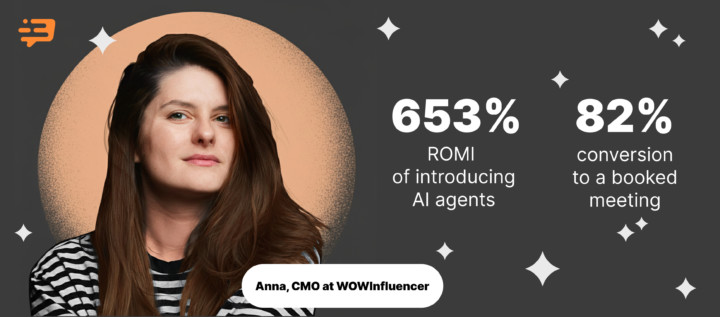
The result was 568% ROMI: every dollar spent on Dashly returned $5.68, and 70% of marketing-qualified leads booked meetings without a manager involved.
Advertising Socials, a social-ads platform with around 500,000 monthly visitors, built its demo funnel from scratch: a demo offer on the site, a qualification quiz, and instant booking for MQLs. Leads who didn’t book right away got AI SDR follow-up in chat, WhatsApp, and email. The signup flow changed the same way. Qualified signups got an instant meeting offer instead of a promise that a manager would reply within an hour.
First-response time dropped from about an hour to about a second, and the team reached 98% of the targets agreed before launch within three months.
Conclusion
AI SDR best practices start with one segment and a baseline you trust; the rest of the plan depends on those two.

FAQ
AI SDR best practices are the principles behind a rollout: scoping, baselines, KPIs, and ownership. AI SDR implementation is the technical setup, including connecting the CRM, configuring channels, and writing qualification rules. A rollout needs both to work.
A focused pilot on one lead segment takes about 30 days: a week to scope and record a baseline, a week to prepare and configure, a week to test and run the pilot live, and a week to review results before deciding to scale.
A well-run rollout keeps a person in the loop. The agent handles first replies, qualification, follow-up, and meeting booking at scale, while a person handles escalations, the meeting itself, and anything the agent can’t answer from its knowledge.
Aim to beat the week-one baseline on lead-to-meeting rate, response time, and show-up rate, rather than hitting an absolute number from a vendor’s marketing page. Judge the pilot on held meetings, with bookings as the step before. Published Dashly case studies show what a full rollout can reach: InfluADS reached 568% ROMI, and Advertising Socials cut first-response time from about an hour to about a second.
The core discipline stays the same (scope, baseline, pilot, review), but the KPIs shift. Inbound rollouts weight response time and lead-to-meeting rate heaviest, since the lead already showed intent. Outbound rollouts weight reply rate and meeting show-up rate more heavily, since the agent is initiating contact with someone who hasn’t engaged yet.
They work when the rollout is scoped and the agent has the context it needs. In published Dashly case studies, 70% of InfluADS marketing-qualified leads booked meetings without a manager, and up to 70% of VoiceFirst leads booked meetings on their own.
The agent replies to every inbound lead within seconds, qualifies it against your MQL criteria, answers product questions, books meetings, and sends reminders until the meeting takes place. The team reads its conversations and refines its knowledge and rules.
The cost has two parts: the platform and your team’s time. Most of the time goes into preparing MQL criteria, knowledge, offers, and escalation rules, plus a pilot owner who reviews conversations and KPIs weekly. Platform pricing varies by vendor, so ask for a quote based on your inbound volume.
Related reading in the AI SDR series