What are inbound leads? How to generate and convert more for B2B SaaS
 15 minutes
 15.05.2026
Your website gets traffic every day. Visitors read your blog posts, check your pricing page, and fill out demo request forms. Then they wait.
Six hours later, an SDR sends a follow-up email. The prospect already had a call with a competitor and went cold.
It’s not about getting more traffic. You’re already generating plenty of inbound leads. The problem is what happens after they show up: slow response, no qualification system, leads falling through the cracks before sales ever sees them.
Inbound leads are the highest-intent contacts in your pipeline. They found you, consumed your content, and decided you were worth reaching out to. When you handle them well, they close faster, cost less to acquire, and churn less than outbound contacts.
This guide covers:
- What inbound leads are and how they differ from outbound;
- Why they convert better;
- 8 ways to generate more of them;
- How to qualify them before your SDR touches them;
- Why speed-to-lead determines whether you win or lose the deal.
Let’s dive in 👇
What are inbound leads?
An inbound lead is a prospective customer who finds your business through your content, search results, or product and then takes an action that signals interest. They reach out to you. You didn’t cold-call or email them first.
That action looks like filling out a contact or demo form, starting a live chat conversation, downloading a guide, signing up for a free trial, or subscribing to a newsletter.
The inbound leads definition, at its core: the prospect chose to engage. That buyer intent separates inbound leads from outbound ones before a single conversation happens.
The inbound leads meaning extends further than just “they filled out a form.” It’s about the context they carry. An inbound lead has already read your content, evaluated your product category, and decided you’re worth their time. That’s a fundamentally different starting position than a cold outbound contact.
Types of inbound leads
Not all inbound leads are equally ready to buy. Three categories matter most in B2B SaaS:
- MQL (Marketing Qualified Lead): Showed interest in content or an offer but hasn’t been vetted for sales fit. They clicked on a case study, downloaded a guide, or attended a webinar.
- SQL (Sales Qualified Lead): Reviewed by sales or scored by your system and confirmed ready for a conversation. They match your ICP, visited your pricing page, or requested a demo.
- PQL (Product Qualified Lead): Used your product through a free trial or freemium plan and hit a trigger that signals upgrade intent: reached usage limits, invited teammates, or activated a premium feature.
PQLs convert at the highest rate because the prospect has already experienced your product’s value firsthand.
A visitor who reads your blog about inbound lead generation and then books a demo is a textbook inbound lead: they found you through content, evaluated their options, and raised their hand.
Inbound leads vs. outbound leads: key differences
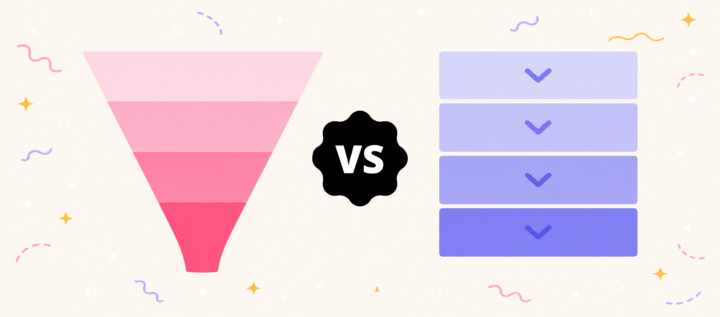
The inbound vs outbound debate often misses the practical point. The real difference is who initiates contact and that single factor changes every subsequent dynamic: cost, trust, cycle length, and conversion rate.
| Inbound leads | Outbound leads | |
|---|---|---|
| Initiative | Prospect finds you | You reach out to prospect |
| Buyer intent | High — they’ve already researched | Low — you interrupted them |
| Cost per lead | Lower (typically 61% less) | Higher (SDR time + ad spend) |
| Sales cycle | Shorter | Longer |
| Trust at first contact | Higher — they already know you | Lower — cold outreach |
| Scalability | Content compounds over time | Linear: more effort = more leads |
Cold calling and paid prospecting still work. But inbound and outbound leads close differently. An inbound lead already trusts you enough to ask for a conversation. An outbound lead needs convincing you’re worth 20 minutes of their calendar.
The strongest B2B lead generation strategy uses both: inbound marketing lead generation for scalable, compounding pipeline; outbound for targeted account pursuit. Inbound vs outbound lead generation is a sequencing question.
Why inbound leads convert better: the data
Three numbers explain why inbound lead gen deserves prioritization in your revenue strategy.
Inbound leads cost 61% less to acquire than outbound leads, according to HubSpot’s State of Marketing research.
Research published in the Harvard Business Review found that leads contacted within 1 hour are 7x more likely to be qualified than leads contacted later. And the probability drops with every hour of delay.
The conversion rate for inbound leads consistently outperforms outbound in B2B SaaS because leads arrive with context: they’ve read your content, checked your pricing, and maybe watched a case study. Your SDR’s first call continues a conversation the buyer already started in their head.
The implication for demand generation teams: generating more inbound marketing leads often matters less than responding to the ones you already have. Most pipeline is lost not in acquisition but in response speed and qualification quality.
8 ways to generate inbound leads for B2B SaaS
These are the best-performing channels for your inbound lead generation strategy, ordered by how reliably they produce high-quality inbound leads at scale. The best way to generate inbound leads is to combine channels so they reinforce each other.
1. Content marketing and SEO
SEO-driven content is the backbone of most B2B inbound marketing lead generation programs. Blog posts, comparison pages, glossary content, and use-case guides attract buyers at every funnel stage.
The compounding nature of content is its main advantage over paid channels: a well-ranked article on “how to qualify inbound leads” keeps generating inbound sales leads months or years after publishing, with no additional cost per click.
What works for a B2B SaaS content strategy:
- Educational guides targeting buyer questions at every funnel stage
- Comparison pages that capture high-intent buyers evaluating options
- Use-case and industry pages built around specific ICP segments
- Glossary pages for foundational terms in your product category
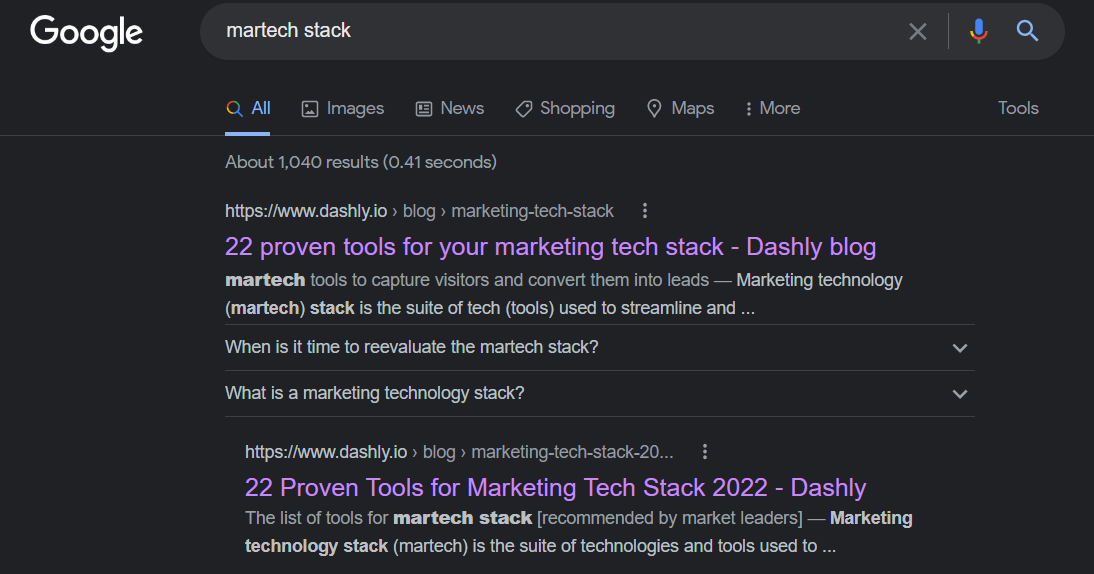
Marketing tech stack post includes numerous lead magnets we offer in exchange for readers’ contacts
Pair content with CTAs, live chat, and lead magnets to convert organic readers into qualified leads. Without a capture mechanism, SEO drives website traffic but not leads.
2. AI agents on the website
An AI agent captures inbound sales leads at the moment of peak buyer intent, while the visitor is reading your pricing page or reviewing a case study. That window is short. Forms lose it. The agent doesn’t.
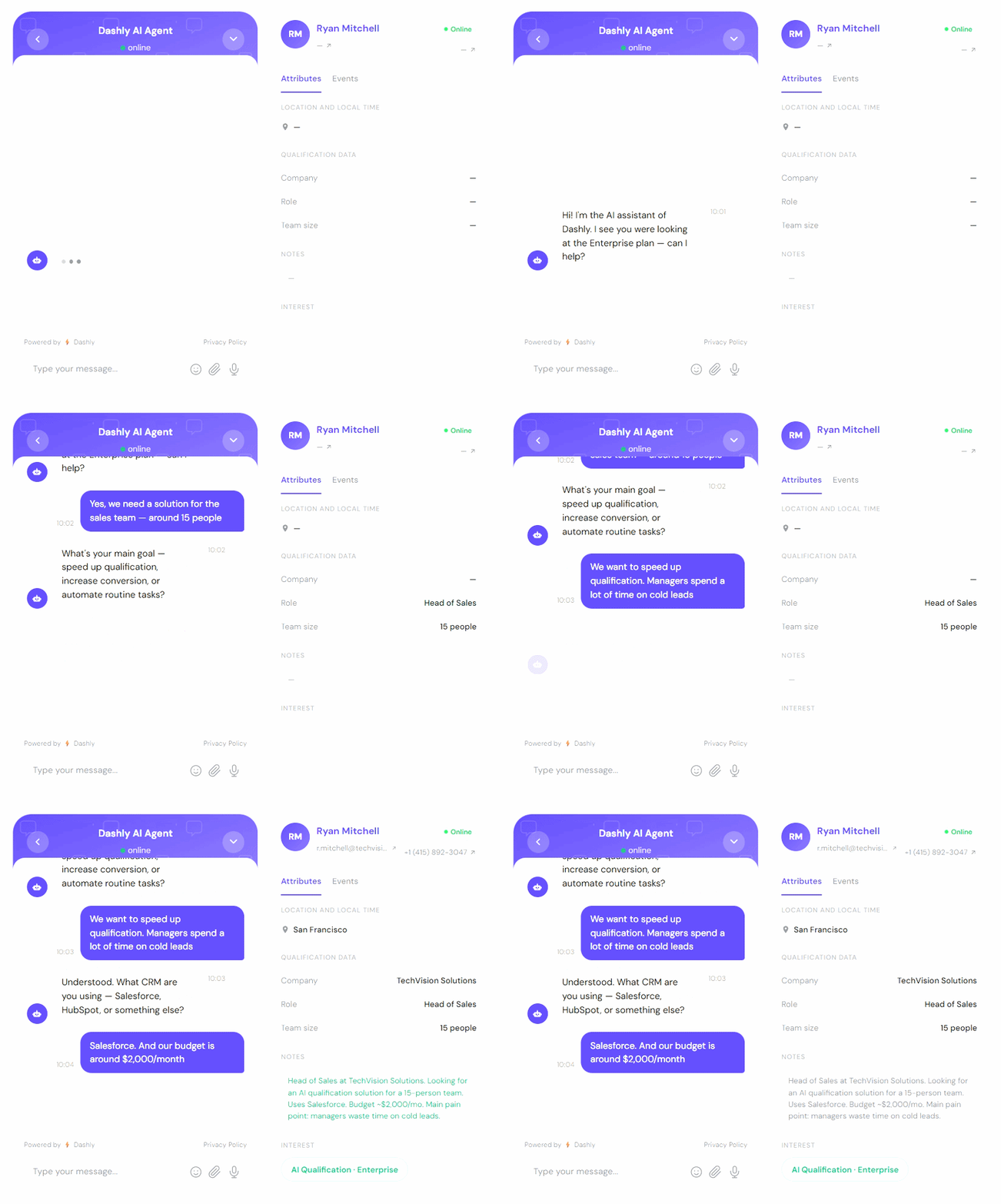
An AI-powered qualification agent handles the full cycle in the same session: asks 3-5 ICP screening questions, scores the responses, routes qualified leads to a meeting, and sends the rest to a nurture sequence without waiting for an SDR.
Here’s how it works in practice: the agent qualifies the lead, handles their questions and book a meeting if they’re a good fit 👇
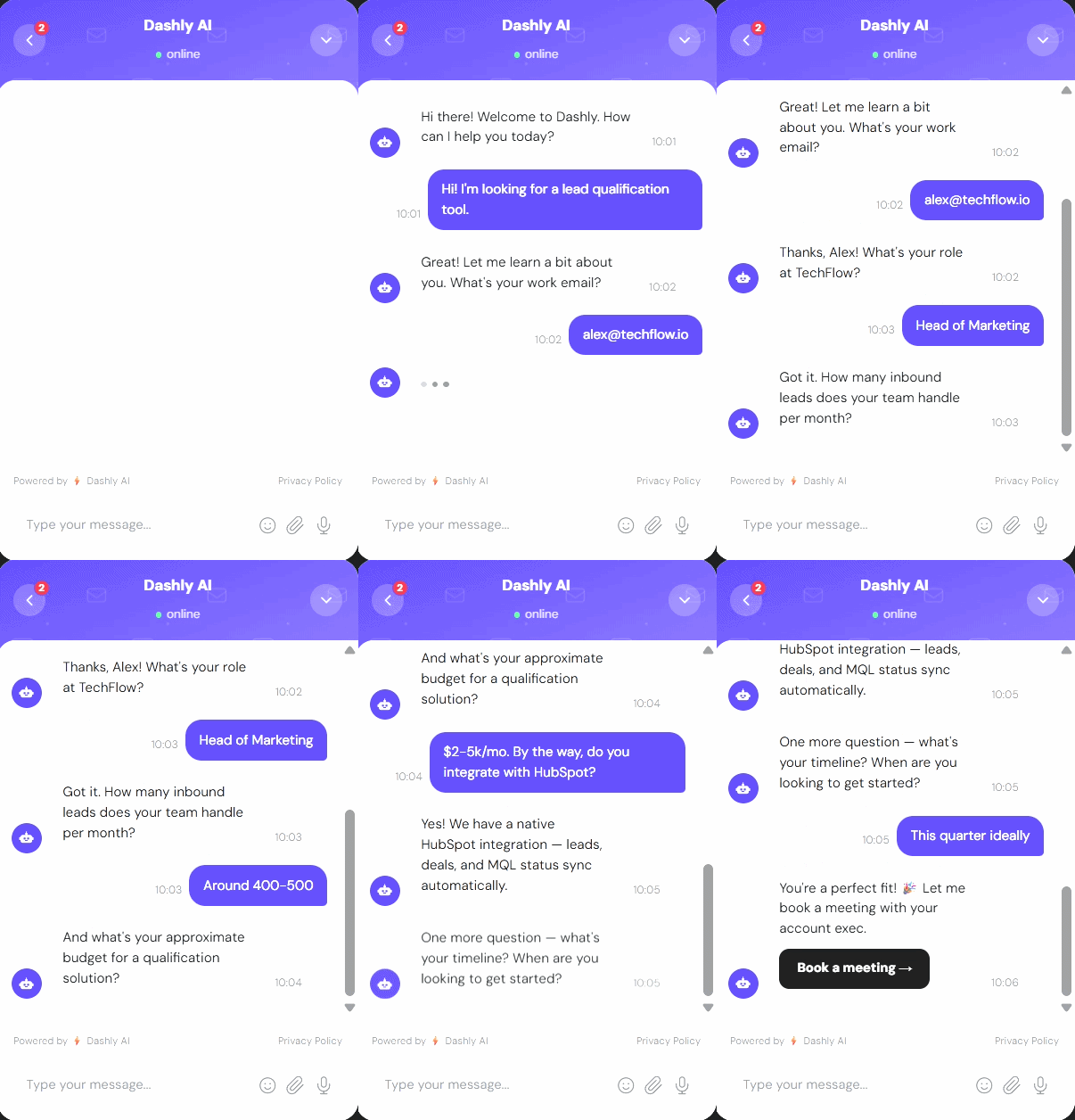
This is the single highest-leverage channel for converting existing website traffic into inbound lead gen results. Dashly’s AI Qualifier runs 24/7, handles multiple conversations simultaneously, and qualifies inbound sales leads in real-time before handing off to your sales team.
💡 Pro tip: Set up your qualification agent to trigger on high-intent pages (pricing, comparison, case studies) rather than on every page. You’ll qualify more inbound leads without interrupting low-intent visitors.
3. Landing pages with lead magnets
A landing page with a gated resource (guide, ROI calculator, audit template, benchmark report) converts website traffic into inbound marketing leads by offering something genuinely useful in exchange for contact information.
Conversion rate for these pages depends on three factors: relevance (does the resource match what the visitor is researching?), friction (is the form short enough?), and trust signals (testimonials, G2 ratings, recognizable company logos).
Best-performing lead magnets for B2B SaaS: ROI calculators, implementation templates, industry benchmark reports, and limited free tool access. The closer the resource is to the buyer’s actual job, the better it converts.
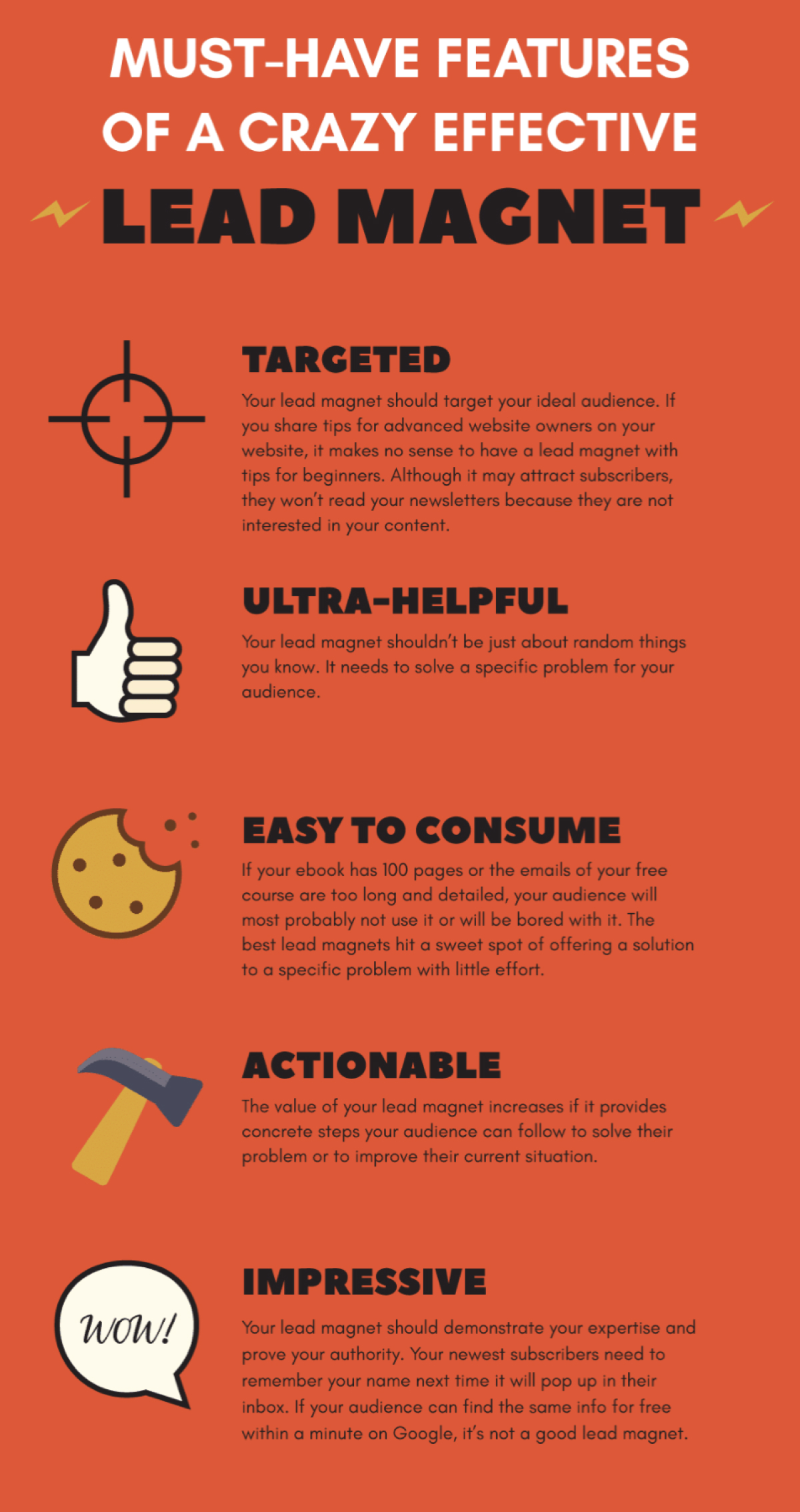
Here are a few tips on making an actually useful lead magnet:
4. Email marketing and lead nurturing
Email keeps inbound leads in your sales funnel between touchpoints. A visitor who downloaded your guide but wasn’t ready to buy can become a qualified lead 6 weeks later when a behavior-triggered nurture sequence delivers the right case study at the right time.
Lead nurturing via email works best when sequences are behavior-triggered (opened email X, visited page Y), content matches funnel stage (awareness to consideration to decision), and send frequency is controlled. Daily blast sequences kill engagement fast.
Email marketing and lead nurturing together add a layer to your inbound lead generation strategy that converts leads who weren’t ready the first time. For B2B lead generation, email is a retention channel for leads who’ve already shown interest, not a cold prospecting tool.
5. Social media and LinkedIn
Organic LinkedIn content builds trust with your target audience and generates inbound sales leads from your exact ICP. Decision-makers in B2B SaaS consume LinkedIn content daily. Posting consistently about the problems your product solves places you in their consideration set before they start a formal vendor evaluation.
Paid social amplifies reach but costs more per lead than organic SEO. For B2B SaaS, LinkedIn ads work best for retargeting visitors who’ve already engaged with your content, not for cold-audience inbound lead gen.
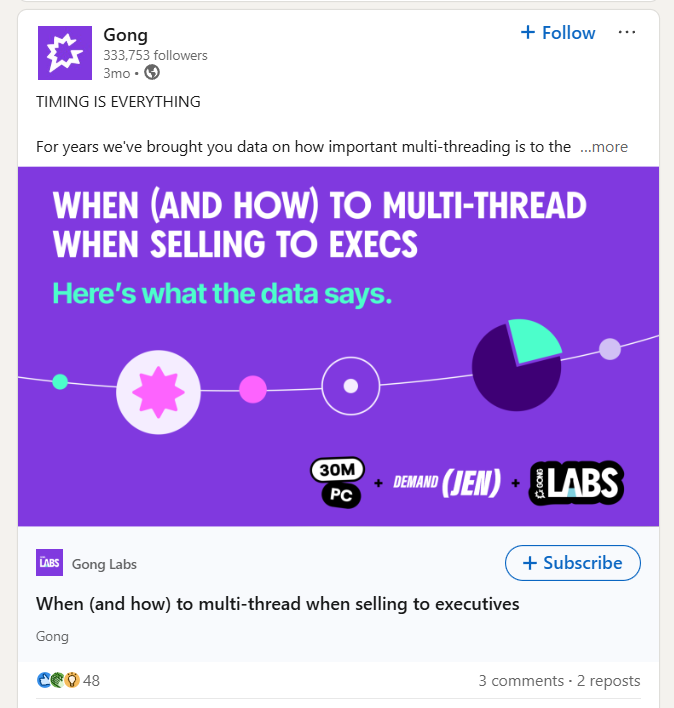
Here’s an example of content distribution by Gong:
6. Webinars and virtual events
A webinar registration is a high-intent inbound marketing lead. The prospect committed 60+ minutes to learn about a problem you solve. That’s a fundamentally different signal than a passive content download.
Post-webinar follow-up is where most teams leave pipeline on the table. A same-day email with the recording and a specific next step (demo offer, free audit, consultation) converts webinar registrants at significantly higher rates than generic sequences sent 2-3 days later.
7. Case studies and customer testimonials
Case studies capture buyers at the evaluation stage. When a prospect compares vendors, a case study from a similar company (same industry, company size, and pain point) often closes the gap between “interested” and “ready to talk.”
The format matters. Leads want specific metrics, not vague outcomes. A concrete before-and-after structure with real numbers is more convincing than a paragraph of praise. Pair case study pages with a chatbot CTA and you qualify readers the moment they finish reading.
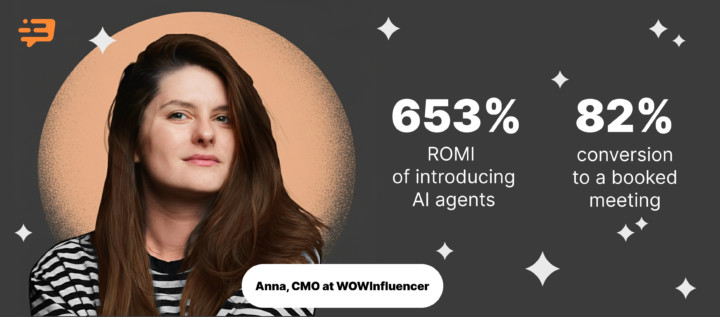
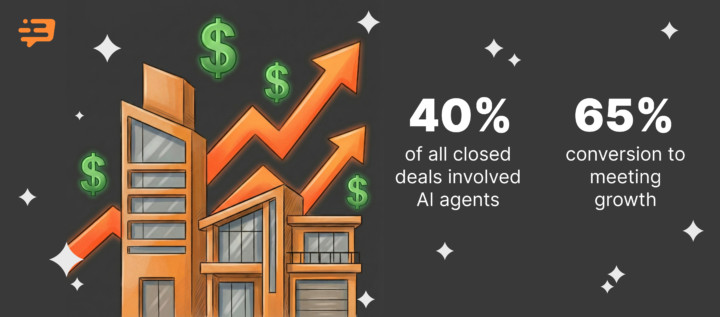
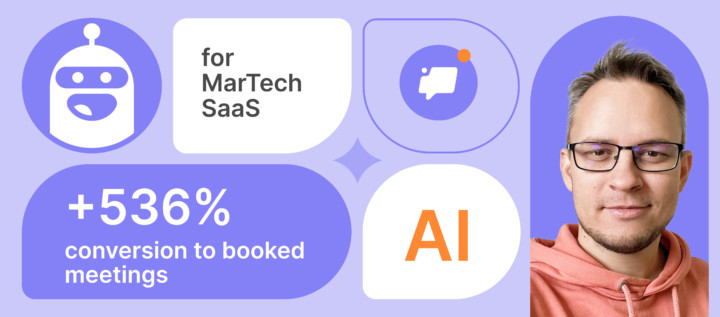
By the way, you can check out impressive results our customers achieve in our case studies 😉
8. Product-led growth and free trials
A free trial or freemium tier is the inbound lead gen channel with the highest conversion rates in SaaS. When a user tries your product and hits a genuine value moment, they become a PQL (the warmest type of inbound lead available).
The product experience is the demo. Your job is to instrument usage data so sales can prioritize trial users by intent signals: feature activations, usage frequency, team invitations, and integration connections. This turns your product into the most effective inbound marketing channel you have.
How to qualify inbound leads before your SDR touches them
Not every inbound lead belongs in your pipeline. Inbound lead qualification is the process of filtering high-quality inbound leads from noise before your sales team spends time on them.
Define your ICP criteria first
- Company size (employee count or ARR range)
- Industry (which verticals your product actually serves)
- Role (who makes or influences the purchase decision)
- Tech stack (does your product integrate with what they use?)
- Behavioral signals: visited pricing 3+ times, requested a demo, activated a trial feature
BANT as a qualifier framework
Budget, Authority, Need, Timing. Use BANT to frame qualification questions in your chatbot or on the first sales call. You don’t need all four confirmed. Need + Authority is usually enough to route a lead to a meeting.
Lead scoring in practice
Assign point values to actions and attributes, then route leads automatically when they cross a score threshold:
| Action / attribute | Score |
|---|---|
| Visited pricing page | +20 |
| Requested a demo | +30 |
| Downloaded a case study | +10 |
| Opened 3+ emails in sequence | +5 |
| Matches ICP company size | +15 |
| Matches ICP industry | +15 |
| Free trial activation | +25 |
Leads above your threshold (e.g., 60+ points) route to sales. Below-threshold leads go into nurture. This lead management system ensures your SDRs work only on already-qualified inbound sales leads, not raw form submissions. For more on structuring this process, see our guide on lead qualification.
AI-powered inbound lead qualification
An AI qualification agent handles qualifying inbound leads in real-time during the chat session. It asks your ICP questions, scores the answers against your criteria, and either books a meeting or routes the lead to a nurture sequence — all in the same session, without SDR involvement.
This removes the qualification bottleneck entirely. Your sales team only sees leads that have already passed the filter.
The speed-to-lead problem: why fast response wins
Speed-to-lead is the most underestimated variable in inbound lead conversion. The data is unambiguous.
Research published in the Harvard Business Review found that leads contacted within 1 hour are 7x more likely to be qualified than leads contacted after that window. And the probability continues to drop with every hour of delay.
Most B2B SaaS companies respond to inbound leads in 4-6 hours. By then, the prospect has moved on.
The fix is replacing the form-and-wait model with a chat-and-qualify model. A chatbot or AI SDR responds the moment the lead is on your site when buyer intent is at its peak. It qualifies, routes, and books the meeting in the same session, before the lead goes cold.
A practical example: a B2B SaaS company with 10,000 monthly visitors was running a standard form-based capture model. SDRs followed up 4-6 hours after submission. Meeting conversion rate: 12%. After switching to an AI qualification agent that responded instantly and automatically booked demos, meeting conversion went to 28%.
The leads were the same quality. The pipeline doubled. The difference was response time.
For inbound sales leads, speed-to-lead is the variable that separates a 12% conversion rate from a 28% one. It’s also the gap that none of the top-ranking competitors address in their content on inbound leads. Winning it is how you generate high-quality inbound leads at scale without increasing lead volume.
Tools to capture, qualify, and manage inbound leads
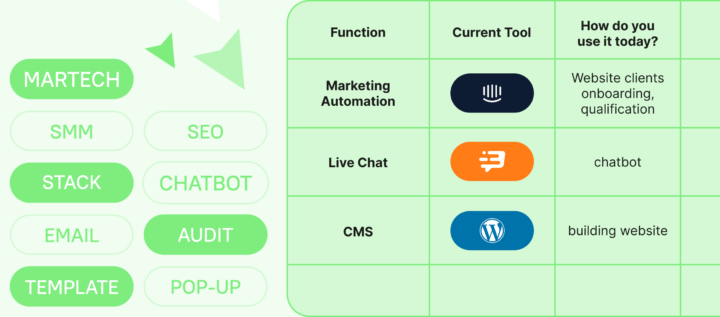
A complete inbound lead gen stack covers four categories. Here are the best tools for driving and managing inbound leads at each stage:
| Category | What it does | Examples |
|---|---|---|
| Chatbot / AI agent | Real-time capture, qualification, and meeting booking | Dashly, Drift |
| CRM | Lead storage, routing, conversation history, pipeline tracking | HubSpot, Salesforce, Pipedrive |
| Marketing automation | Lead nurturing, email sequences, behavioral scoring | HubSpot, ActiveCampaign |
| Landing page builder | Lead capture through gated content and optimized forms | Unbounce, Webflow |
| Analytics | Attribution, pipeline tracking, channel performance | Dashly Analytics, GA4 |
Dashly combines the chatbot, AI qualification agent, and analytics layer in one platform, so your inbound lead generation strategy doesn’t require stitching together five separate tools and maintaining five separate integrations.
Start converting the inbound leads you already have
Inbound leads are the most purchase-ready contacts in your pipeline. They showed up, consumed your content, and decided you were worth talking to. Your job is to be ready when they arrive: capture the signal, qualify instantly, and respond fast enough to be the first vendor they actually speak with.
The teams that win at inbound lead gen don’t generate more leads. They respond faster, qualify more precisely, and convert the website traffic they already have.
Inbound leads FAQ
An inbound lead is a prospective customer who finds your business through content, search results, social media, or referrals — and then takes an action to express interest, such as filling out a form, starting a chat, or signing up for a free trial. Unlike outbound leads, inbound leads initiate contact themselves. That buyer intent signals they’ve already done some research, which is why inbound leads typically close faster and cost less to acquire than outbound contacts.
Inbound leads find you through content, SEO, social media, or referrals and raise their hand. Outbound leads are identified by your team and contacted through cold calls, email prospecting, or paid ads. Inbound leads close faster and cost significantly less to acquire — but outbound gives you direct control over targeting and timing. The strongest B2B pipeline strategies use both.
The most effective inbound lead generation channels for B2B SaaS are: SEO content targeting buyer-intent keywords, a website chatbot or AI agent that captures and qualifies visitors in real-time, gated lead magnets on landing pages, behavior-triggered email nurture sequences, LinkedIn content marketing, webinars, and free trials or freemium products that turn users into PQLs.
Use ICP criteria (company size, industry, role, tech stack) combined with behavioral signals (pages visited, emails opened, trial usage). Assign lead scores to actions and route leads above your threshold to sales automatically. An AI qualification agent can handle this in real-time during the chat session, so your SDRs only work with leads that have already passed the filter.
Within 1 hour, ideally within 5 minutes. Harvard Business Review research shows leads contacted within 1 hour are 7x more likely to be qualified than those contacted later. A chatbot or AI agent eliminates this problem by responding instantly, qualifying the lead in real-time, and booking a meeting before buyer intent fades.
A B2B marketing director reads your blog post about lead qualification, downloads a free audit template, and then opens a chat asking about your pricing plans. They’re an inbound lead: they found your content through search, engaged with it, and self-identified as a potential buyer. Your job is to qualify them and book a meeting before that intent fades.