Guide to 10 best AI tools for sales funnel automation in 2026
 28 minutes
 03.02.2026
According to the McKinsey research, your sales team spends only one-third of their time actually selling.
The rest? Lost to manual data entry, endless follow-ups, and trying to figure out which leads are actually worth pursuing. Meanwhile, qualified prospects slip through the cracks because your sales reps responded three hours too late.
This is the reality for most B2B teams managing sales funnels without AI. You’re burning resources on repetitive tasks while competitors with automation close deals faster, qualify leads more accurately, and never miss a follow-up.
Here’s the good news: early successes with AI tools for sales funnel automation show 30% or better improvement in win rates. AI handles the grunt work (lead scoring, data enrichment, CRM updates, and outreach sequences), so your team can focus on high-value conversations.
In this guide, we’ll compare the best AI tools for sales funnel automation across various stage of your sales funnel. Whether you need AI sales agents for qualification, pipeline visibility, or email marketing automation, you’ll find the right platform for your team’s specific needs.
Let’s dive into tools that actually deliver results.
Why you need specialized AI tools for sales funnel automation
Managing a sales funnel without automation is like trying to fill a leaky bucket. You pour in traffic at the top, but by the time prospects reach the bottom, most have disappeared. The average B2B sales funnel loses 79% of leads between first contact and closed deal and most of these losses are preventable.
Manual funnel management creates inevitable gaps. Your sales reps juggle dozens of leads, responding in 30-60 minutes when responding within 5 minutes makes you 21x more likely to qualify a lead. Without standardized lead scoring, teams waste time on tire-kickers while high-intent buyers wait. Reps spend 2-3 hours daily on manual CRM data entry. It’s 15 hours per week that should go toward closing deals! And when prospects go quiet, leads fall through the cracks because no one tracks follow-ups systematically.
AI tools for sales funnel automation solve these problems by handling repetitive, time-sensitive work:
- Instant qualification: AI agents respond to leads in seconds, qualify prospects through conversation, and route hot leads to sales reps immediately
- Consistent lead scoring: AI sales tools apply uniform criteria to every prospect, analyzing firmographic data and behavioral patterns to identify which leads need immediate attention
- Automated CRM enrichment: The best sales funnel software captures every interaction (calls, emails, website visits) and logs them automatically
- Smart follow-up sequences: AI monitors your pipeline and triggers personalized outreach based on prospect behavior
- Predictive insights: Advanced platforms analyze data to predict which deals will close and where sales reps should focus
The benefits span your entire revenue operation. Sales reps spend 65% more time selling instead of doing admin work and close deals 30-40% faster. Sales managers get accurate pipeline forecasting and complete visibility into every lead interaction. Revenue leaders reduce cost per lead by 40-60% through automation and build predictable revenue engines that don’t depend on individual heroics.
The bottom line? While competitors manually chase leads, AI-powered funnel automation converts them systematically with software that never sleeps, never forgets, and continuously improves.
Now let’s compare the best AI tools for sales funnel automation across different use cases.
Dashly — AI-powered inbound sales & lead qualification
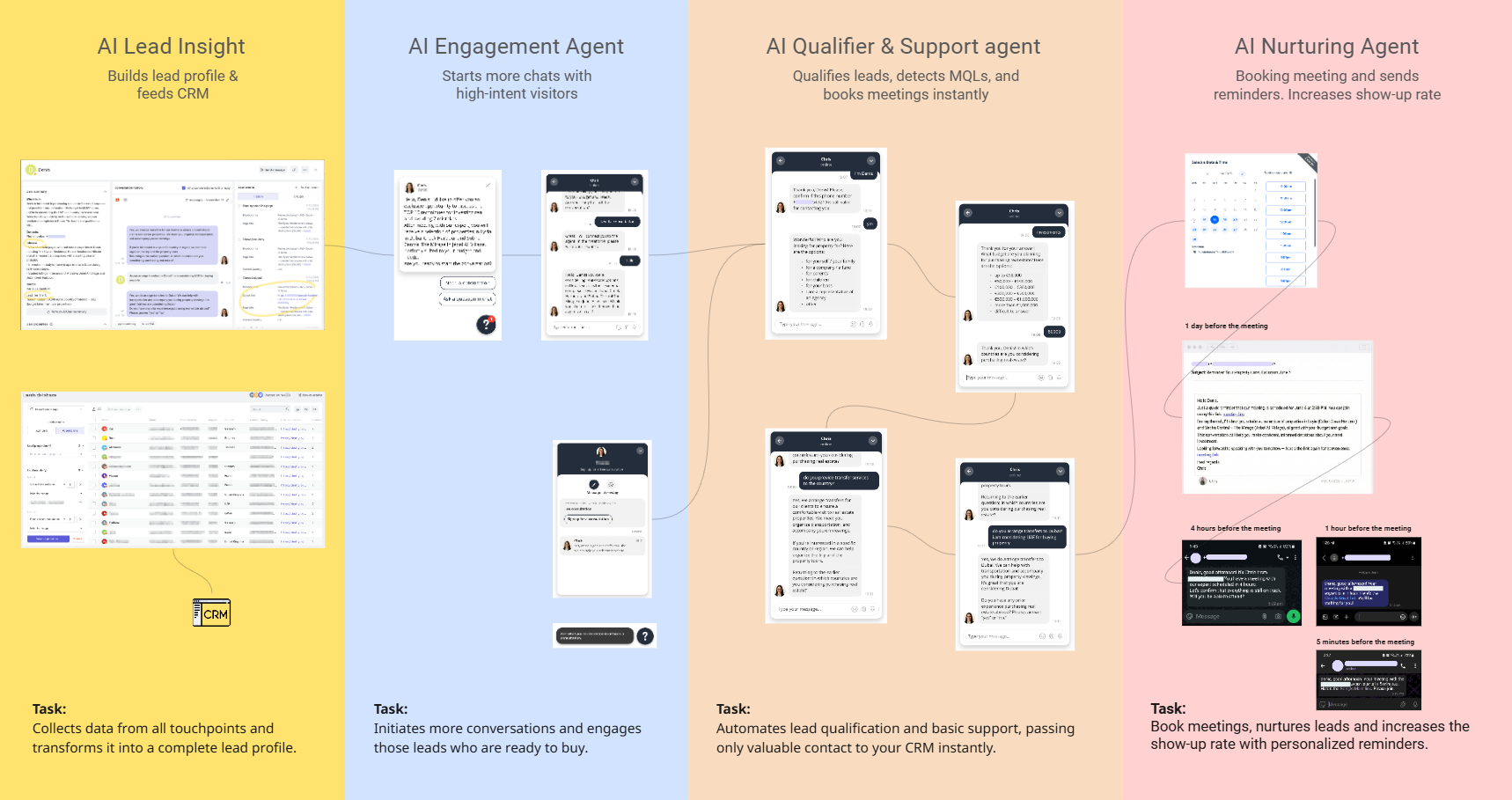
Dashly is a data-driven AI agent platform that automates your entire inbound sales funnel from first website visit to confirmed meeting. Unlike chatbots that work from scripted conversations, Dashly’s AI sales agents make decisions based on complete customer profiles from your CDP and CRM, including site behavior, past interactions, product usage, and ICP fit.
The platform deploys four specialized agents that cover every stage of your funnel: AI Lead Insight enriches visitor data in real-time, AI Engagement Agent initiates conversations at the optimal moment, AI Qualifier handles lead scoring and qualification through natural dialogue, and AI Nurturing Agent books meetings and drives 60-90% show-up rates with personalized sequences.
Overview and core sales funnel features
Dashly solves the core problem killing B2B inbound conversion: 55% of leads are lost between inquiry and meeting due to slow manual response times (median 5 hours). The platform addresses this with a team of four specialized AI sales agents that automate your entire funnel.
AI Lead Insight acts as your data intelligence layer. It collects every piece of information about website visitors: browsing history, CRM records, LinkedIn profiles, product usage, past conversations. And then the agent transforms it into complete customer profiles. It determines visitor intent (high/medium/low) and warmth level (cold/warm/hot) in real-time, powering smart decisions for all other agents. And your managers.
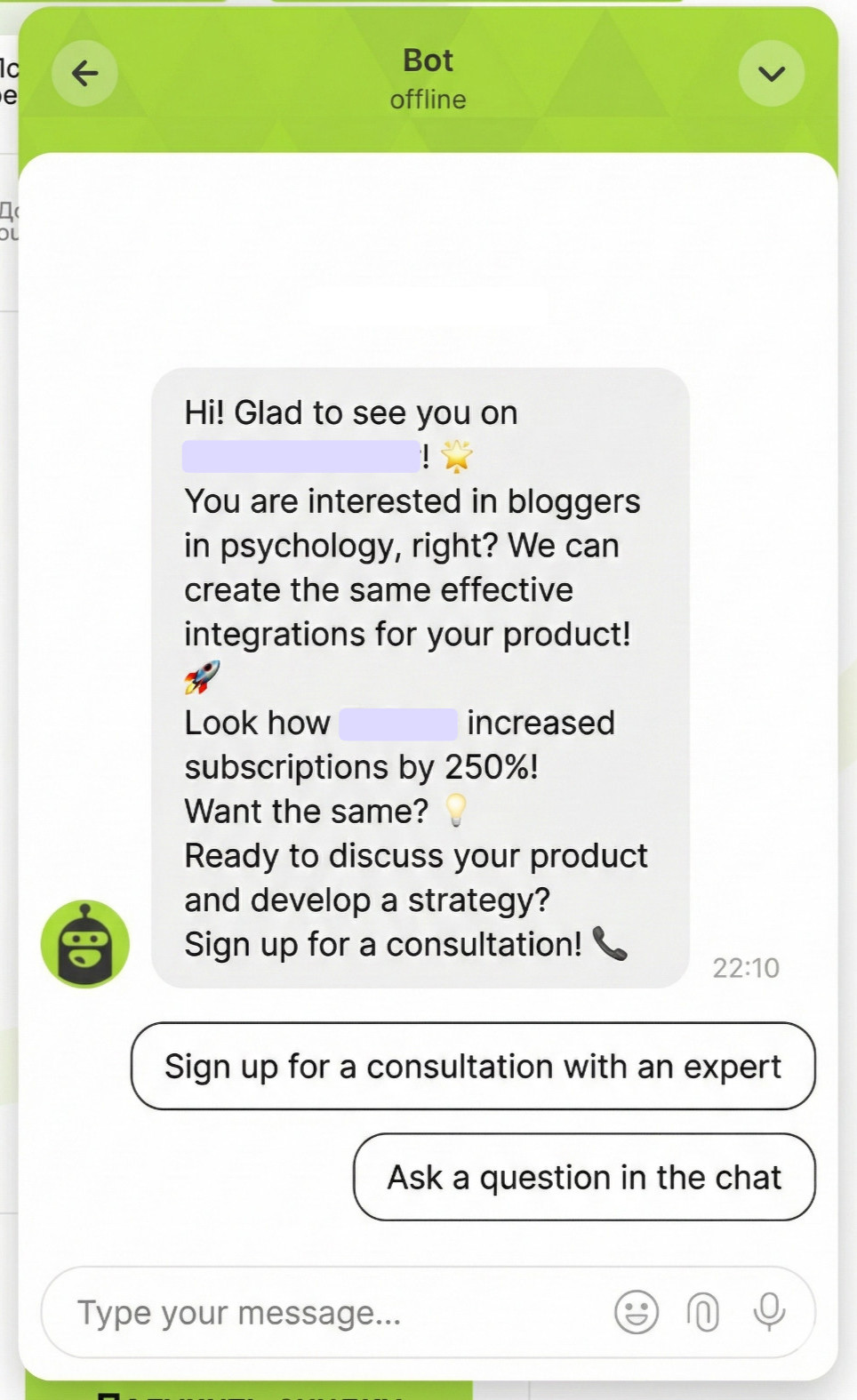
AI Engagement Agent converts traffic into conversations. It analyzes visitor behavior continuously and initiates personalized chat messages at the optimal moment.
For instance, when someone views pricing three times, returns after reading a case study, or spends significant time on a key page. This proactive engagement generates 66% of MQLs for typical clients, compared to 15% from passive forms.
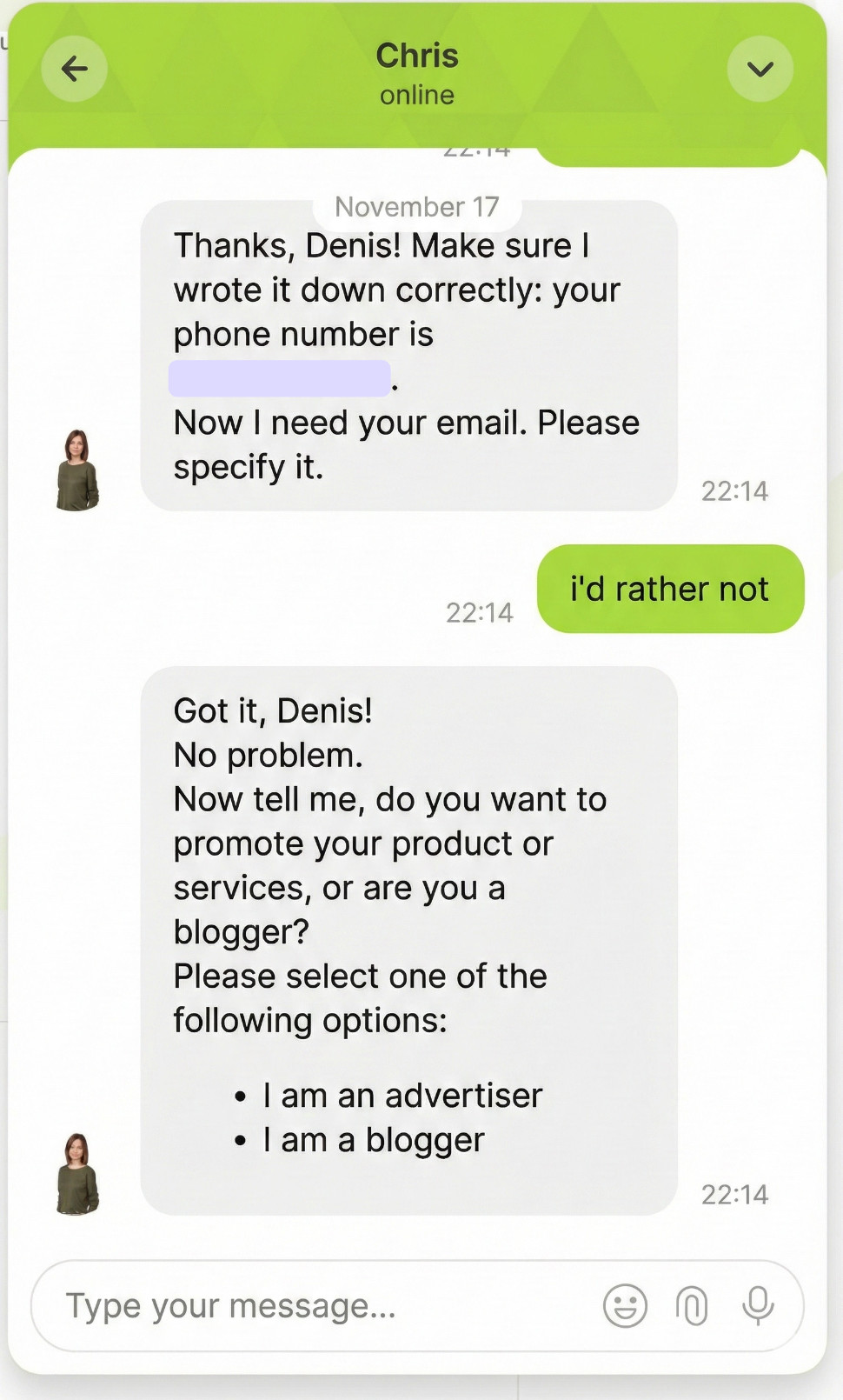
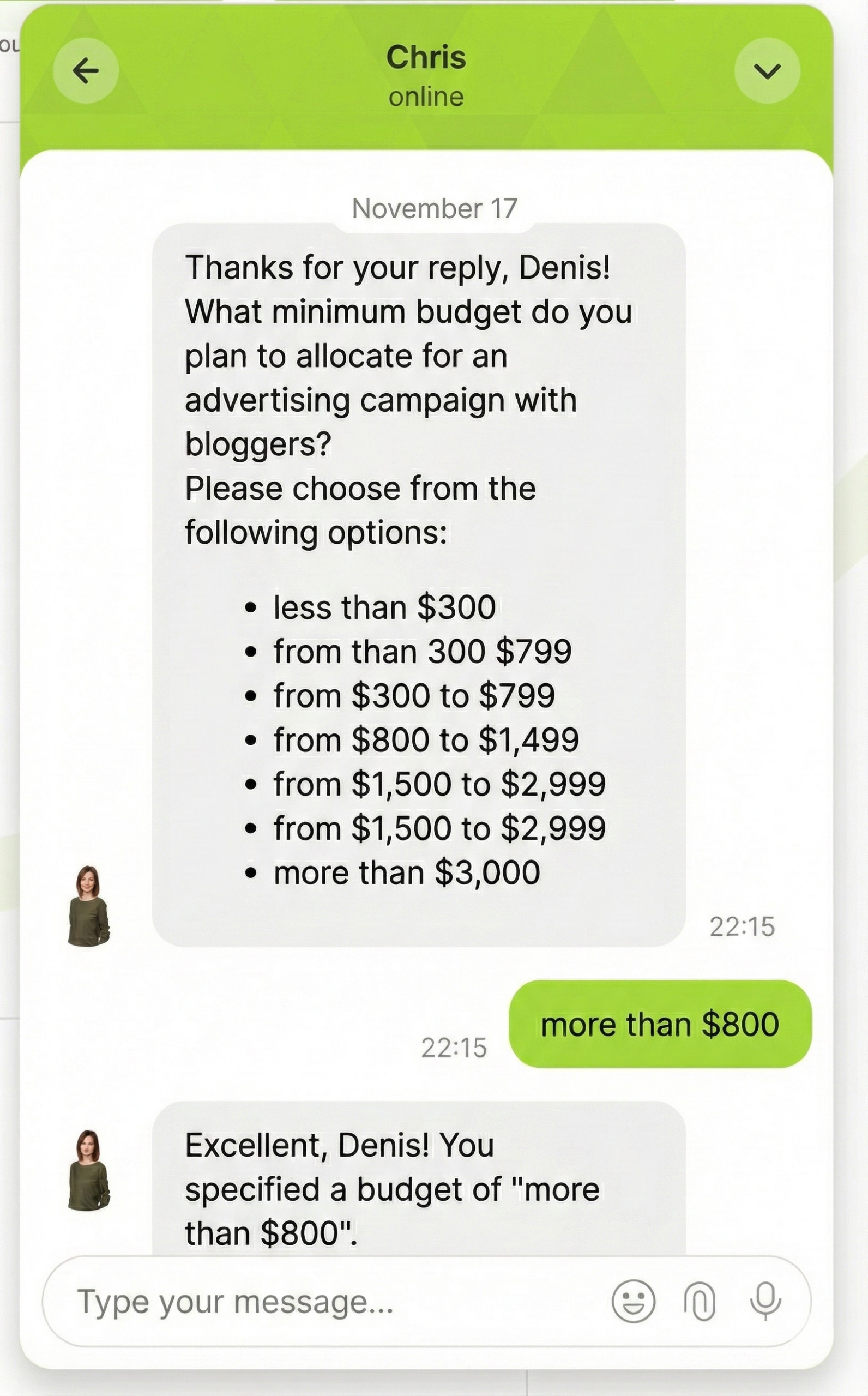
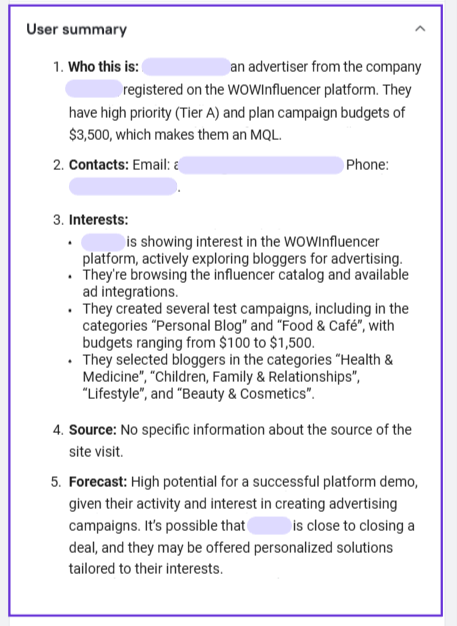
AI Qualifier & Support Agents handle two critical tasks. First, one agent qualifies leads through natural conversation, asking the right questions based on what it already knows from your CRM and tracking data. The agent never asks prospects to repeat information, determines A/B/C priority tiers using your ICP criteria, and routes high-value leads to sales reps immediately. Simultaneously, another agent provides 24/7 product support, answering common questions and handling up to 40% of all chat inquiries without human intervention.
Here’s how the Agent qualifies a repeated website visitor:
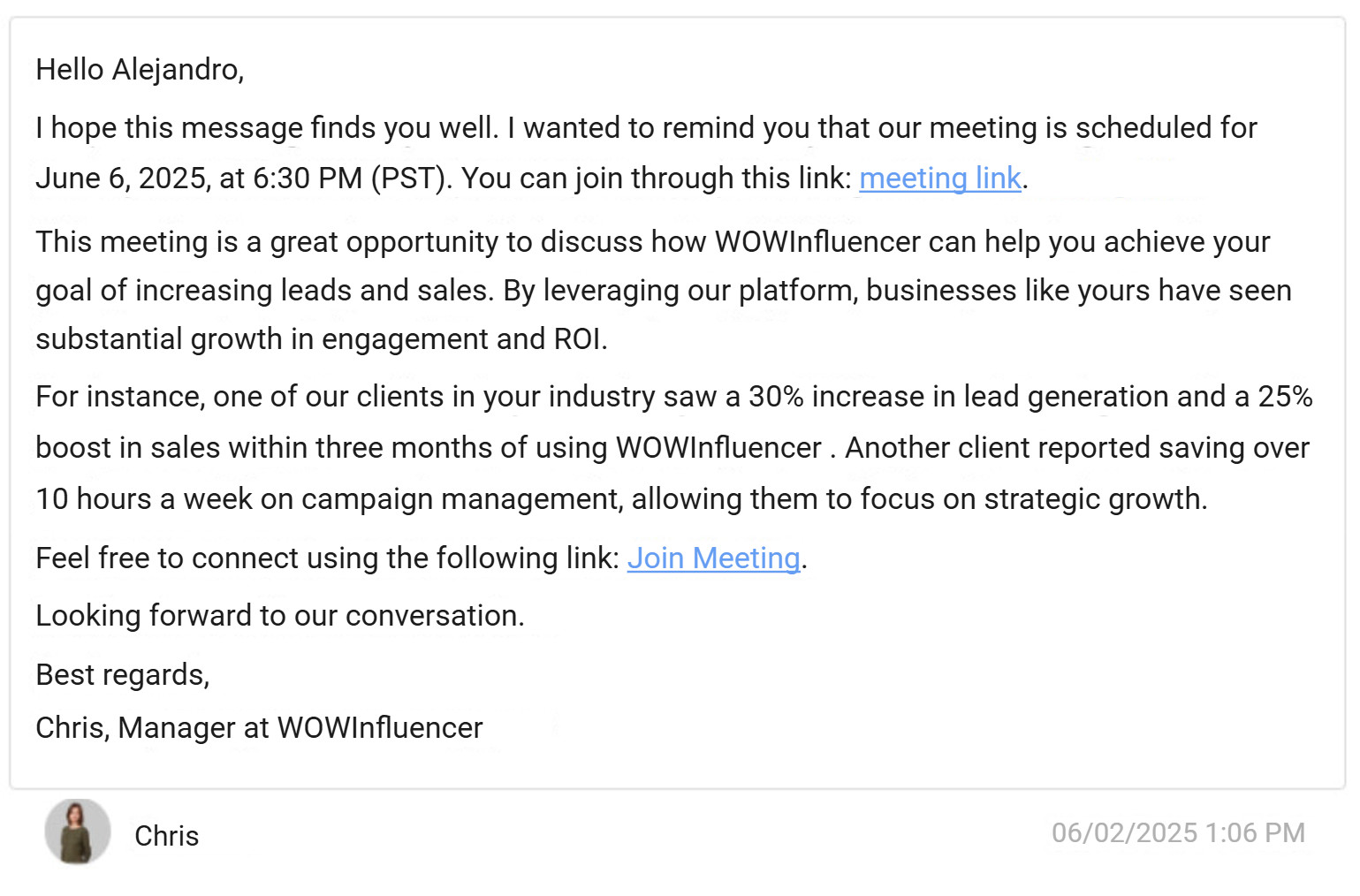
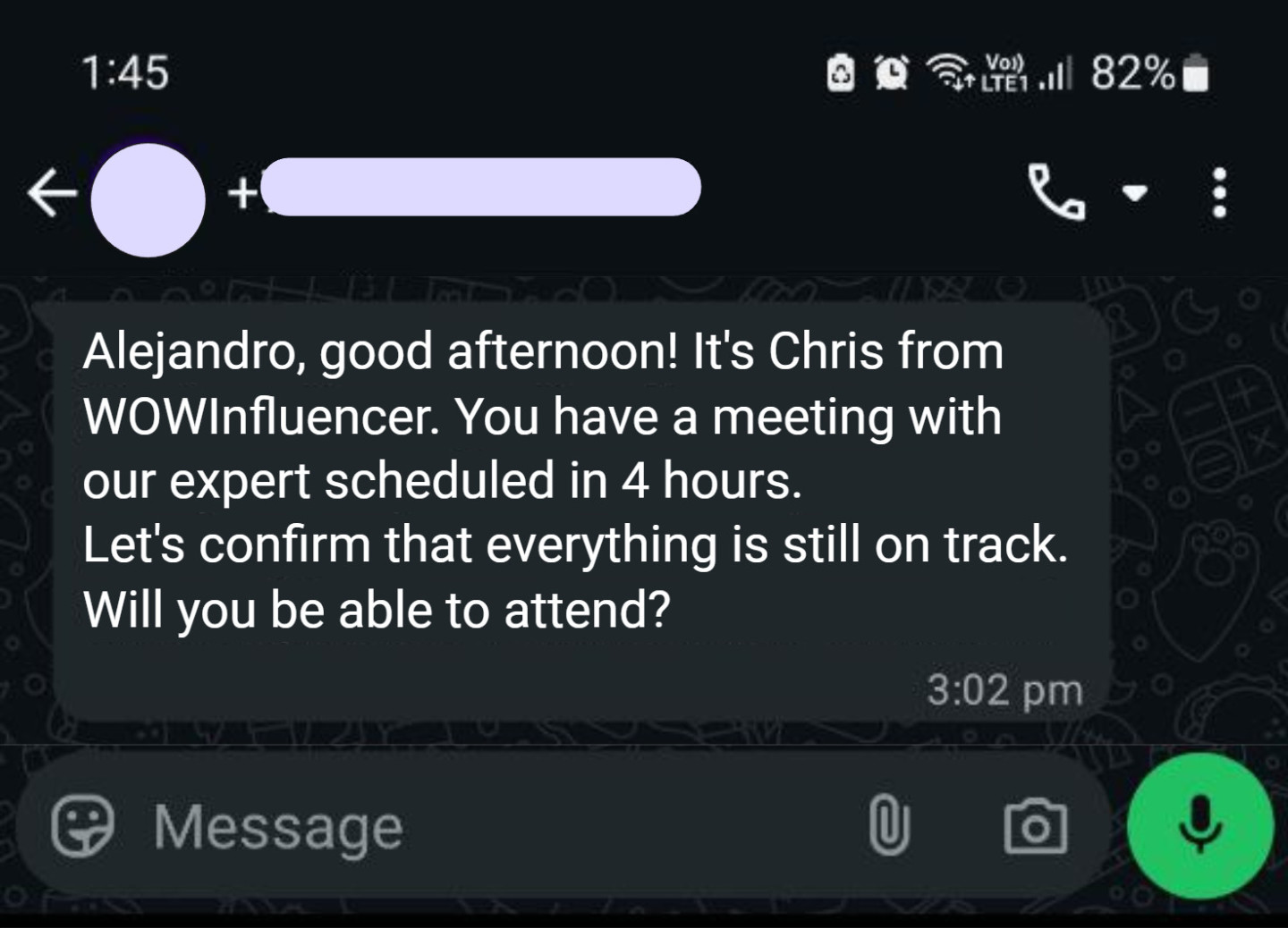
AI Nurturing Agent owns the meeting booking and show-up process. After qualification, it schedules meetings directly through calendar integrations (Calendly, Google Calendar), then executes personalized reminder sequences across email, WhatsApp, and SMS. Each message is uniquely generated to avoid spam filters. The result: 60-90% show-up rates compared to industry averages of 40-50%.
AI chat automation and lead scoring capabilities
Dashly’s data infrastructure powers smarter automation than script-based chatbots. The platform integrates with your complete tech stack to make every agent interaction contextual and intelligent.
- CRM integration allows you quickly sync with HubSpot, Pipedrive, Salesforce, and other CRM systems to pull existing contact data, deal stages, and interaction history. Every conversation, page view, and qualification result flows back to your CRM instantly, creating complete audit trails without manual data entry. Your sales reps see exactly what the AI discussed before they take over a conversation.
- Behavioral tracking captures granular visitor activity across your entire site. The platform logs page views, time on page, scroll depth, clicks, form interactions, file downloads, and return visits. This behavioral data allows to assign priority tiers (A/B/C) based on your custom ICP criteria: company size, industry, role, budget indicators, engagement patterns, and buying signals. High-intent visitors trigger immediate rep alerts while lower-priority leads enter nurturing sequences.
- Analytics and reporting provide full funnel visibility. Dashly tracks every stage: visitor → engaged → qualified → booked → showed up → closed. You see conversion rates at each transition, agent performance metrics, average response times, and revenue attribution by channel. The platform identifies where leads drop off and which agent interactions correlate with closed deals.
- Omnichannel execution unifies all conversations in a single inbox. Whether prospects start on web chat, continue via WhatsApp, or respond to email sequences, agents maintain full context. Seamless handoff to human sales reps happens when needed, e.g. complex questions, enterprise deals, or specific rep requests. Complete conversation history is transferred instantly.
Best use cases and results for B2B
Dashly delivers the strongest results for B2B SaaS companies with 50K+ monthly website visitors running inbound-led sales motions. Typical clients have deal cycles of 1-6 months and average contract values above $5,000.
Real results from B2B customers:
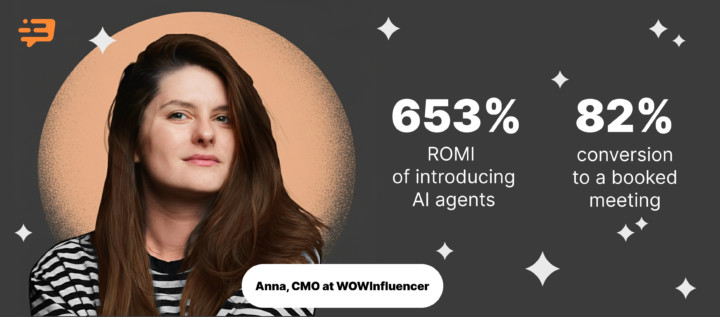
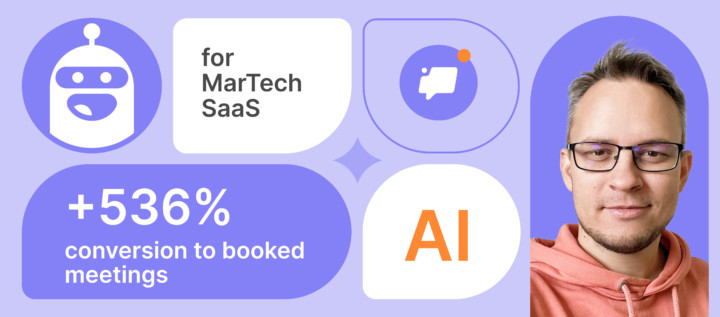
MarTech SaaS company (WOWInfluencer) achieved 82% conversion rate from chat to meeting booking and 653% ROMI from Dashly implementation. AI-powered chat now generates 66% of all MQLs (versus 15% from forms), with 99.6% faster first response time than human SDRs.
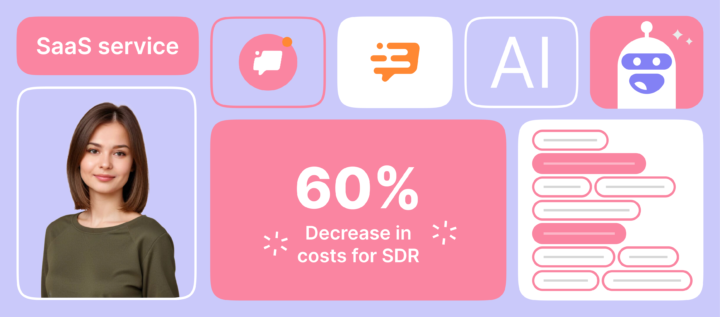
B2B SaaS company automated their demo funnel completely: 70% of leads now book meetings without any manager involvement, delivering 568% ROMI and 60% reduction in SDR costs.
Dashly works best when you have existing CRM data to enrich conversations, enough funnel volume to justify automation (100+ leads/month), and a sales team ready to focus on closing rather than initial qualification.

Salesforce Sales Cloud Einstein — Enterprise AI for complex sales funnels
Salesforce Sales Cloud Einstein is enterprise-grade sales funnel software for mid-market to enterprise companies managing complex sales funnels with multiple stakeholders and long deal cycles. As part of the Salesforce CRM platform, Einstein integrates directly into your existing workflows without requiring separate tools or data migration.
Einstein’s AI layer makes Salesforce proactive, telling sales teams what to do next instead of just showing what happened.
How Salesforce Einstein automates pipeline management
Einstein eliminates manual pipeline updates and gives reps a clear view of priorities through AI-powered automation.
What Einstein automates:
- Automatic CRM updates: Updates deal stage, next steps, and close probability across CRM fields without manual data entry
- Pipeline Inspection: Flags at-risk deals, identifies stalled opportunities, and surfaces accounts needing immediate attention
- Data hygiene: Agentforce for sales maintains pipeline field accuracy in suggestive mode (requires approval) or fully automated mode
- Centralized workspace: Sales Workspace brings together AI agents, analytics, and predictive insights in one hub where reps view priorities and performance
Your sales team stops wasting hours on CRM admin work and gets instant visibility into which deals need action.
Predictive lead scoring and CRM integration features
Einstein’s AI analyzes your historical data to tell reps exactly where to focus, automatically capturing sales activity along the way.
Core AI features:
- Einstein Lead Scoring: Ranks leads by conversion likelihood using machine learning models (refreshed every 10 days) that analyze firmographic data, engagement patterns, and behavioral signals from your CRM.
- Opportunity Scoring: Predicts deal win probability, customers see 14% improvement in win rates.
- Activity Capture: Automatically logs emails, meetings, and calls into Salesforce CRM, eliminating manual data entry.
- Call Insights: Transcribes sales conversations and flags key moments (competitor mentions, pricing objections, customer questions) without requiring reps to listen to entire recordings.
Sales reps spend time on high-probability deals instead of manual logging or chasing dead-end leads.
Advanced sales forecasting and process automation tools
AI Forecasting guides reps through optimal sales motions. You get 30% more accurate predictions based on analysis of pipeline trends, historical opportunity data, and deal velocity
Einstein dynamically assesses win/loss patterns, close date probabilities, and revenue impact of at-risk deals in real-time. Revenue Intelligence combines forecasting with pipeline inspection for real-time visibility into quota attainment.
The platform’s process automation includes predictive next-best-action recommendations that guide reps through optimal sales motions, automated prospect research that summarizes CRM records, and intelligent workflow triggers based on deal health.
HubSpot marketing automation platform — All-in-one CRM and funnel tools
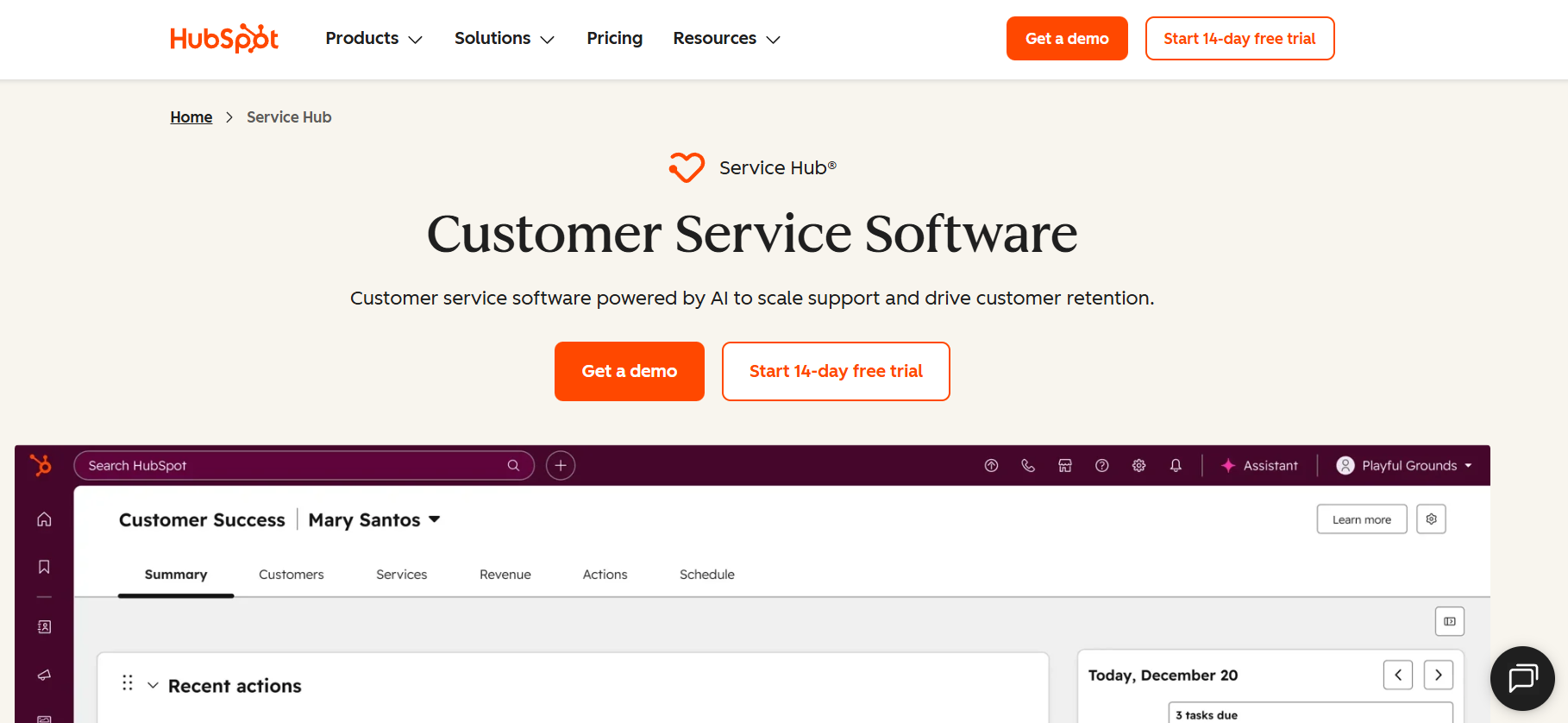
HubSpot combines marketing automation, email marketing, and CRM in a unified platform designed for teams that want everything under one roof. Its all-in-one approach means your sales funnel data flows automatically between marketing campaigns, sales pipelines, and customer support without manual exports or API connections.
The platform works best for growing B2B companies that need professional marketing automation without enterprise complexity.
Marketing automation and email marketing capabilities
HubSpot’s email marketing engine combines drag-and-drop editors with smart personalization tokens that pull data directly from your CRM. You can send targeted campaigns based on lifecycle stage, lead score, or any custom property, with A/B testing built into every send.
Key funnel automation features:
- Automated nurture sequences that enroll leads when they download content or hit behavioral triggers;
- Multi-touch attribution tracking across emails, landing pages, and CRM interactions;
- Dynamic lead scoring that updates based on engagement and behavioral signals;
- Automatic sales notifications when prospects hit key engagement thresholds;
- Personalization tokens that pull CRM data into email copy automatically.
Sales funnel templates and workflow automation
HubSpot provides pre-built sales funnel templates that map to standard B2B buying journeys. These templates include landing pages, email sequences, and workflow automation for common scenarios like webinar registration funnels, demo request funnels, and content download nurture paths.
Workflow automation features:
- Progressive profiling that gradually collects lead data across multiple form fills
- Points-based lead scoring that assigns values for engagement actions
- Automatic segmentation based on firmographic or behavioral criteria
- Deal stage automation in the CRM that updates records and triggers follow-up tasks
- Custom workflow builders that create sophisticated automation without code
Lead nurturing with HubSpot’s AI features (Breeze)
Breeze AI is HubSpot’s AI layer that supercharges lead nurturing with predictive intelligence. Predictive lead scoring analyzes historical data to automatically rank which leads are most likely to convert, helping sales focus on high-probability prospects.
Breeze automates content creation for nurture campaigns, generates personalized email copy based on CRM context, and provides AI forecasting that predicts pipeline outcomes.
ClickFunnels — Dedicated funnel builder for sales funnels
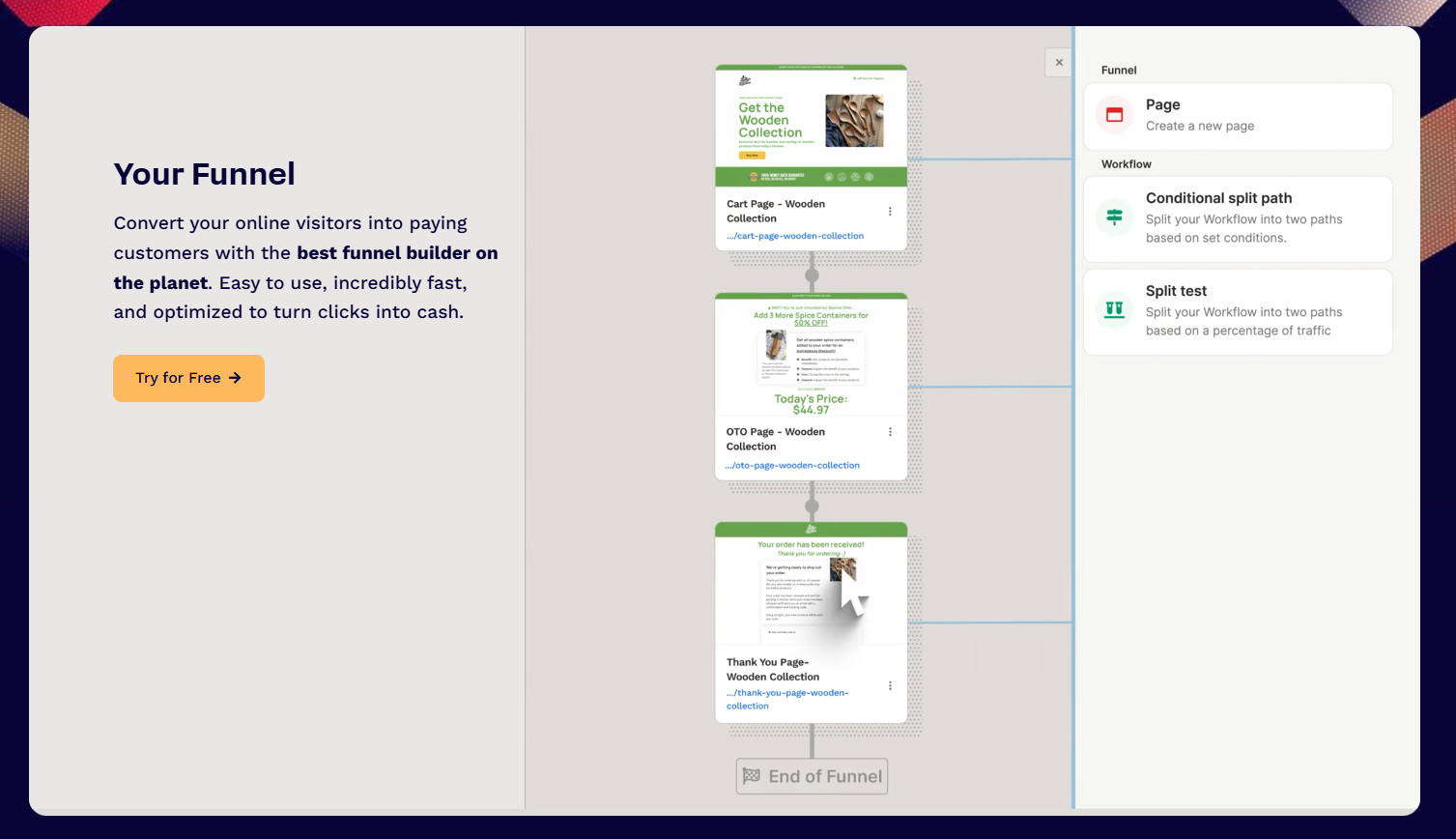
ClickFunnels is specialized sales funnel software built specifically for creating high-converting funnels without coding or design skills. Unlike all-in-one platforms, ClickFunnels puts funnel creation at the center with optimization tools like A/B testing, upsells, and order bumps that maximize revenue per customer.
Pre-built funnel templates and drag-and-drop editor
ClickFunnels offers 44+ proven sales funnel templates for lead generation, webinars, product launches, memberships, and e-commerce. Each template is pre-structured to guide prospects from awareness to purchase.
The funnel builder uses an intuitive drag-and-drop editor:
Key funnel building features:
- Visual funnel builder with path splitting and automated triggers
- Pre-designed sections, rows, and columns
- Complete customization: text, images, videos, buttons, forms, checkout elements
- Universal sections to reuse across multiple funnels
- Mobile-responsive design
Upsells, order bumps, and funnel optimization features
ClickFunnels is built for revenue optimization. The platform includes native features that increase average order value:
Revenue optimization features:
- Order bumps: Add complementary products on checkout pages with one click;
- One-click upsells: Offer premium upgrades after purchase without re-entering payment info;
- Downsells: Present lower-priced alternatives when customers reject upsells;
- A/B testing: Test headlines, images, layouts, and offers;
- Smart Checkout: Optimized flow that reduces cart abandonment.
Email marketing integration and funnel analytics
ClickFunnels includes built-in email marketing and integrates with ActiveCampaign, HubSpot, Mailchimp, ConvertKit, and Klaviyo.
Email automation features:
- Automated email sequences triggered by funnel actions;
- Behavioral triggers based on customer actions;
- Broadcast emails and list segmentation.
The platform provides comprehensive funnel analytics: conversion rates at each step, revenue tracking, contact metrics, and A/B test results.
ActiveCampaign — Advanced email marketing and sales automation
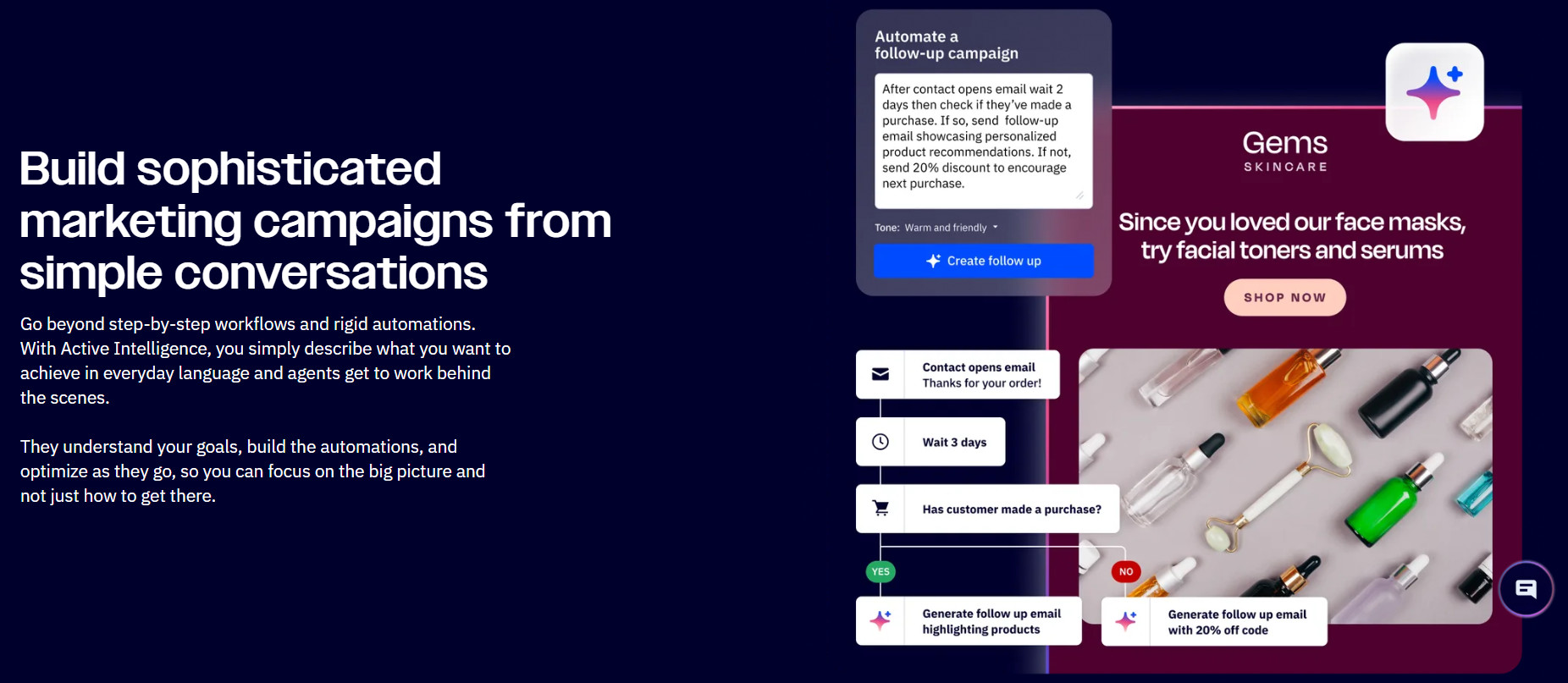
ActiveCampaign is an email marketing and automation platform that combines marketing automation, CRM, and sales tools in one system. The platform excels at funnel automation through sophisticated behavioral triggers and lead scoring, making it ideal for sales teams that need tight alignment between marketing and sales activities.
Email marketing automation and behavioral triggers
ActiveCampaign’s email marketing engine uses behavioral data to trigger personalized automation sequences based on customer actions.
Behavioral automation features:
- Automated email sequences triggered by website behavior, form submissions, purchase history, and engagement patterns;
- If/else conditional logic that adapts email content based on recipient actions;
- Wait conditions that pause automation until specific behaviors occur;
- Dynamic content personalization using CRM data and custom fields;
- Multi-channel sequences combining email, WhatsApp, and SMS;
- Goal tracking that ends automation when desired actions are completed.
CRM and sales pipeline management for funnel automation
ActiveCampaign’s CRM features customizable sales pipelines with deal stages that match your sales process. The platform offers two enhanced CRM add-ons: Pipelines (basic sales automation) and Sales Engagement (includes win probability and sentiment analysis).
Sales funnel automation features:
- Custom pipeline stages with drag-and-drop deal management;
- Automated deal creation when leads hit score thresholds;
- Task automation that assigns follow-ups to sales reps based on deal stage;
- Account records for managing B2B relationships;
- Deal forecasting and sales performance reports.
Lead scoring and segmentation for sales teams
ActiveCampaign’s lead scoring system updates in real-time based on engagement, demographics, and behavior. Scores automatically trigger CRM actions like deal creation or sales rep notifications.
Segmentation features:
- Points-based lead scoring with customizable criteria;
- Behavioral segmentation based on website activity, email engagement, and purchase patterns;
- Geographic and demographic segmentation;
- Advanced segment builder with unlimited condition combinations.
The platform enables sales teams to focus on high-scoring leads while lower-priority contacts receive automated nurture sequences.
Outreach — AI-powered sales engagement and prospecting platform
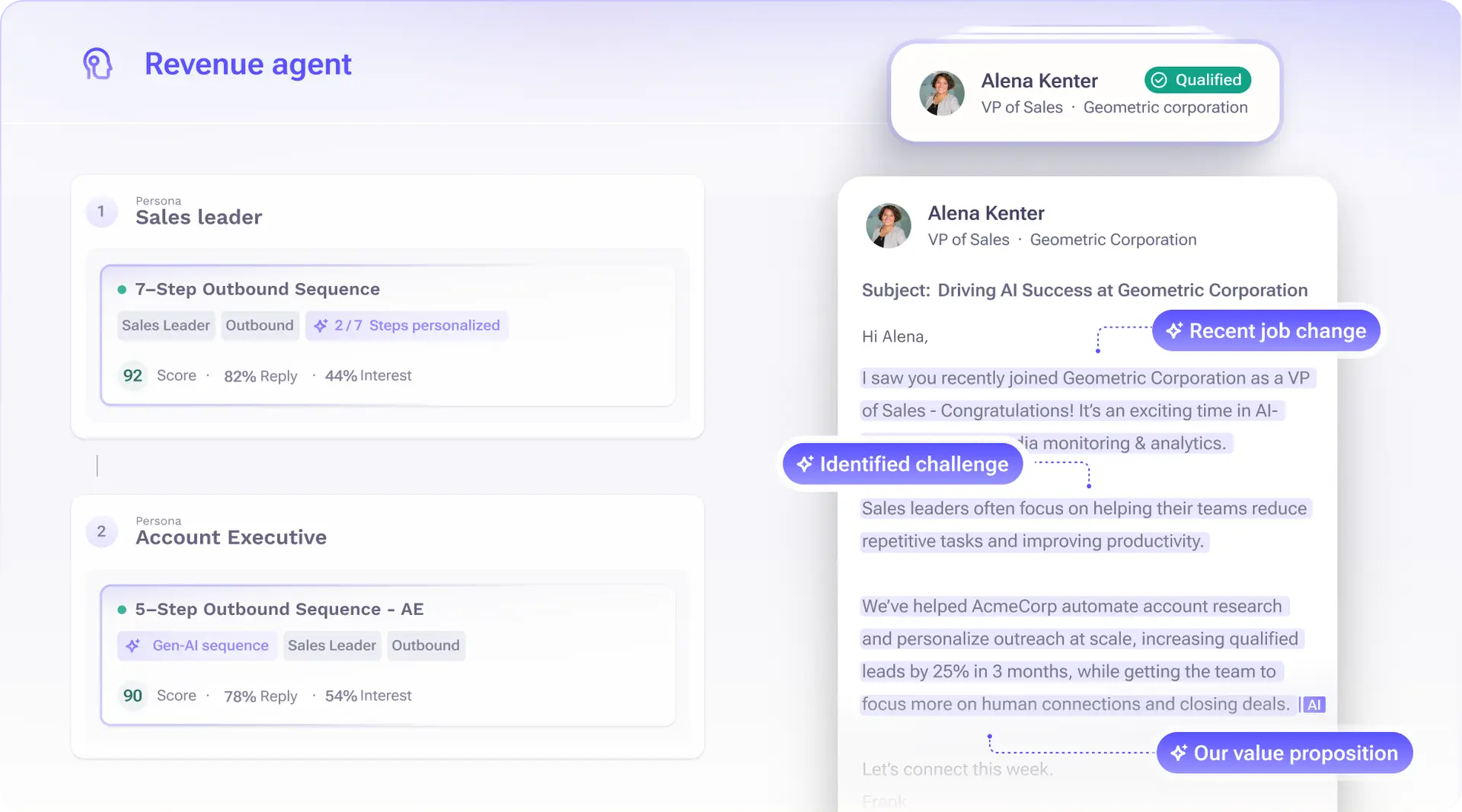
Outreach is an AI sales engagement platform designed for teams that need sophisticated prospecting and multi-channel outreach automation. The platform coordinates email, LinkedIn, and phone sequences while AI agents handle personalization and research, making it ideal for sales teams managing complex B2B sales funnels.
Outreach positions itself as an “AI Revenue Workflow Platform” that unifies sales engagement, deal management, and conversation intelligence in one system.
Automated outreach sequences and multi-channel sales engagement
Outreach’s AI Prospecting Agent eliminates manual research and generic messaging. The AI researches every prospect in the background, then crafts personalized outreach content for each sequence step. Sales reps choose how autonomous the agent should be: manual sequences where reps review and send, or fully automated sequences where AI handles outreach until prospects engage.
Multi-channel automation features:
- Coordinated sequences across email, LinkedIn, and phone with behavioral triggers that adapt based on prospect actions;
- AI-generated personalization that maintains your brand voice while operating at scale;
- Smart Account Plans that organize books of business and send timely, relevant messages;
- 60% reduction in prospect research time, freeing sales reps to focus on conversations rather than data gathering.
Conversation intelligence and deal management tools
Outreach’s conversation intelligence transcribes sales calls and surfaces key moments: competitor mentions, pricing objections, and customer questions. This way, you reps won’t need to manually review entire recordings.
The platform’s Deal Agent analyzes engagement patterns across thousands of sequences to identify which messaging resonates versus generic replies. Combined with CRM sync capabilities, Outreach automatically updates deal stages and logs every interaction without manual data entry.
AI agents for sales funnel optimization and lead generation
Outreach deploys multiple specialized AI agents across the revenue lifecycle to optimize lead flow and sales velocity:
AI agents for funnel automation:
- Prospecting agents that increase seller productivity by 60% through automated lead research and personalized sequence content.
- Deal agents that predict win probability, surface at-risk opportunities, and recommend next-best actions.
- Forecasting agents that analyze pipeline trends and deal velocity for accurate revenue predictions.
- Predictive scoring that prioritizes which leads and sequences to optimize based on pipeline impact.
Pipedrive — Visual pipeline management with AI sales assistant
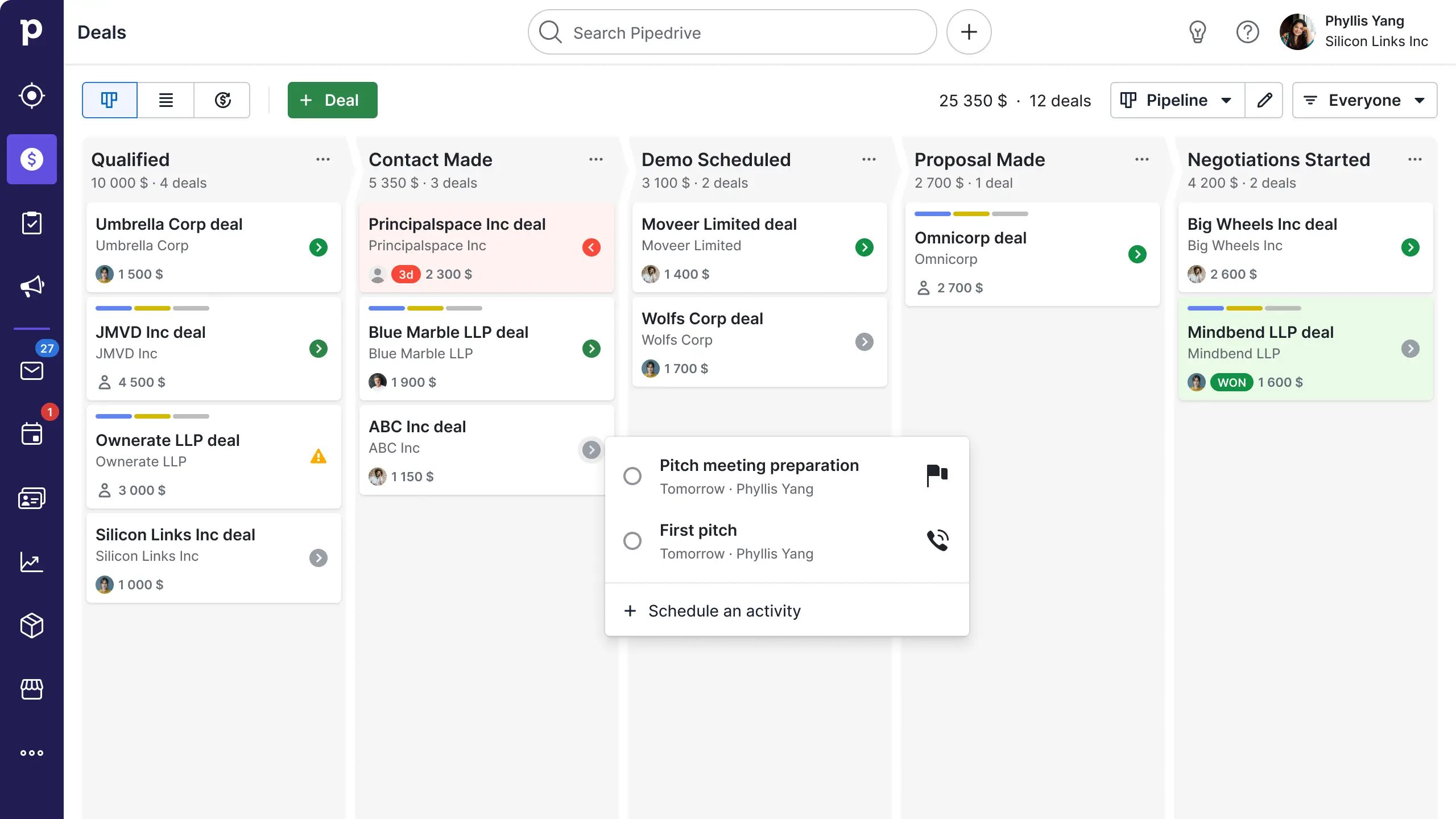
Pipedrive is a CRM built around visual pipeline management, making it ideal for teams that need clear visibility into their sales funnel at every stage. Unlike traditional CRM systems that bury pipeline data in reports, Pipedrive’s primary interface is the pipeline itself: a drag-and-drop visual board that shows exactly where each deal stands and what actions sales reps need to take next.
The platform combines intuitive pipeline tracking with an AI Sales Assistant that analyzes your sales data to identify opportunities, prioritize leads, and recommend next actions.
Visual sales funnel and pipeline tracking
Pipedrive’s visual sales funnel gives you complete visibility into the buyer’s journey through your sales process. The pipeline view displays deals as cards that move across customizable stages, prompting sales reps to stay organized and on top of complex sales processes.
Pipeline management features:
- Customizable pipeline stages that reflect your unique sales process with drag-and-drop deal management;
- Visual deal cards showing key information, next steps, and activity history at a glance;
- Multiple pipeline views for managing different products, regions, or sales processes;
- Automated stage updates that trigger notifications when deals progress;
- Activity-based planner that keeps sales reps focused on high-priority tasks.
AI-powered sales tips and lead prioritization
Pipedrive’s AI Sales Assistant (currently in beta) analyzes your pipeline to deliver actionable insights. The AI examines sales data, contacts, and deals to identify patterns, recommend high-potential deals, and suggest which leads need immediate attention.
Lead prioritization features:
- Lead scoring automation that ranks contacts based on engagement and buyer intent;
- Smart notifications that alert sales reps when leads reach score thresholds;
- Automatic lead assignment that routes leads to the right sales reps based on territory, expertise, or workload;
- Deal health analysis that flags at-risk opportunities and stalled deals;
- Revenue forecasting that predicts pipeline outcomes based on historical performance.
Integration with email marketing and sales tools
Pipedrive offers Campaigns by Pipedrive, a built-in email marketing add-on that brings marketing and sales under one roof. The CRM integrates with your email client to sync, store, and manage every message while tracking engagement.
Pipedrive connects with 400+ sales tools through its Marketplace, including email platforms (Mailchimp, ActiveCampaign), document management (DocuSign), accounting (QuickBooks), and collaboration tools (Slack, Asana).
GetResponse — Email marketing platform with funnel automation
GetResponse is an email marketing and marketing automation platform that combines comprehensive funnel automation capabilities with webinar hosting and landing page creation. The platform is designed to manage the entire sales funnel from lead capture to conversion.
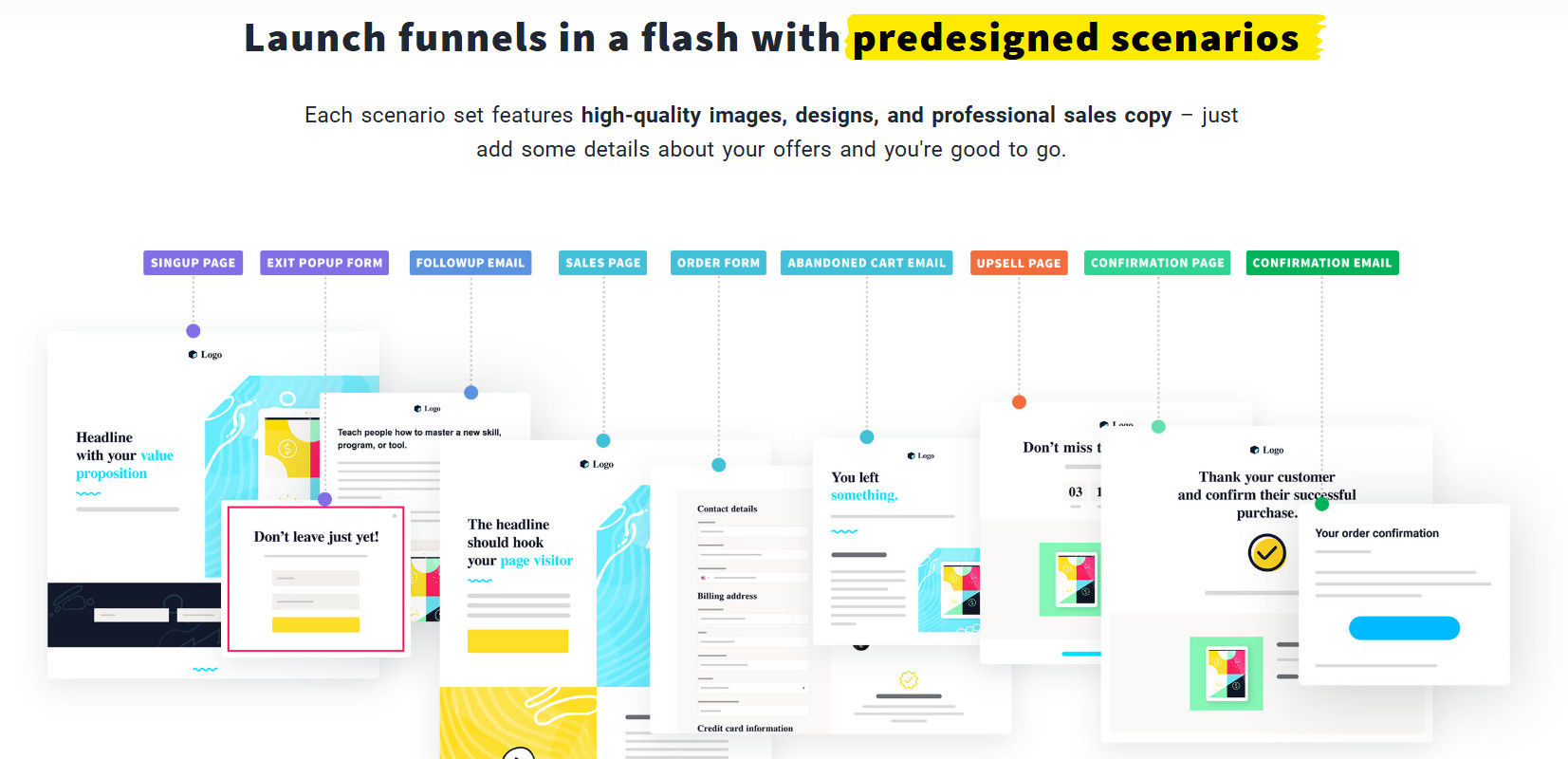
GetResponse stands out with its Conversion Funnel (AutoFunnel) feature, which provides ready-made, automated step-by-step systems to build landing pages, automate emails, and recover abandoned orders.
AutoFunnel tool and landing page builder for sales
GetResponse’s Conversion Funnel (formerly AutoFunnel) is a complete funnel automation system that integrates landing pages, email marketing, and sales processes into one automated flow. You get industry-specific landing page templates optimized for conversion with ready-made content you can customize.
AutoFunnel features:
- Four funnel types: simple opt-in funnels for lead generation, sales funnels for product promotion, webinar funnels for relationship building, and lead-magnet funnels for content exchange;
- Landing page builder with drag-and-drop editor, exit-intent popups, and signup forms that automatically connect to your campaigns;
- Payment integrations with Stripe and PayPal for direct product sales;
- Abandoned cart recovery sequences that automatically remind customers about incomplete purchases.
Email marketing sequences and webinar integration
GetResponse includes built-in webinar software that hosts unlimited webinars with up to 1,000 live attendees. The platform automatically syncs webinar registrants and attendees with your email marketing lists, triggering automated follow-up sequences based on attendance behavior.
Webinar integrations with WebinarJam and GoToWebinar allow you to capture leads, send automated reminders, and launch targeted campaigns.
Marketing automation workflows for lead nurturing
GetResponse’s marketing automation features include prebuilt workflows that nurture leads through the entire customer journey.
Lead nurturing automation:
- Welcome series workflows that start conversations with new signups and share special offers.
- Lead scoring systems that assign points based on email opens, link clicks, and page visits.
- Abandoned cart workflows triggered when users add products and leave within specific timeframes.
- Win-back campaigns that reactivate inactive subscribers who reach particular score thresholds.
- Negative path automation that responds when visitors don’t engage, triggering reminders or exit messages.
GoHighLevel — White-label CRM and marketing automation platform
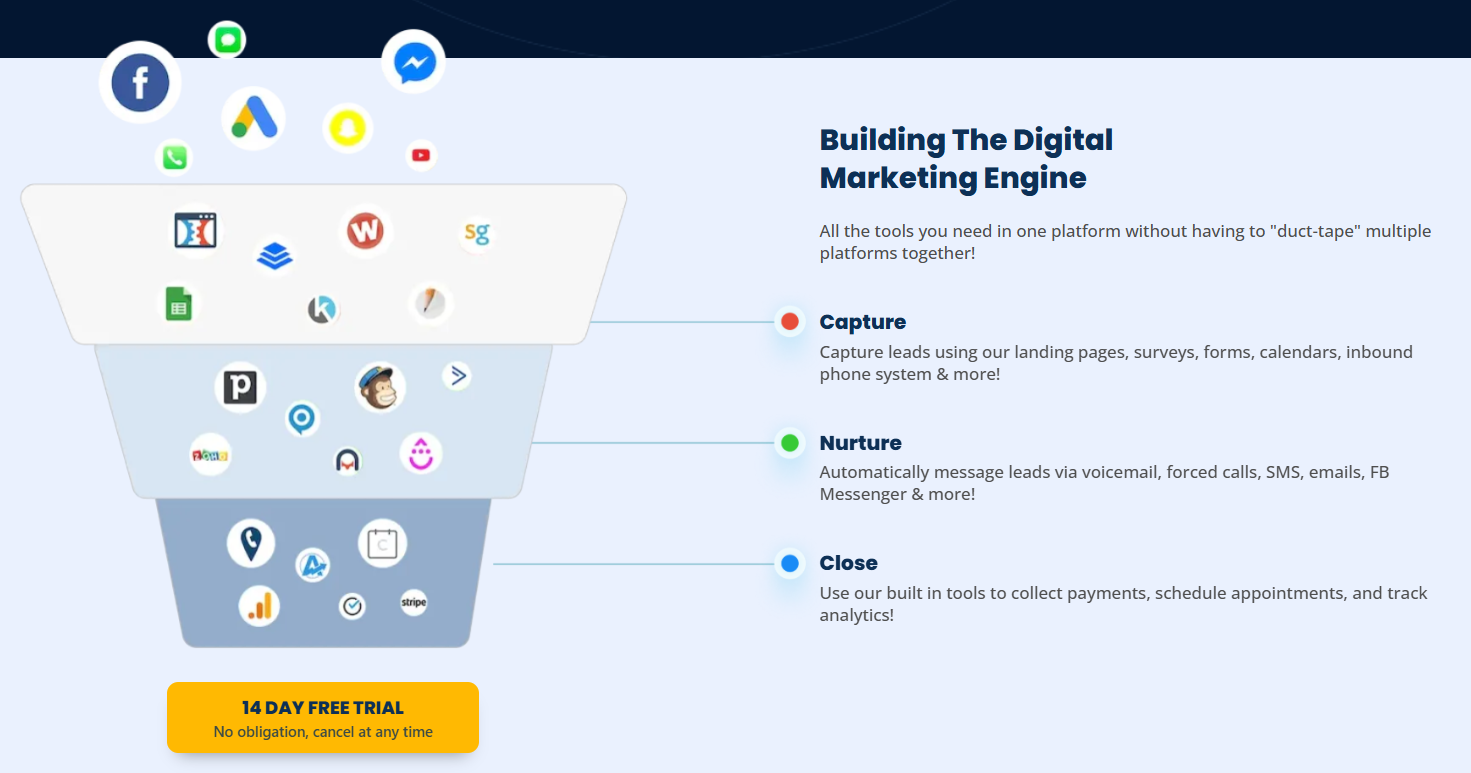
GoHighLevel is an all-in-one CRM and marketing automation platform built specifically for marketing agencies, consultants, and service businesses that manage multiple clients. Unlike traditional CRM systems, GoHighLevel offers white-label capabilities, allowing agencies to rebrand the entire platform as their own software and resell it to clients under their own brand name.
The platform brings together CRM, sales funnel builder, email and SMS marketing automation, website builder, appointment scheduling, course hosting, and pipeline management. This consolidation cuts costs and eliminates the complexity of connecting multiple systems through APIs.
White-label CRM and agency features
GoHighLevel’s lients access a branded dashboard that appears to be the agency’s proprietary software, creating additional revenue streams through platform reselling.
White-label features:
- Custom branding across the entire CRM interface, client portal, and mobile app;
- SaaS Configurator that allows agencies to set custom pricing tiers and billing options for clients;
- Agency dashboard for managing unlimited client accounts from a single interface;
- Branded mobile app option where clients can order their own white-labeled mobile app for their community;
- Snapshots that package pre-built sales funnel templates, workflows, and CRM configurations for rapid client onboarding.
Sales funnel builder and marketing automation workflows
GoHighLevel includes a drag-and-drop sales funnel builder with pre-designed templates for lead generation, webinar registration, appointment booking, and e-commerce.
Funnel automation features:
- Visual workflow builder with triggers (form submissions, page visits, SMS replies) and automation actions (send emails, update CRM fields, assign tasks, create deals)
- Pipeline management with customizable deal stages that track where leads are in the sales funnel
- Two-way SMS communication and automated text conversations that book appointments without human intervention
- Email and SMS sequences triggered by customer behavior, with personalization tokens pulling data from the CRM
- AI voice agents (2026 roadmap) for automated follow-up calls and lead qualification
Best for agencies and service businesses
GoHighLevel delivers the strongest value for marketing agencies managing 5+ clients, consultants offering done-for-you marketing automation services, and service businesses (contractors, real estate, fitness).
Systeme.io — Affordable all-in-one sales funnel software
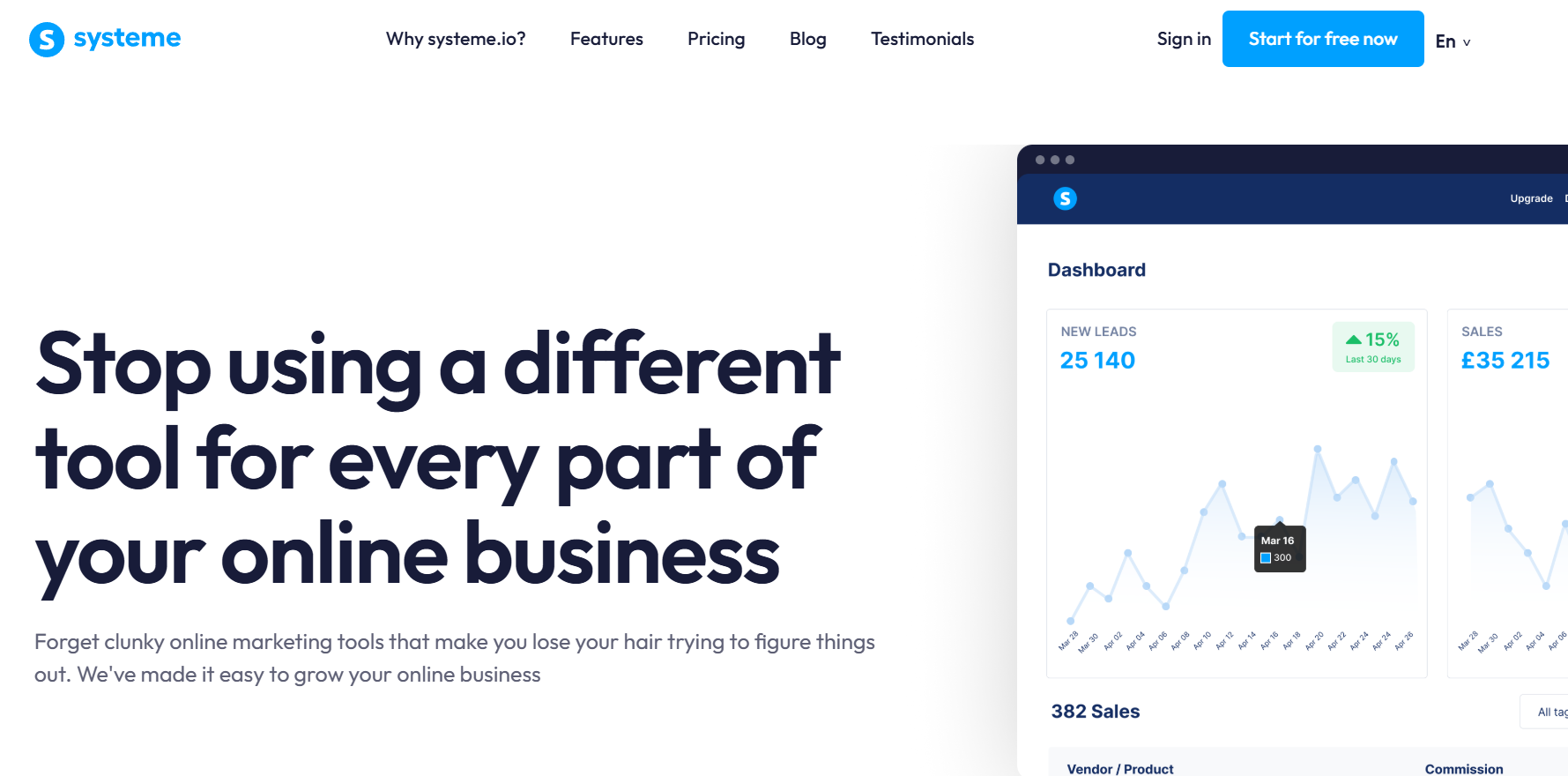
Systeme.io is budget-friendly sales funnel software built for solo entrepreneurs, coaches, and small businesses that need professional funnel automation without enterprise pricing. The platform stands out by offering a genuinely free forever plan with core features.
The platform combines funnel building, email marketing, course hosting, automation, and affiliate management in one interface. Currently powering 500,000+ entrepreneurs, Systeme.io replaces tools like ClickFunnels, Teachable, and Mailchimp with a single software solution.
Free plan and affordable pricing tiers for small businesses
Systeme.io’s free plan is unusually generous compared to competitors. You get 2,000 contacts with unlimited email sends, three sales funnels with up to 15 steps each, one blog with unlimited posts, and one automation rule. This free tier includes payment gateway integration, allowing you to start generating revenue immediately without monthly software costs.
Paid plans scale affordably: Startup ($17/month) supports 5,000 contacts and 10 funnels, Webinar ($47/month) adds evergreen webinar hosting and 15 automation rules, and Unlimited ($97/month) removes contact limits entirely.
Funnel builder, email marketing, and course creation tools
The platform includes deadline funnels (scarcity timers), upsells, downsells, and order bumps for revenue optimization.
Funnel automation features:
- Visual funnel builder that triggers email sequences, grants course access, and assigns tags based on customer actions;
- CRM pipeline for tracking leads through deal stages and managing customer relationships;
- Integration with payment gateways (Stripe, PayPal) that automatically delivers digital products and courses;
- A/B testing built into funnels for optimizing conversion rates.
Email marketing and course tools:
- Unlimited email campaigns with segmentation, personalization, and automated sequences;
- Course builder with drip content, student management, and timed access control;
- Affiliate program management to recruit promoters and automate commission payouts;
- Evergreen webinar hosting for automated lead generation.
Best use cases for solo entrepreneurs and startups
Systeme.io delivers the strongest value for info product creators launching their first course or membership site, coaches and consultants building funnels without technical skills, affiliate marketers who need landing pages and email automation. The free plan makes it ideal for validating business ideas before investing in paid software.
How to implement AI tools in your sales funnel workflow
Implementing AI tools in your sales funnel requires a systematic approach to ensure smooth automation without disrupting existing workflows. Follow these steps to integrate funnel tools effectively and maximize ROI.
Step 1: Map your current sales funnel and identify bottlenecks
Start by documenting every stage of your sales funnel from first contact to closed deal. Track where leads drop off, where sales reps spend the most time, and which manual tasks consume resources. Look for high-friction points like slow response times, inconsistent lead qualification, or manual CRM data entry. These pain points are your prime candidates for automation.
Step 2: Define clear objectives for automation
Set specific, measurable goals for your AI tools. Do you want to reduce response time from 2 hours to 5 minutes? Increase lead qualification accuracy by 30%? Free up 10 hours per week per rep? Clear objectives help you choose the right funnel tools and measure success. Align these goals with your revenue targets and team capacity.
See how SaaS B2B companies implemented AI tools for automating their funnel and raised conversion:
Step 3: Choose AI tools that integrate with your existing CRM
Select automation tools that connect seamlessly with your current CRM system. Check for native integrations with your tech stack: HubSpot, Salesforce, Pipedrive, or other platforms. Poor integration creates data silos and forces sales reps to work across multiple systems. The best funnel tools sync data bidirectionally in real-time, ensuring your CRM stays current without manual updates.
Step 4: Start with one funnel stage, not everything at once
Begin process automation at a single sales funnel stage where you identified the biggest bottleneck. If lead response time is your issue, start with AI qualification agents. If CRM data entry consumes hours, implement activity capture first. This focused approach lets your team adapt gradually and proves ROI before expanding automation to other stages.
Step 5: Train your sales reps on the new workflow
Your sales reps need hands-on training with the new funnel tools. Show them how AI-qualified leads appear in their queue, how to review conversation transcripts, and when to take over from automation. Address concerns about AI replacing jobs by emphasizing that automation handles grunt work so reps can focus on closing deals. Create quick-reference guides for common scenarios.
Step 6: Monitor performance and optimize continuously
Track key metrics weekly: lead response times, qualification accuracy, conversion rates at each funnel stage, and time saved per rep. Compare AI-generated leads against manually qualified ones. Identify where automation underperforms and refine your rules, triggers, or AI training. Process automation improves over time as AI learns from your sales funnel data. Schedule monthly reviews to expand automation to additional stages once initial implementation stabilizes.
Successful implementation typically takes 30-90 days from planning to full automation at scale, depending on sales funnel complexity and team size.
Final thoughts: Choosing the best AI tools for sales funnel automation
The right AI tools for sales funnel automation transform your revenue engine from manual chaos into a predictable system. Automation eliminates response delays, qualifies leads consistently, and frees your sales team to focus on closing deals. Start with one funnel stage, prove ROI, then scale systematically.
Frequently asked questions (FAQ)
For small businesses and startups, Systeme.io offers the strongest value with its free forever plan that includes 2,000 contacts and three sales funnels. HubSpot provides a robust free CRM tier with basic funnel automation features that grow with your business. GetResponse delivers professional email marketing and funnel automation starting at affordable pricing tiers. These platforms balance cost-effectiveness with essential AI sales capabilities like automated sequences, lead scoring, and CRM integration.
Yes, Systeme.io offers a genuinely free AI funnel builder with no time limit or credit card requirement. The free plan includes three complete sales funnels with up to 15 steps each, unlimited email sends, payment gateway integration, and one automation rule. HubSpot also provides free funnel tools through its CRM, including landing pages, forms, and basic email marketing automation. While these free plans have contact limits, they provide everything needed to build and test automated funnels before upgrading.
AI sales tools eliminate the delays and inconsistencies that plague manual funnel management. AI responds to leads in seconds versus hours, applies uniform qualification criteria to every prospect, and never forgets follow-ups. Funnel automation powered by AI continuously analyzes behavioral data to score leads accurately, predict deal outcomes, and trigger personalized outreach at optimal moments. This results in 30% higher win rates, 50% faster lead response times, and 40-60% cost savings compared to manual processes.
Most modern AI tools for sales funnel automation offer native integrations with popular CRM systems like Salesforce, HubSpot, and Pipedrive. Platforms like Dashly, ActiveCampaign, and Outreach sync bidirectionally with your CRM in real-time, automatically logging conversations, updating deal stages, and enriching contact records. When evaluating funnel automation tools, verify that your specific CRM appears in their integration list and confirm whether the integration requires additional API setup or works natively out of the box.



![Ultimate guide to creating a successful marketing growth strategy in 2025 [6 real-life examples]](https://www.dashly.io/blog/wp-content/uploads/2023/05/Expert-guide-to-creating-marketing-growth-strategy-6-examples-720x317.png)