Best AI agents for B2B SaaS inbound funnel in 2026 (Dashly and Alternatives)
 22 minutes
 27.01.2026
You’re working hard on your sales funnel your inbound funnel. Your marketing generates traffic. Your SDR team works hard. Yet somewhere between initial interest and booked meetings, qualified leads disappear, and conversion rates don’t grow despite your best efforts.
You’re not alone in facing this challenge.
Dashly research shows that 55% of inbound leads are lost between inquiry and meeting. Not because products or pricing are wrong, but because slow responses, inconsistent qualification, and manual processes simply can’t scale with growing demand.
The good news? Your competitors face these same pain points, and many are finding solutions through AI agents purpose-built for B2B SaaS inbound funnels.
This guide will help you understand what AI agents actually do, how they work across your entire funnel, and which platforms deliver real results in 2026. We’ll compare Dashly’s data-driven approach against alternatives like Intercom, Drift, Conversica, and 11x.ai. So you can choose the right solution for your team.
What are AI agents for B2B SaaS inbound sales?
AI agents represent the next evolution of sales automation. They’re not static chatbots following decision trees. These intelligent systems analyze customer data, make contextual decisions, and execute multi-step workflows autonomously across your entire inbound funnel.
From simple automation to intelligent agents in B2B SaaS
Early automation tackled simple tasks through rules-based systems. If a visitor clicks the pricing page, show a pop-up. These processes worked for straightforward workflows but collapsed under complexity.
AI agents changed the game. They process signals from multiple sources simultaneously (behavioral data, CRM history, product usage, LinkedIn profiles) and decide the next best action in real time. One agent might engage a high-intent visitor on your pricing page while another nurtures a returning user who abandoned a demo request. Both interactions happen simultaneously, personalized to each visitor’s context.
Your best SDRs don’t follow scripts. They read the room, adapt their approach, and adjust mid-conversation. AI agents for B2B SaaS replicate this intelligence through data-driven decision making rather than rigid automation.
Why AI agents excel at inbound lead qualification vs. classic chatbots
Classic chatbots are more like interactive quizes. All questions and answers are pre-defined. AI agents actually communicate.
A traditional chatbot responds to visitor queries by matching keywords to canned responses. The interaction stays transactional and reactive.
AI agents flip the script. They proactively engage visitors at optimal moments based on intent signals, guide conversations toward qualification goals, and extract information your sales team needs.
Dashly experience proves that using AI agents see 82% conversion rates from chat to booked meetings, compared to 15-25% with traditional chatbots.
Why AI agents deliver superior results for inbound lead qualification:
- Context awareness: AI agents access your complete customer data platform, pulling in previous conversations, page views, email engagement, and CRM status.
- Intent recognition: Rather than waiting for questions, AI agents identify buying signals in real time.
- Adaptive conversations: AI agents adjust their approach based on responses, offering demos or sharing comparison guides as needed.
Where AI agents fit in the modern B2B SaaS sales cycle
AI agents operate at every stage of the B2B SaaS sales cycle, ensuring no opportunity slips through.
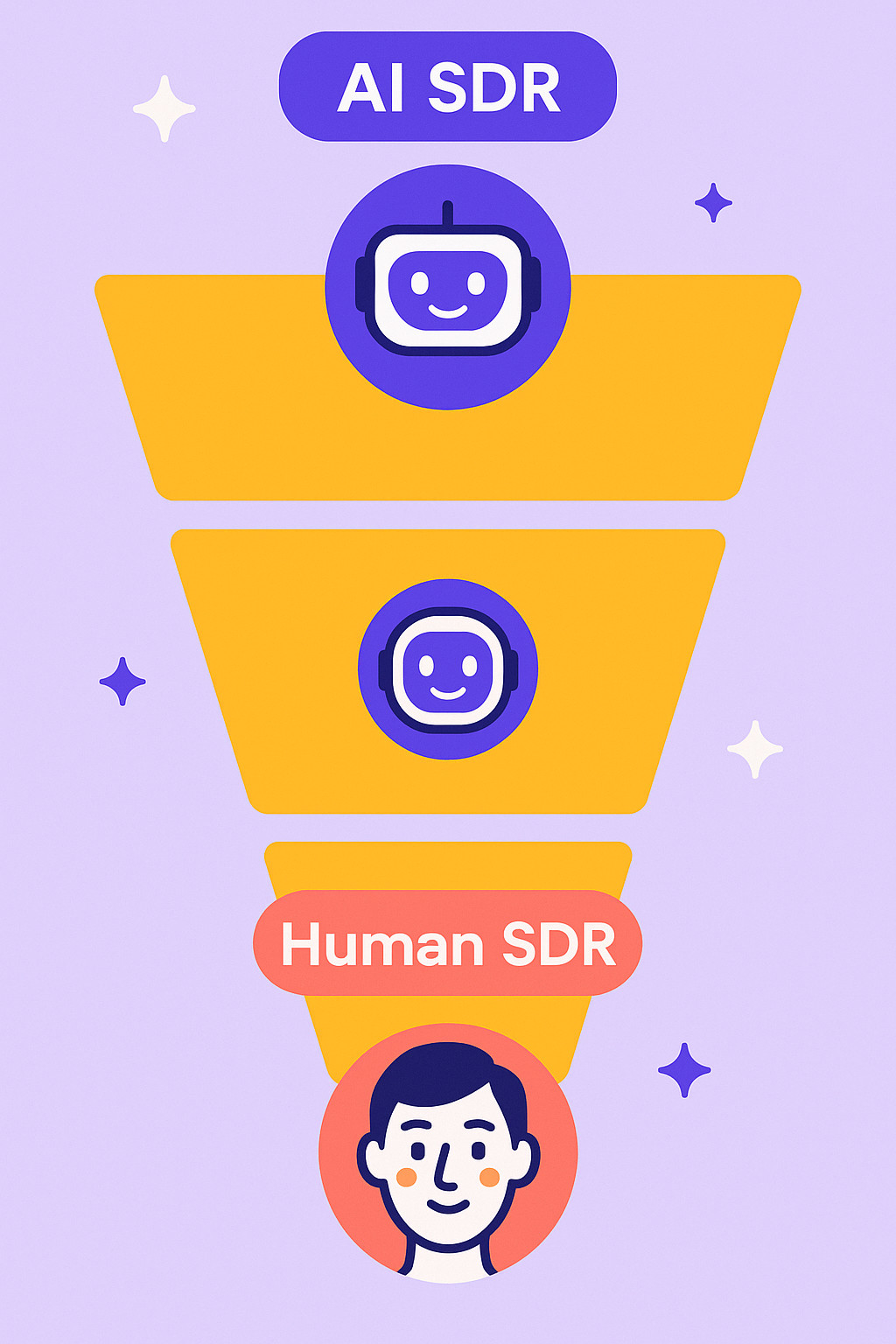
- Top of funnel: AI agents engage anonymous visitors showing buying intent, identifying companies from IP addresses and initiating conversations at peak engagement moments.
- Middle of funnel: AI agents qualify leads automatically, routing high-value prospects to sales while nurturing others with relevant content.
- Bottom of funnel: AI agents handle meeting logistics and send personalized reminders. This coordination increases show-up rates by 30-90%.
This end-to-end presence transforms how B2B SaaS companies scale inbound sales without proportionally scaling SDR headcount.
Core problems in inbound funnels AI agents can fix in 2026
Even the best marketing efforts fail when your funnel can’t convert inquiries into meetings efficiently.
55% of inbound leads are lost between inquiry and meeting
More than half of your inbound leads disappear before ever speaking with sales. They vanish because of speed and process failures:
- Response time kills deals. The odds of qualifying a lead drop 8x if you respond after 5 minutes instead of 1 minute. Yet the median first response time for B2B companies sits at 5 hours.
- Inconsistent qualification creates chaos. One SDR asks about budget and timeline. Another focuses on pain points. No standardization means no predictable pipeline quality.
- Manual booking adds friction. The back-and-forth of scheduling introduces delays. By the time you book the meeting, the lead’s priorities have shifted.
AI agents solve this by responding in seconds, following consistent qualification frameworks, and booking meetings instantly.
Why human-only SDR and support agents don’t scale for B2B SaaS
Lead volumes grow faster than headcount. Each new hire takes months to ramp. Top performers burn out or leave. You’re stuck in constant hiring cycles.
A productive SDR handles 50-100 leads per day. When marketing drives 200 inbound leads daily, you need multiple SDRs in shifts. Weekend leads wait until Monday. International prospects receive delayed responses.
AI agents handle unlimited concurrent conversations without degradation in quality or speed. One AI agent can engage 50 leads simultaneously at 2 AM on Sunday, maintaining the same qualification standards as your best SDR.
This doesn’t mean eliminating your sales team. It means freeing them from repetitive work to focus on complex deals, executive relationships, and strategic accounts.
When inbound lead qualification becomes too complex for rules and playbooks
B2B SaaS products serve diverse customer segments with different use cases, company sizes, and buying processes. Static playbooks crack under this complexity.
Real qualification involves nuance, context, and adaptive questioning. AI agents process multiple signals simultaneously and adjust their approach based on responses. They recognize when to dive deeper into technical requirements versus focusing on business outcomes.
This adaptive intelligence transforms qualification from a binary filter into a sophisticated scoring and routing system that maximizes conversion while maintaining quality standards.
How AI agents work across the entire B2B SaaS inbound funnel
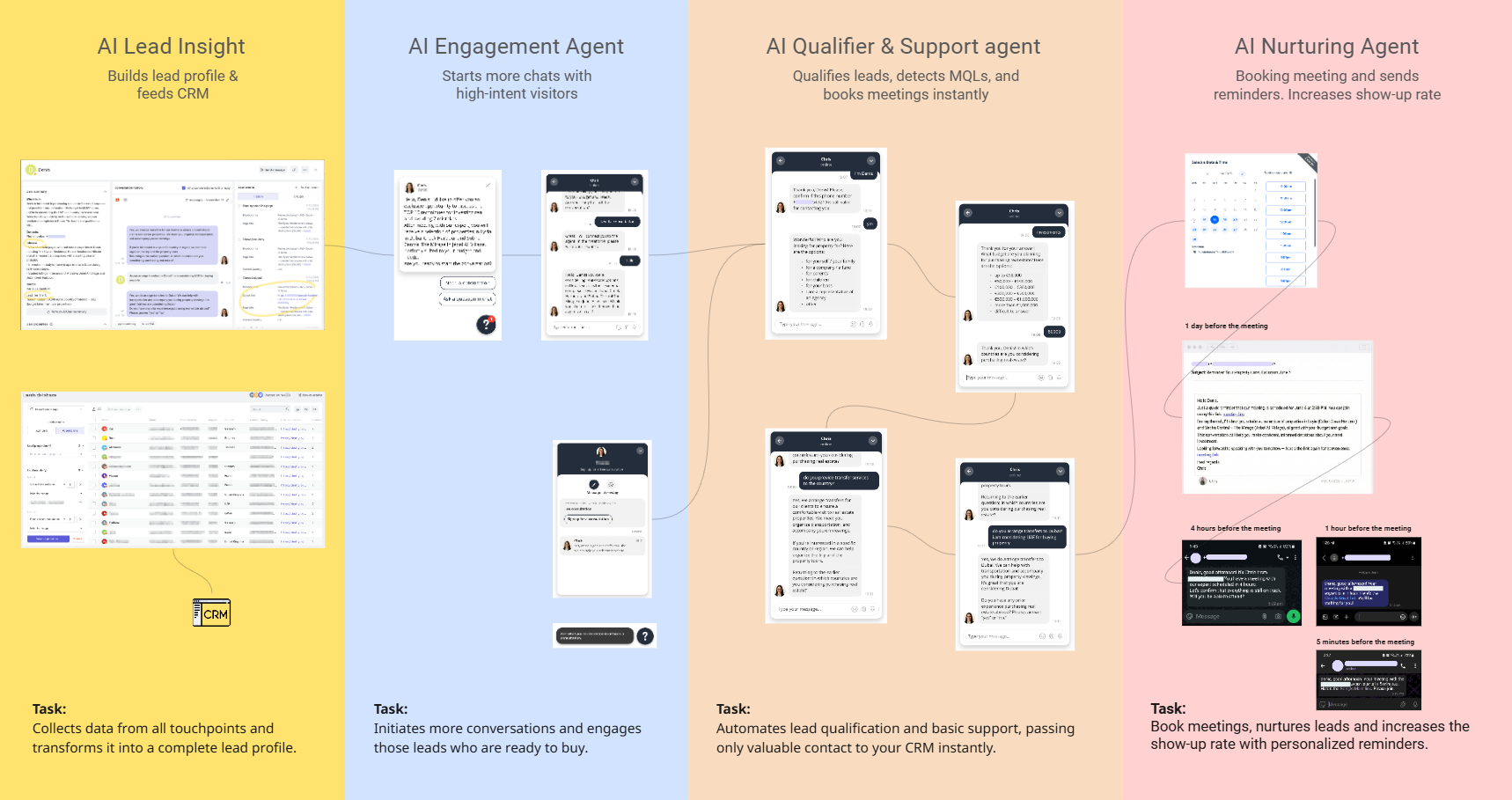
AI agents form a coordinated system spanning your entire inbound funnel.
Data-driven decision making: what input signals AI agents use at every stage
The power of AI agents comes from the data they access in real time.
Behavioral data forms the foundation. AI agents track which pages visitors view, time spent, resources downloaded, and navigation patterns.
CRM and historical data provides context. Has this person engaged before? Are they a customer exploring upsells? Did they request a demo six months ago?
Technographic and firmographic data reveals fit. Company size, industry, technology stack, and growth signals help AI agents prioritize leads.
Real-time intent signals trigger engagement. AI agents monitor high-intent behaviors (checking pricing pages, signing up for trials, exploring comparison content) and initiate conversations at peak interest.
Product usage data (for PLG companies) shows how prospects interact with your product.
This comprehensive data access enables personalization based on complete context, not isolated data points.
From anonymous visitor to loyal customer: an end-to-end AI-assisted inbound journey
- Sarah, a Marketing Director, lands on your website from Google. AI agents gets a signal that she’s viewing your Marketing Analytics page. After 90 seconds, the AI Engagement Agent initiates conversation.
- Sarah responds that her team needs better attribution. The AI Qualifier Agent asks targeted questions about team size and timeline. It recognizes she matches your ICP.
- The AI agent offers to book a demo, providing your AE’s calendar link. Meeting confirmed in 90 seconds.
- Over three days, the AI agent sends personalized case studies, answers questions, and confirms meeting details.
- Sarah attends the demo. Post-meeting, the AI agent helps your sales manager with ROI calculations and answering technical questions.
This journey happens automatically, with human reps stepping in only for the demo and contract discussion.
Here’s what it looks like:
Key use cases: where AI agents deliver the most value in B2B SaaS
Inbound demo requests, pricing page visits, and trial sign-ups
These high-intent actions signal buying interest. Someone requesting a demo or exploring pricing is actively evaluating solutions. Yet many B2B SaaS companies lose these valuable leads through delayed response times.
AI agents transform left demo requests into booked meetings instantly.
When someone submits a demo request at 11 PM on Saturday, AI agents engage immediately, qualify the lead through targeted questions, check calendar availability across your sales team, and book a meeting before the prospect closes their laptop. No waiting until Monday morning when the lead has moved on to competitors.
For pricing page visitors who don’t submit forms, AI agents identify prolonged page views and engagement patterns. If someone spends three minutes on your pricing page, scrolls to the enterprise tier, then navigates to your features page, that’s a strong buying signal. AI agents initiate proactive conversations: “I see you’re exploring our pricing. Happy to answer questions or help you determine which plan fits your needs.”
This proactive approach converts passive researchers into active leads. Rather than hoping visitors fill out forms, you start conversations at the exact moment they’re most engaged.
Trial sign-ups present another high-value opportunity. Not every trial user will convert, but AI agents monitor product usage to identify users showing high engagement or struggling with specific features. When a trial user logs in daily, invites team members, or explores advanced features, AI agents reach out with targeted assistance that accelerates conversion.
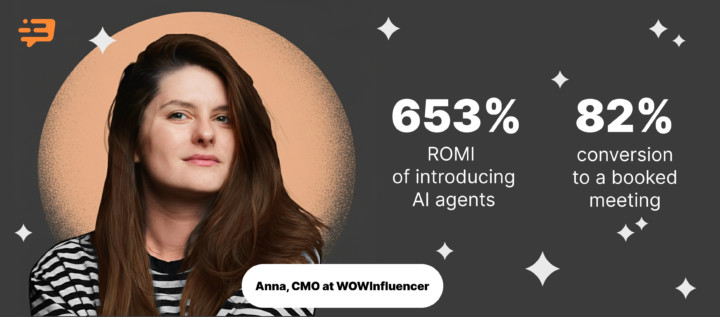
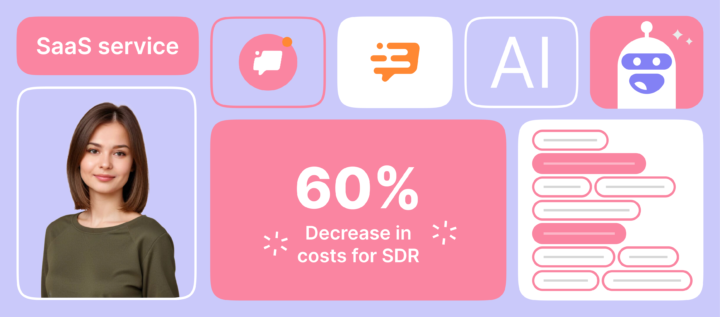
One Dashly customer reports that 66% of their qualified leads now originate from AI agent conversations, with 653% ROMI. The agents identified high-intent product users that would have otherwise converted slowly or churned.
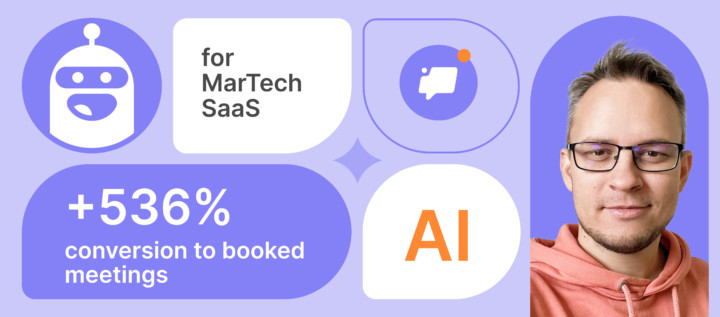
Learn how B2B SaaS companies raise their inbound funnel metrics with AI:
Content-driven inbound: webinars, SEO, gated content, and events
Content marketing generates awareness and educates prospects, but converting content consumers into sales conversations requires strategic nurturing and timely engagement through intelligent automation.
For webinar attendees, timing matters. AI agents follow up immediately after sessions end, while content is fresh. They ask which topics resonated, answer specific questions from the presentation, and offer personalized next steps. This immediate engagement transforms passive attendance into active pipeline through relevant interactions that move prospects toward decisions.
SEO-driven traffic presents unique challenges because visitors arrive at various awareness stages. Someone searching “best B2B sales tools” is early in research. Someone searching “Dashly vs Intercom pricing” is much closer to a decision.
AI agents analyze which content each visitor consumes, engagement depth, and return visits. A visitor reading one blog post gets light-touch nurturing. A visitor reading five articles over three days, viewing pricing, and checking case studies triggers immediate qualification conversations. High-intent patterns (e.g. multiple visits, pricing views, competitor research) signal sales readiness.
Gated content downloads provide contact information but often don’t indicate immediate buying intent. AI agents nurture these leads over time through automated processes, tracking repeat visits and behavioral changes. When someone who downloaded a report three months ago returns to view pricing, AI agents initiate qualification conversations.
Event leads require rapid follow-up. AI agents reach out within hours of conference meetings, reference specific booth conversations, and move relationships forward while momentum remains high.
PLG and in-product qualification for self-serve users
Product-led growth companies face unique challenges qualifying users who sign up for free trials or freemium plans. Not every trial user represents a sales opportunity, and manual outreach wastes sales resources on users who will never convert.
AI agents monitor product usage patterns through sophisticated systems to identify signals indicating sales readiness:
- Team growth: When users invite colleagues, it signals organizational adoption. A single user experimenting differs from a team collaborating in your product.
- Feature engagement: Users exploring enterprise features, hitting usage limits, or requesting capabilities beyond their plan show expansion potential. Someone on a free plan hitting API rate limits is a qualified lead.
- Usage frequency: Daily active users demonstrate product-market fit and real investment. Someone logging in daily for two weeks shows stronger intent than someone who signs up and disappears.
- Workflow completion: Users completing core workflows (like integrations, data imports, first projects) are more likely to convert. They’ve invested time and see value.
Best AI agents for B2B SaaS inbound lead qualification in 2026
Dashly: data-driven AI agents for B2B SaaS inbound funnels
Dashly combines a customer data platform with AI agents specifically designed for B2B SaaS inbound funnels. The platform collects behavioral data, integrates with your CRM and product analytics, and uses this complete context to power intelligent agent decisions.
Dashly’s AI agents access your entire customer data infrastructure: complete visitor history, CRM integration, product usage, and third-party enrichment.
Dashly customers see 2x more visitors convert into qualified leads compared to traditional form-based approaches, with 82% of initiated conversations resulting in booked meetings.
How Dashly’s AI agents qualify and nurture inbound leads end-to-end
Real-time engagement based on intent and behavior
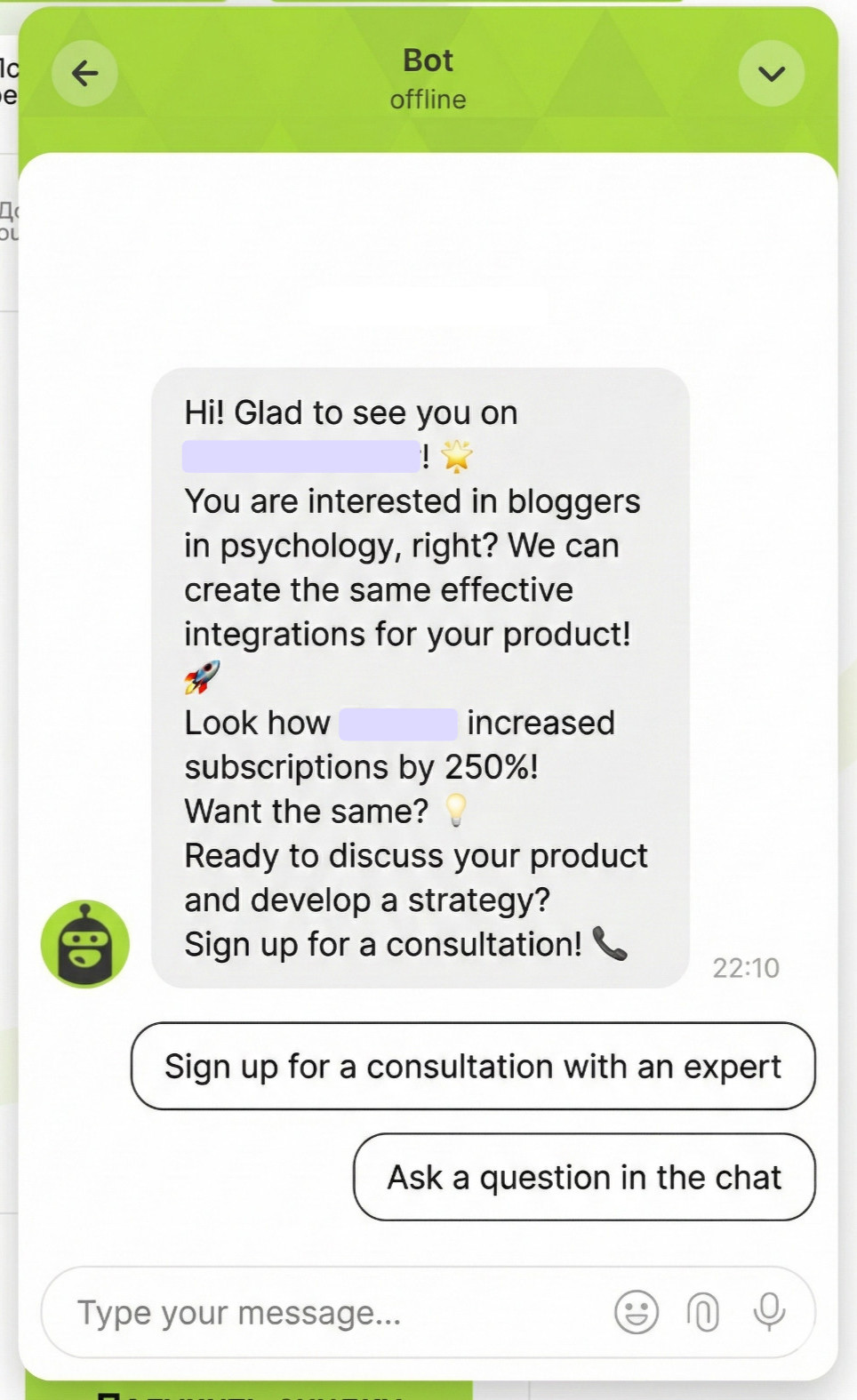
Dashly’s AI Engagement Agent analyzes visitor behavior to identify optimal engagement moments. It evaluates pages viewed, time spent, competitor searches, and ICP match, then initiates personalized conversations that reference the visitor’s context.
Smart qualification using complete customer data
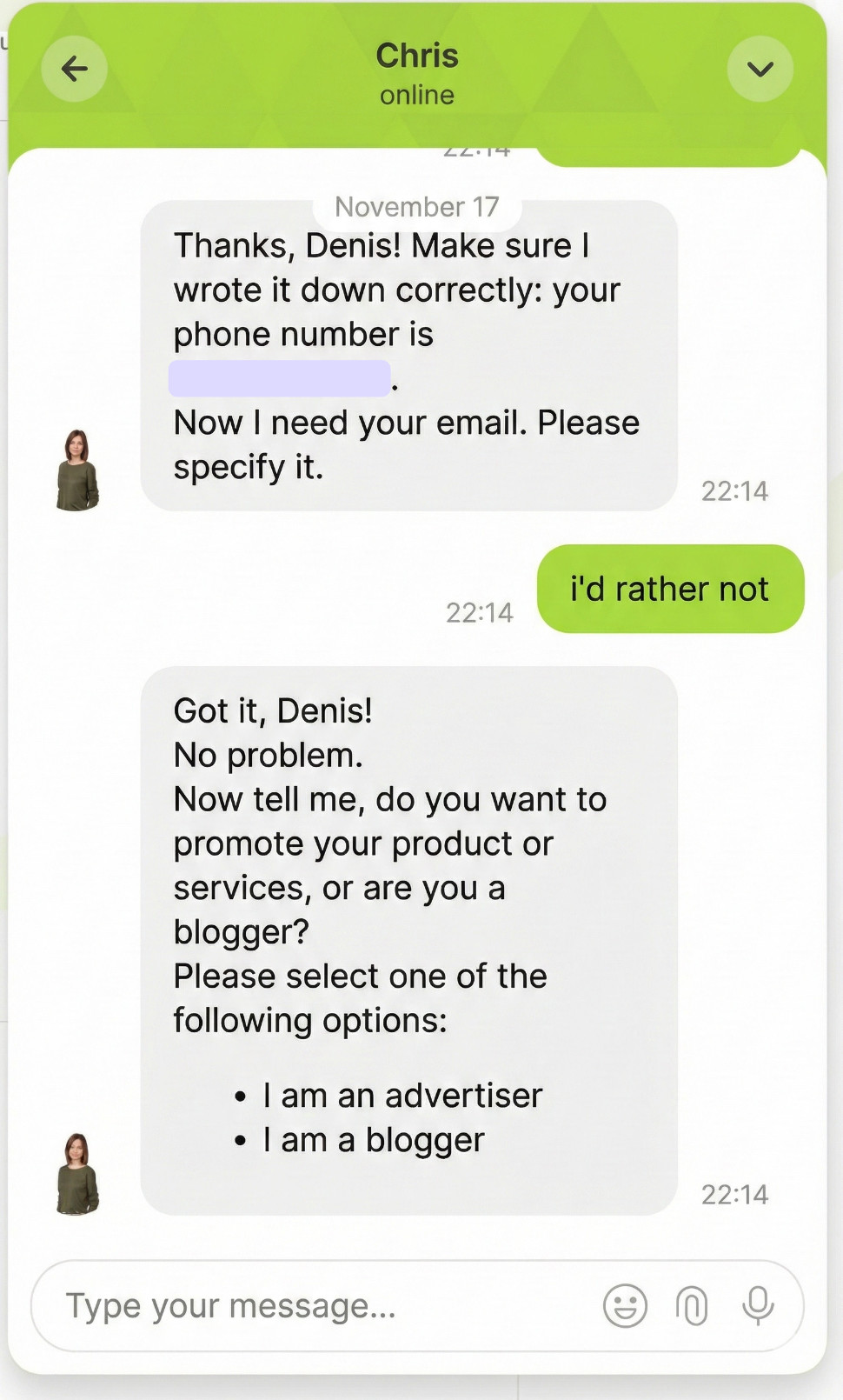
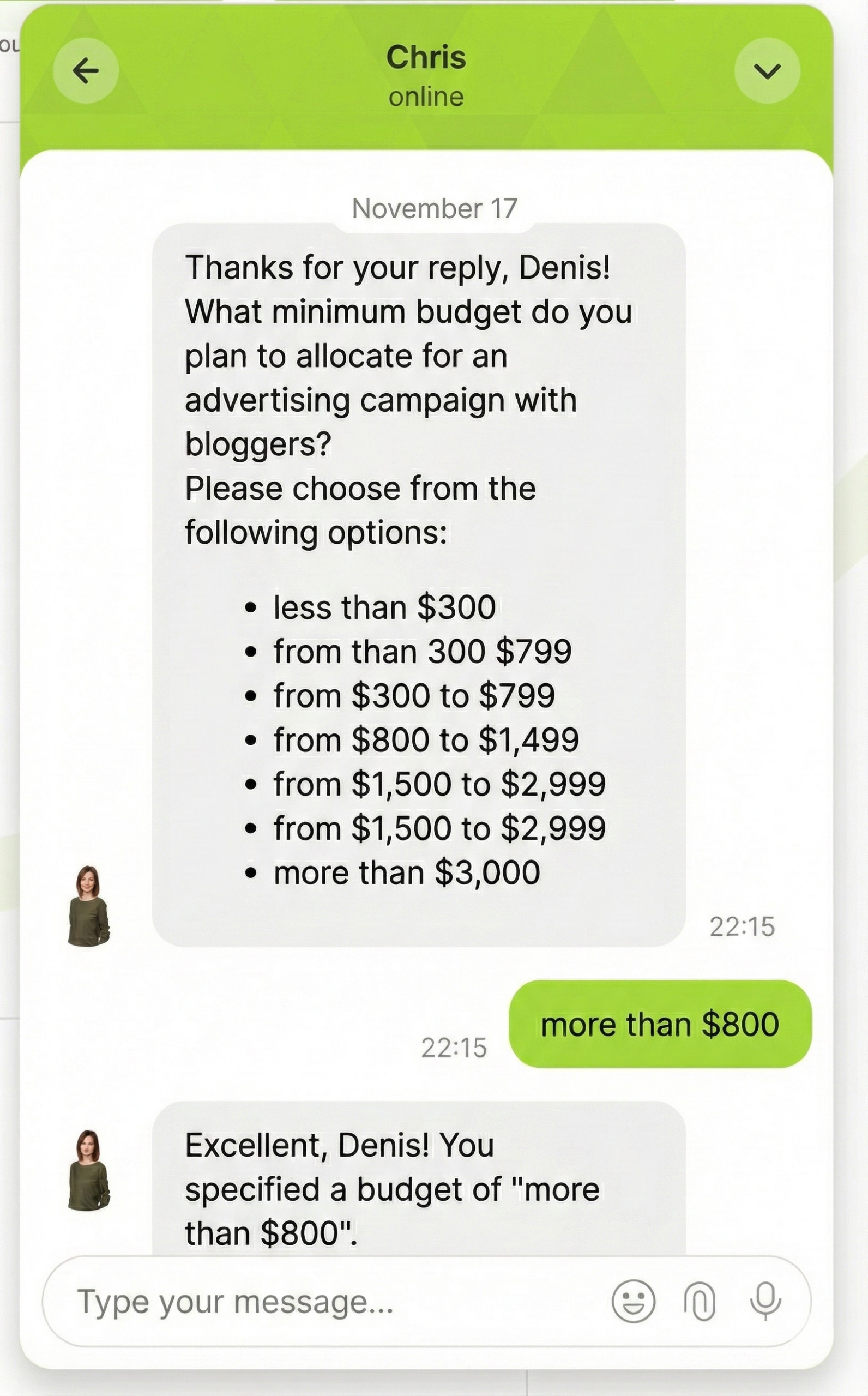
The AI Qualifier Agent conducts discovery using your complete customer data platform. It builds on previous interactions, asks only new qualification questions, and automatically assigns lead scores based on your ICP criteria.
Handling lead’s questions about the product
Dashly also has AI Support Agent that manages lead’s queries about your product. It’s trained on your knowledge base and is ready to cover up to 40% of all user queries.
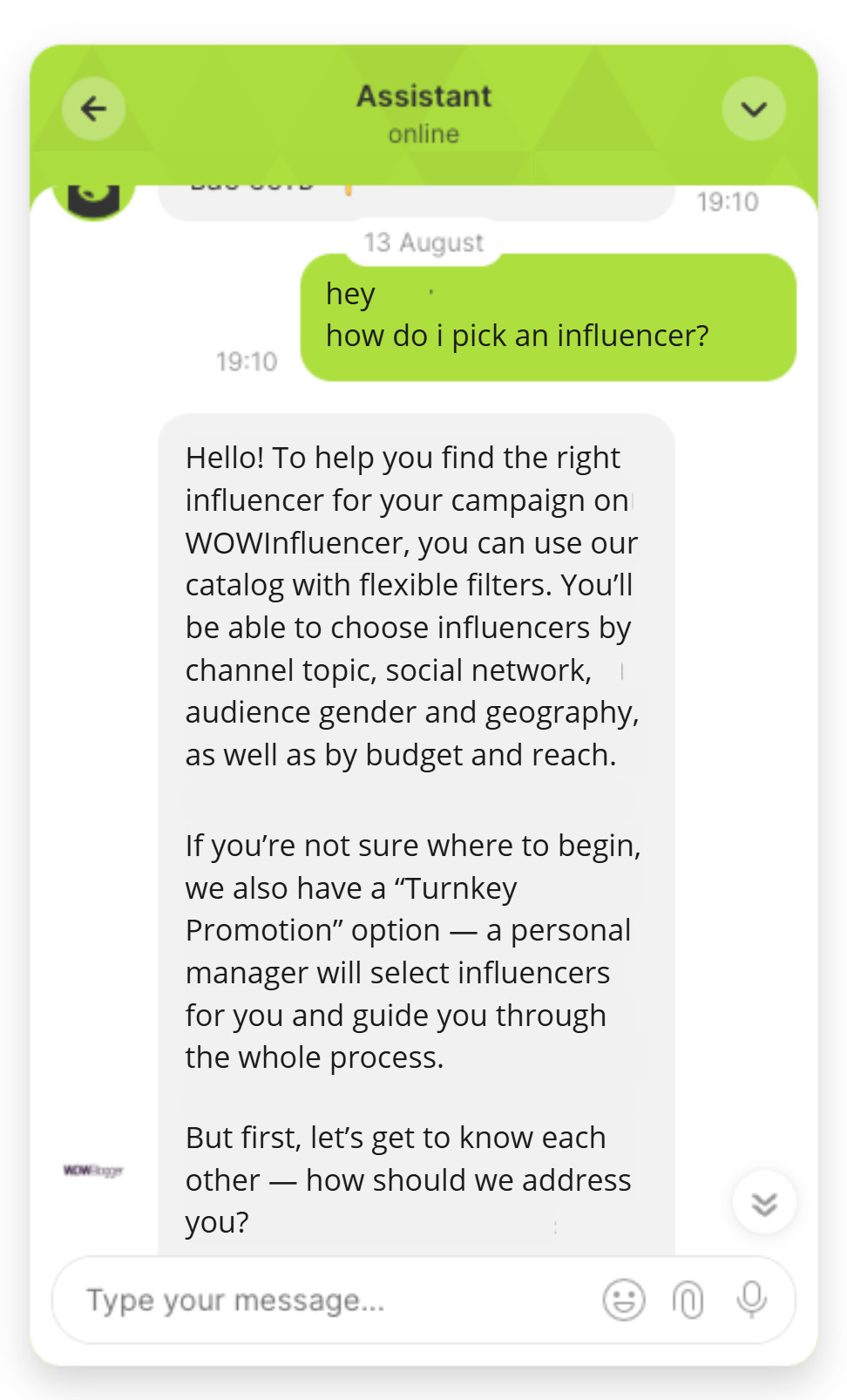
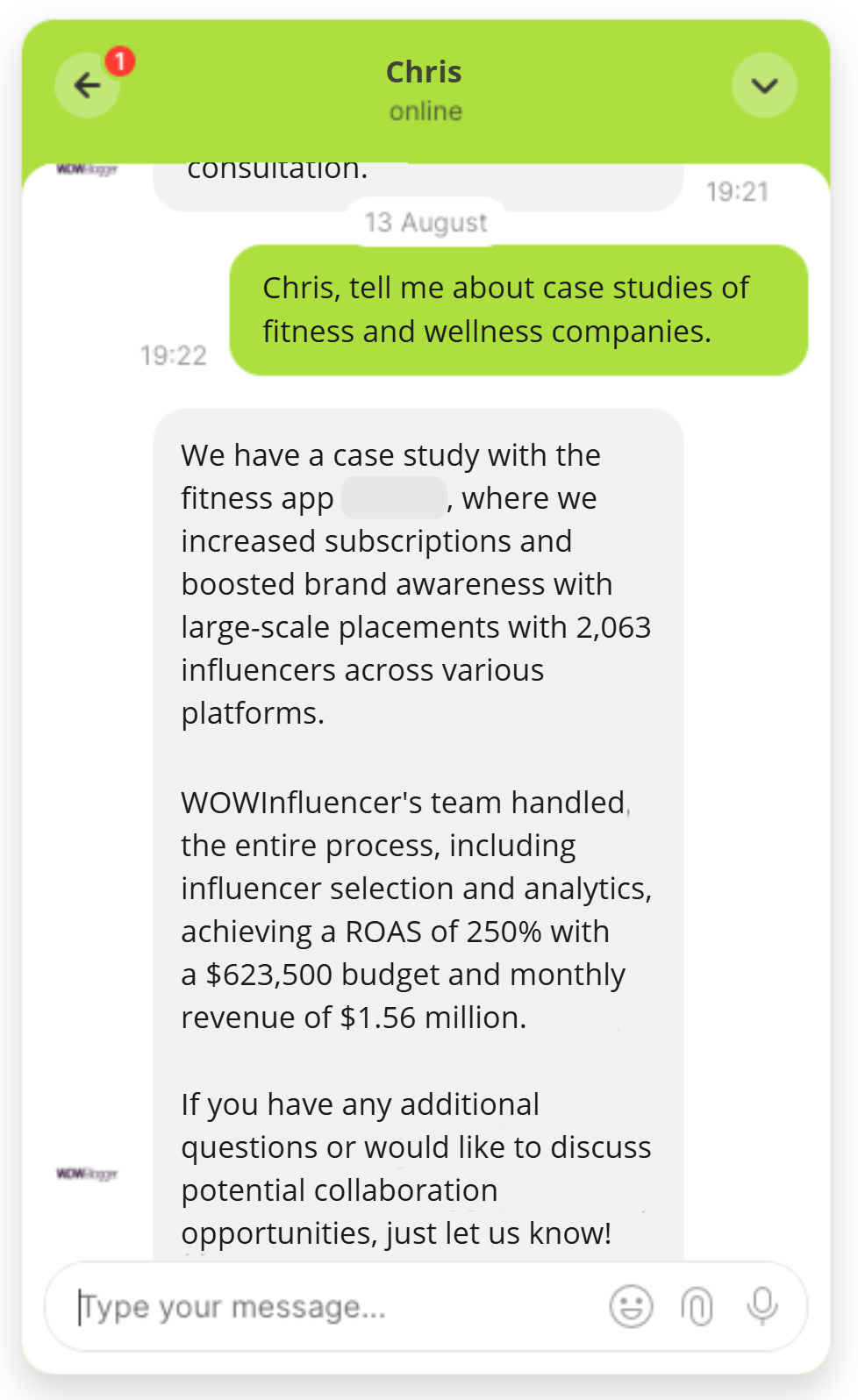
Automated meeting booking and show-up optimization
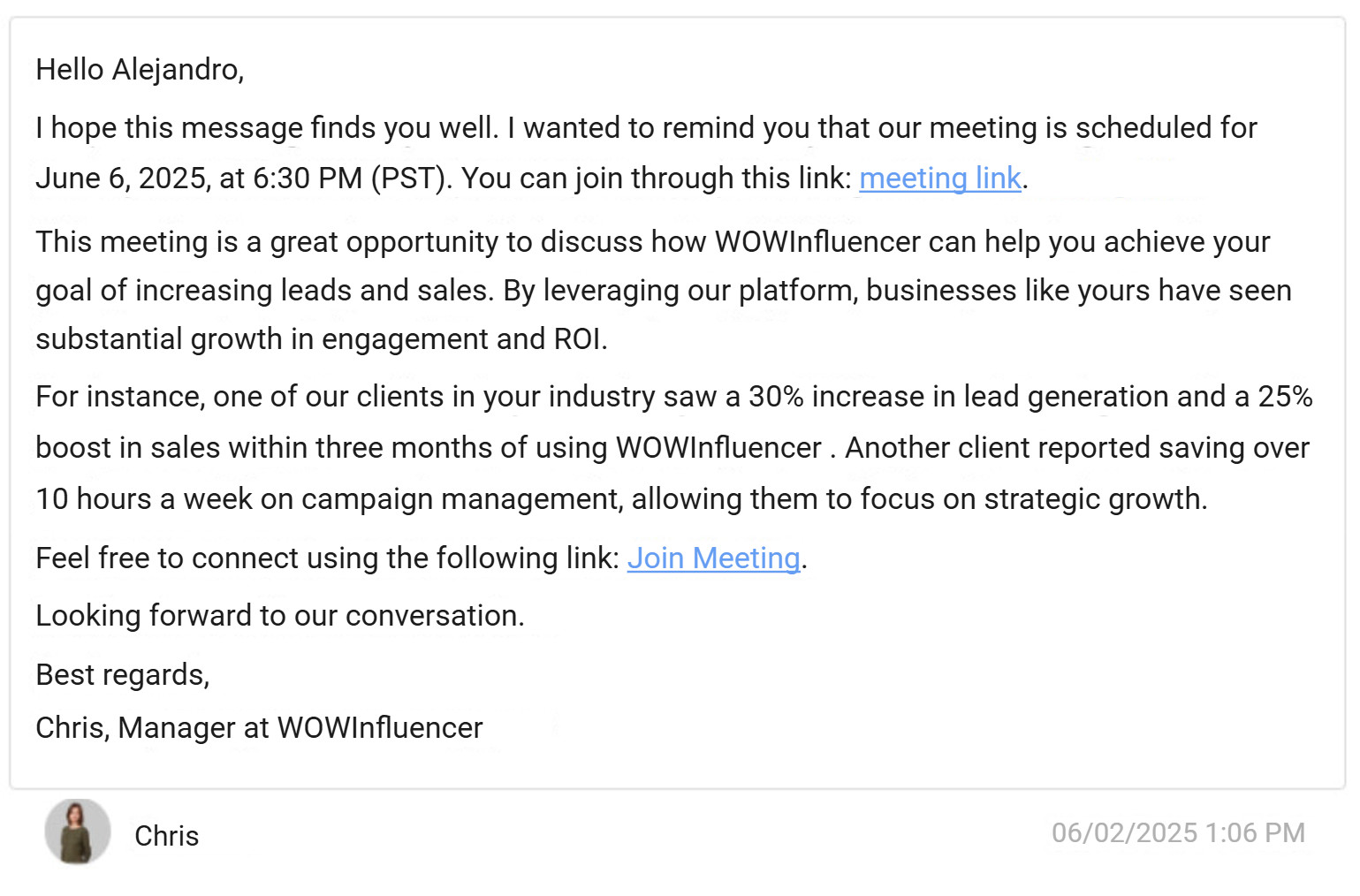
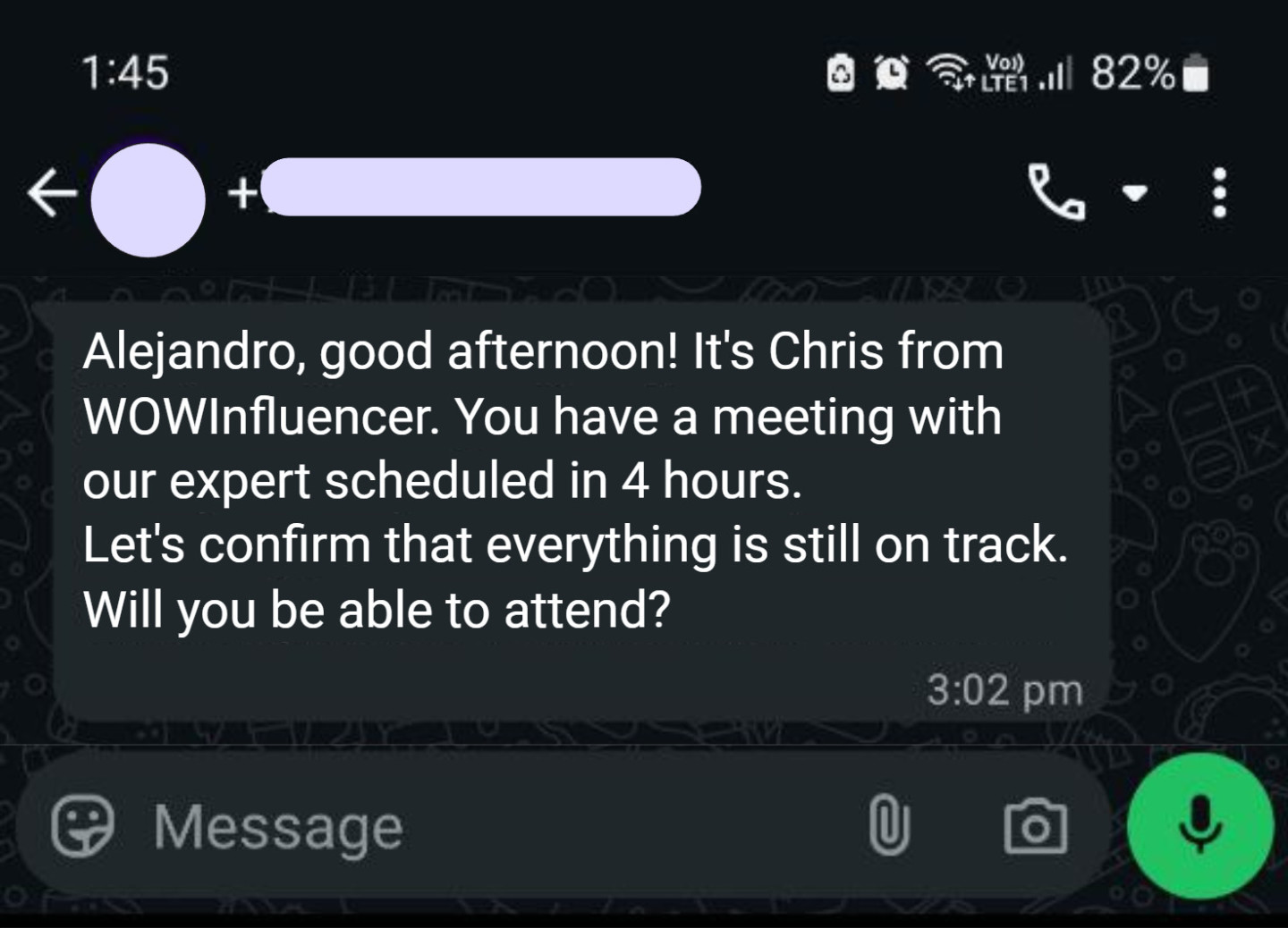
Research shows that leads contacted within 5 minutes are 8x more likely to convert. Dashly books meetings in under 60 seconds, then orchestrates multi-channel reminder sequences across email, SMS, and WhatsApp. The result is show-up rates of 60-90%.
Intercom and Drift: conversational support and virtual sales assistants
Intercom and Drift pioneered conversational marketing for B2B SaaS. Both offer AI-powered chatbots, customer support automation, and sales engagement tools with mature ecosystems.
These platforms excel at customer support use cases:
- answering product questions,
- routing support tickets,
- deflecting common inquiries.
Intercom provides comprehensive customer communication including email marketing and product tours. Drift focuses more aggressively on revenue acceleration and sales teams.
Where they fall short for inbound sales: AI agents operate primarily within chat conversations without deep customer data platform integration. Multi-channel nurturing requires significant configuration. Qualification capabilities remain basic compared to specialized platforms. Per-seat pricing adds up quickly for growing sales teams.
Their sweet spot is companies needing conversational support first and lead generation second.
Conversica and Qualified: email and web-based AI sales agents
Conversica focuses on email-based AI sales agents conducting nurture campaigns and follow-up sequences. Their AI engages leads via email, responds intelligently, and escalates hot leads to human reps.
The platform excels at persistent follow-up, re-engaging cold leads, following up after events, and nurturing MQLs.
The limitation? No real-time website engagement or instant meeting booking for high-intent moments.
Qualified specializes in website visitor identification and routing. Their platform identifies companies visiting your site, captures intent data, and alerts sales reps to engage high-value prospects. The “pounce” approach works well for account-based sales motions. It also can engage website visitors and book meeting with them.
Both are strong tools but for bigger companies that can afford an expensive tool stack.
Build-your-own intelligent agents with generic LLM stacks
Some technical teams build custom AI agents using OpenAI, Anthropic, or other LLM APIs. This offers maximum flexibility: complete control, deep integration with specific systems, no per-seat pricing.
Early prototypes work impressively. The reality of production proves challenging. Building production-ready AI agents requires expertise in natural language processing, conversation design, and system architecture. Key challenges: maintaining quality at scale, preventing hallucinations, building error handling, creating escalation paths, managing security.
The ongoing investment gets underestimated. Factor in engineering time (senior engineers earning $150K-300K annually), opportunity cost, and maintenance. Total cost often exceeds purpose-built platforms.
This path makes sense for large enterprises with dedicated AI engineering teams and unique requirements. For most B2B SaaS companies, purpose-built platforms deliver faster time-to-value and better results.
11x.ai and other AI SDR agents: powerful, but for a different motion (outbound)
11x.ai and similar platforms like Artisan and AiSDR focus on outbound prospecting rather than inbound qualification. Their virtual SDRs research accounts, write personalized cold emails, follow up on sequences, and book meetings with outbound-sourced leads.
These tools excel at scaling outbound prospecting without hiring armies of SDRs. One AI SDR can execute the prospecting volume of 5-10 human SDRs at a fraction of the cost.
However, they’re not optimized for inbound funnels. They don’t engage website visitors in real time or provide the immediate response critical for hot inbound leads.
Inbound leads come to you showing interest. They need instant engagement while intent is high. Outbound prospecting reaches cold prospects, response time in hours or days is acceptable. The workflows and timing are fundamentally different.
Dashly vs. alternatives: when each AI agent platform makes sense
When to choose Dashly over support-first AI agents
Choose Dashly when inbound lead generation and qualification are your primary goals. Dashly makes sense when you have meaningful inbound traffic (10,000+ monthly visitors), generate 50+ leads monthly, and want to scale pipeline without scaling SDR headcount.
Choose support-first platforms like Intercom or Drift when customer support automation is your primary objective.
When AI SDR tools like 11x.ai are better than Dashly
Choose outbound-focused AI SDR platforms when your sales motion is primarily outbound prospecting. These excel when you have clear ICP criteria, access to contact databases, and need to generate pipeline through outreach.
The ideal scenario for many B2B SaaS companies is using both: Dashly for inbound funnel optimization and an AI SDR tool for outbound prospecting.
When large CRMs’ embedded AI (HubSpot, Salesforce) is enough
HubSpot and Salesforce offer AI features within their platforms. Choose embedded CRM AI when you have simple qualification needs, smaller lead volumes, and want to minimize vendors.
However, CRM-embedded AI agents typically offer basic chatbot functionality rather than sophisticated, data-driven agent intelligence. As inbound volumes grow, you’ll likely outgrow embedded CRM tools.
Why data depth matters more than “AI magic” in lead qualification
Every platform claims advanced AI. What actually drives results? Data depth.
AI agents that access complete customer data (behavioral history, CRM context, product usage, third-party enrichment) make better decisions than agents with limited context.
Your best sales reps succeed because they do research, understand prospect context, and personalize their approach. AI agents work the same way. Give them rich customer data, and they’ll conduct relevant conversations and qualify accurately.
Implementation guide: how to launch AI agents in your B2B SaaS inbound funnel
Step 1: Audit your current inbound sales and support workflows
Document existing processes. Map the journey from website visit through booked meeting. Identify bottlenecks and failure points.
Interview your sales and support teams to understand workflows, tools, and challenges. This ensures AI agents augment their work rather than create friction.
Step 2: Define inbound goals and data requirements for AI agents
Set specific metrics: Increase chat-to-meeting conversion from 20% to 40%. Reduce response time from 4 hours to under 1 minute. Boost show-up rates from 50% to 75%.
Identify the data AI agents need. Audit your current data infrastructure and address gaps before or during implementation.
Step 3: Connect AI agents to your inbound tech stack
AI agents require integration with CRM, marketing automation, calendar tools, customer data platform, analytics, and communication channels.
Most platforms offer pre-built connections to major systems. Set up event tracking to capture behavioral data. Test data flows before launch.
Step 4: Design conversations and playbooks for each inbound stage
Create conversation frameworks for different scenarios. Define qualification criteria explicitly. Write sample conversations demonstrating desired tone.
Build in escalation paths for complex technical questions, enterprise deals, or when prospects request human contact.
Step 5: Pilot AI agents on a narrow inbound slice before going full-funnel
Start with a controlled pilot on pricing pages or specific campaign landing pages. Run for 2-4 weeks, monitoring performance closely.
Iterate based on results. Adjust conversation flows, refine qualification questions, and fix technical issues.
Step 6: Optimize productivity and outcomes with continuous testing
Review agent conversation logs weekly. Test variations systematically. Monitor key metrics: conversation initiation rate, qualification completion rate, meeting booking rate, and conversion to closed deals.
Metrics that prove AI agents work for B2B SaaS inbound qualification
Funnel KPIs: from visitor to SQL and closed-won
Visitor-to-conversation rate: AI agents with intelligent targeting should reach 5-8% (vs. 1-3% for chatbots).
Conversation-to-qualified-lead rate: 40-60% of conversations should produce qualified leads.
Qualified-lead-to-meeting rate: Aim for 60-80% booking rates.
Operational KPIs: response times, coverage, SDR and support productivity
Average response time: AI agents respond in seconds. Dashly customers report 99.6% faster response times.
Coverage rate: AI agents provide 100% coverage, 24/7.
SDR productivity: AI agents typically free up 1.5-2 FTE worth of SDR capacity.
Revenue KPIs: pipeline growth, ROMI, and payback period from AI agents
Pipeline contribution: Top performers see 20-40% of total pipeline attributed to AI agents within 6 months.
ROMI: Strong performance is 400-600% within first year.
Payback period: Best-in-class results are 2-3 months.
Here are some success stories of B2B SaaS companies for your benchmarks:
Common pitfalls when implementing AI agents in B2B SaaS
Over-automating complex conversations without clear escalation paths
The biggest mistake: letting AI agents handle conversations they’re not equipped for. Companies forget to build escalation paths, frustrating prospects or losing sophisticated buyers.
How Dashly addresses this: Dashly’s agents include built-in escalation logic, smoothly handing off to human team members with full context.
Ignoring data quality and backend workflows behind the AI layer
Poor CRM data hygiene, incomplete behavioral tracking, or broken integrations create bad agent decisions.
How Dashly addresses this: Dashly’s implementation includes data infrastructure audit, identifying gaps and ensuring integrations work correctly before launch.
Treating AI agents as “set and forget” instead of strategic assets
The best results come from ongoing optimization. Top-performing companies review conversations weekly and test new approaches monthly.
How Dashly addresses this: Dashly provides analytics dashboards and assists you throughout your whole journey. We help set up AI agents, train them and fine-tune their work.
Conclusion: choosing the best AI agents for B2B SaaS inbound funnel in 2026
AI agents purpose-built for B2B SaaS inbound sales deliver measurable results: faster response, higher conversion, predictable qualification, and scaled capacity without proportional headcount growth.
Your choice of platform matters. Support-focused chatbots, outbound AI SDRs, generic LLM tools, and built-in CRM agents serve different needs.
Dashly’s data-driven approach delivers superior results specifically for B2B SaaS inbound funnels. The multi-agent system covers your entire funnel. Complete customer data integration enables personalization that generic chatbots can’t match. Real results demonstrate what’s possible: 2x MQL-to-SQL conversion, 82% chat-to-meeting conversion, 653% ROMI.
The companies that win in 2026 will strategically implement intelligent systems that transform inbound funnels from leaky pipelines into efficient revenue engines.
FAQ
No, AI agents won’t replace SaaS, they’ll enhance it. AI agents automate repetitive qualification and engagement tasks, allowing human sales teams to focus on relationship-building and closing deals.
There isn’t an industry-standard “Big 4” yet. Leading platforms in 2026 include Dashly (inbound qualification), Intercom/Drift (conversational support), 11x.ai (outbound prospecting), and Conversica (email nurture).
Implementation timelines vary by platform and complexity. Purpose-built platforms like Dashly typically take 2-4 weeks from kickoff to launch, including data integration, agent training, and pilot testing. Custom-built solutions require 3-6 months for development, testing, and refinement. Start with a controlled pilot on high-intent pages (pricing, demo requests) before full-funnel rollout.
Yes. Modern AI agent platforms offer pre-built integrations with major CRMs (Salesforce, HubSpot, Pipedrive), marketing automation tools, calendar systems (Calendly, Google Calendar), and communication channels (WhatsApp, Telegram, SMS). The key is ensuring clean data flows between systems. During evaluation, verify that your specific tech stack is supported and ask about API capabilities for custom integrations.




![Sales and Marketing Automation: How to align their workflow to 2x revenue [Dashly example]](https://www.dashly.io/blog/wp-content/uploads/2021/06/IMG_1074-1100x471-1-720x308.jpg)